Endangered
Ludwig's Bustard
Neotis ludwigii
Ludwig's bustard (Neotis ludwigii) is a large, long-legged ground bird of the dry shrublands, grasslands and deserts of south-western Africa, mostly in South Africa and Namibia. It is listed as Endangered, most recently in the 2025 Red List assessment. Collisions with power lines are the main threat.
How to recognise it
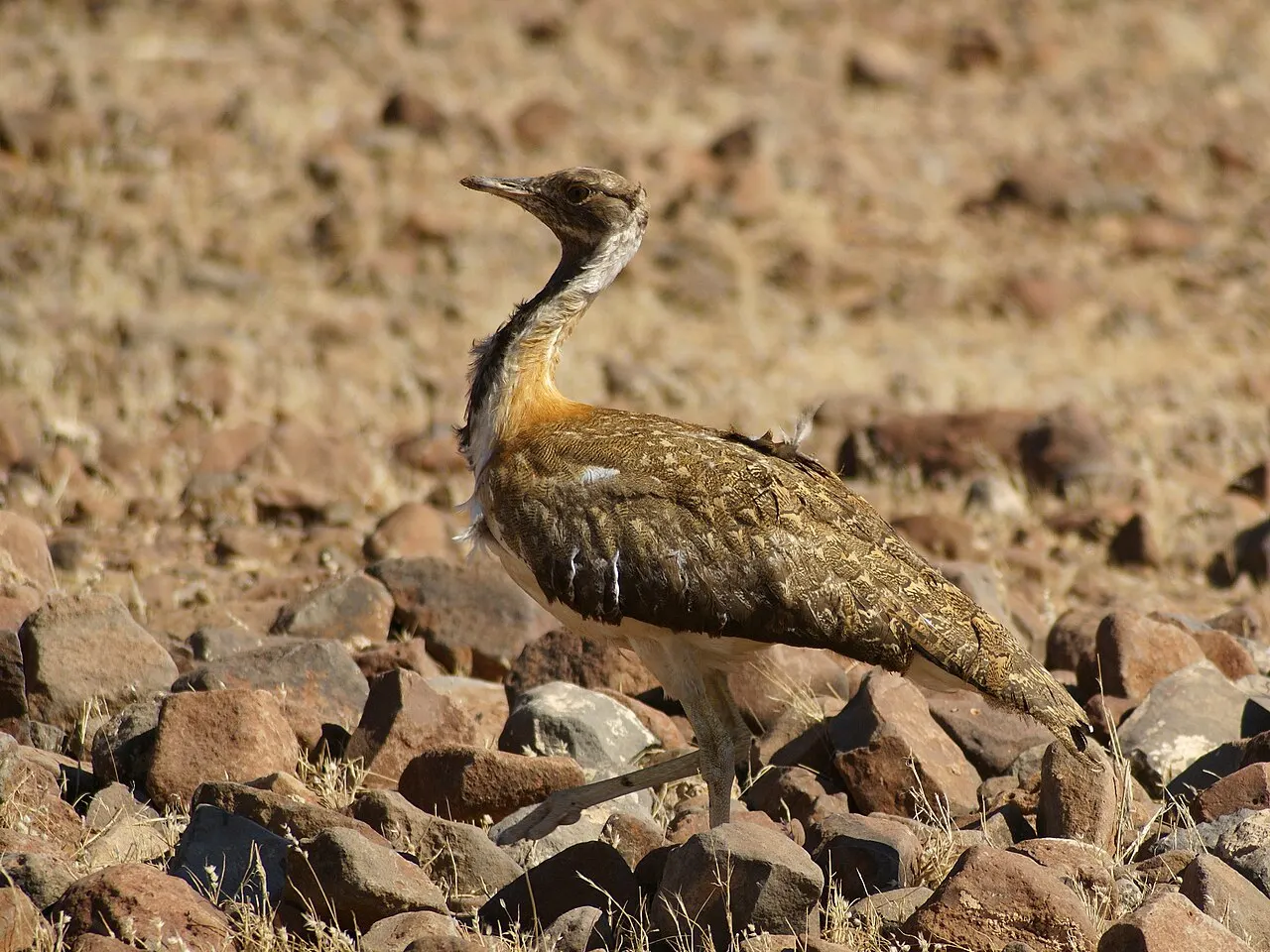
It's one of Africa's heavier flying birds. Males measure roughly 80 to 95 cm and females 76 to 85 cm, and the sexes differ a lot in weight, with males averaging about 6.3 kg and females about 3.4 kg. The nape is dull orange, and the face and front of the neck are grey-brown.
It is often confused with Denham's bustard, which has a paler grey face and front neck and black and white crown stripes. Males give a deep, bloop-like call in the breeding season.
Where it lives
The range is centred on the dry Karoo and Namib regions of southern Africa: the extreme south-west of Angola, western Namibia, much of South Africa and the far south-west of Botswana. Most birds live in South Africa. Non-breeding birds occasionally visit Lesotho. Records reach up to about 1,860 m, and the range is contracting, with a modelled 4.5% fall in occupied area between 2015 and 2023.
The Red List names a wide mix of habitats: hot desert, dry savanna, dry grassland, Mediterranean-type and dry shrubland, and rocky areas. It also uses pasture and arable land. The species is nomadic, and also makes partial seasonal moves, shifting west to winter-rainfall areas in winter and back east in summer.
Pins are Wikidata “endemic to” fields. Orange dots, when present, are GBIF occurrence tiles — survey bias included.
How it lives
Birds are usually alone or in small groups, though flocks of up to 70 have been recorded. Food is varied: invertebrates (locusts and other grasshoppers are a favourite), some small vertebrates, flowers, seeds and berries. Birds move with the rains to follow grasshopper hatchlings.
Breeding mostly runs from July to February, and into May in Namibia. The nest is a scrape on bare ground with a clutch of two or three eggs, and females raise the chicks alone. Females often leave the nest if disturbed. In February 2023 a GPS-tagged female in the Karoo was found incubating a single large egg, so well camouflaged that she was only noticed at under 3 m.
Why it is in trouble
The 2025 Red List assessment estimates 70,000 to 335,000 mature individuals and says the population is decreasing. A census in the 1980s put the entire population at 56,000 to 81,000 birds, but that was probably a significant underestimate. Road-count data suggest the chance of recording the species on a route has been falling by about 1.3% a year.
Overhead power lines are the main threat, with potentially thousands of birds killed each year. Bustards have limited frontal vision, so they may not see wires even when marked. A South African study estimated 1.12 deaths per kilometre per year on 400 kV transmission lines and 0.86 on 22 kV distribution lines, the highest rates recorded for a South African species. The Red List also lists renewable energy development, persecution, snaring and hunting for food as threats.
What is being done
A 10-year marking experiment by the Endangered Wildlife Trust and Eskom found that line markers did not reduce bustard deaths. A newer trial of four different markers on a Karoo line, begun in February 2022, had recorded no new bustard deaths by early 2024, though that is early evidence.
The Karoo Ludwig's Bustard Project began fitting GPS trackers to adults in 2022 (16 birds by early 2024) to study movements and breeding. The IUCN says finding an effective way to reduce collisions is the most important action, and also lists awareness work and site protection. The species is on CITES Appendix II.
Sources
Written for this catalog in our own words from the sources below, checked against them on 12 November 2026. Population figures are estimates and carry the year they were made. Status and assessment year: IUCN. 2026. The IUCN Red List of Threatened Species. Version 2026-1. iucnredlist.org.




