Endangered
Loveridge's Sunbird
Cinnyris loveridgei
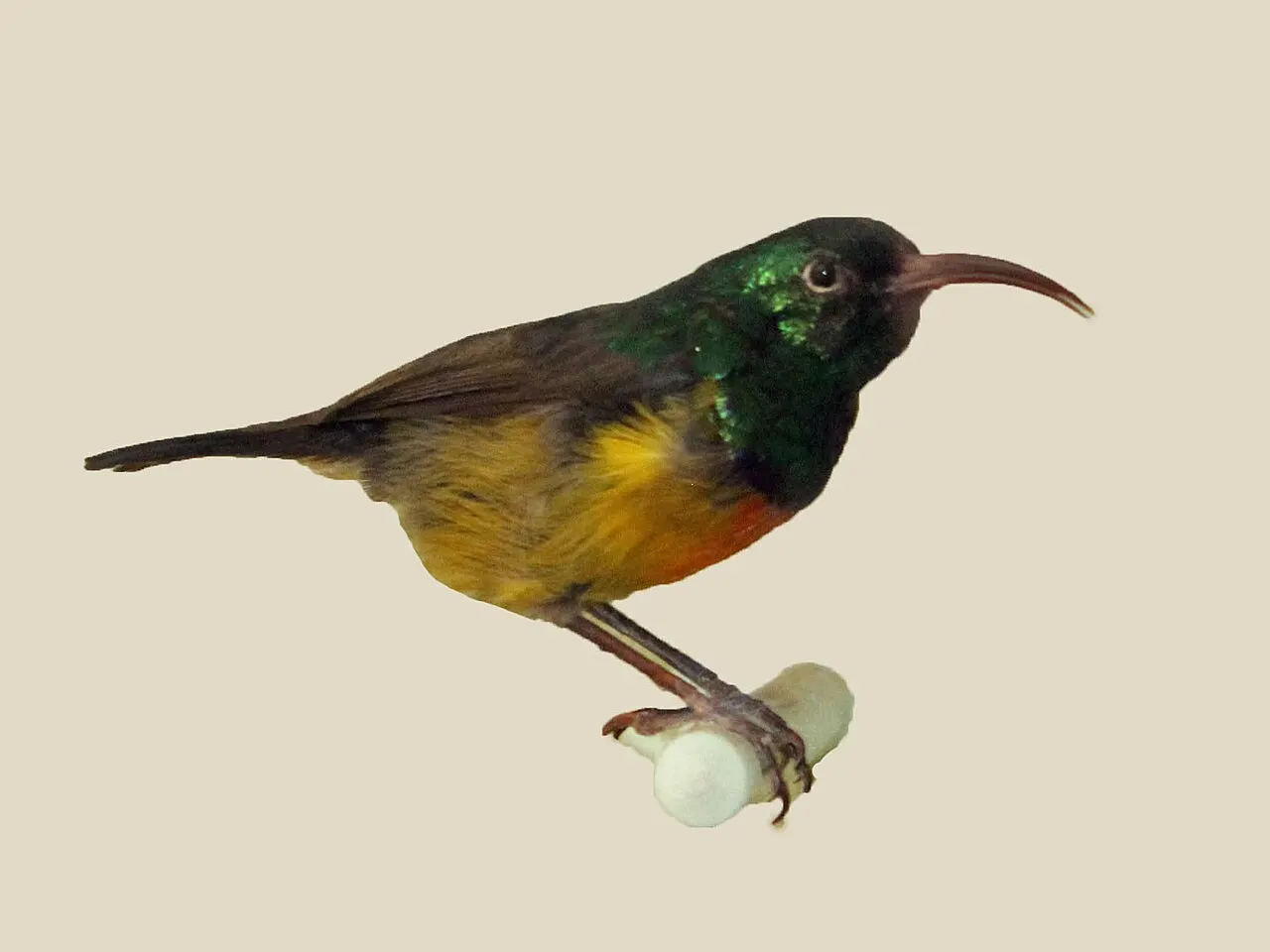
Loveridge's sunbird (Cinnyris loveridgei) is a small forest sunbird found only in the Uluguru Mountains of eastern Tanzania. The IUCN Red List assessed it as Endangered in 2021 because its range is tiny, limited to about three locations, and its forest continues to shrink.
How to recognise it
It is a small sunbird, about 11 cm long, with a long curved bill. The male has an iridescent green head and upperparts, a thin violet breast band and an orange-red breast patch. The female is greenish-olive above and yellower below. Its song is a fast, rolling rattle of high-pitched notes.
Ernst Hartert described the species in 1922. Its name honours the American herpetologist Arthur Loveridge.
Where it lives
It is endemic to Tanzania and known only from the Uluguru Mountains, one of the isolated Eastern Arc ranges, near Morogoro. The IUCN records it in montane forest and high-altitude shrubland between 1,200 and 2,560 m. A survey of the Uluguru Nature Forest Reserve in 2006 and 2007 recorded it from 1,200 to 2,400 m.
That survey found it in both open and closed canopy.
Pins are Wikidata “endemic to” fields. Orange dots, when present, are GBIF occurrence tiles — survey bias included.
Why it is in trouble
The IUCN names small-holder farming and subsistence harvesting as threats, and lists the population as decreasing. The 2006 to 2007 survey found almost no forest left in the lower montane zone.
How many birds there are depends on who is counting. A mist-net study in September to December 2000 estimated 21,000 to 166,000 birds, with about 37,000 at a median home range of 0.45 square km. Home range was unknown, so that was an assumption. The IUCN's 2021 assessment gives a range of 14,000 to 110,700. The 2006 to 2007 survey recorded 79 birds on 9 square km and extrapolated to about 1,935 across the 241 square km reserve. The 2000 study judged the species not currently threatened, while stressing that its survival depends on the forest and on how well the reserves are managed.
What is being done
The IUCN records that it occurs in at least one protected area, and lists site and area management as an action. It reports no recovery plan, no monitoring scheme and no captive population.
Sources
Written for this catalog in our own words from the sources below, checked against them on 12 November 2026. Population figures are estimates and carry the year they were made. Status and assessment year: IUCN. 2026. The IUCN Red List of Threatened Species. Version 2026-1. iucnredlist.org.




