Critically Endangered
Short-crested coquette
Lophornis brachylophus
The short-crested coquette (Lophornis brachylophus) is a hummingbird about 7 cm long, known only from the Sierra de Atoyac in Guerrero, southern Mexico. The IUCN Red List rated it Critically Endangered in 2018, with fewer than 1,000 adults. Its mountain forest home is shrinking, though the first reserves for it were created in 2023.
How to recognise it
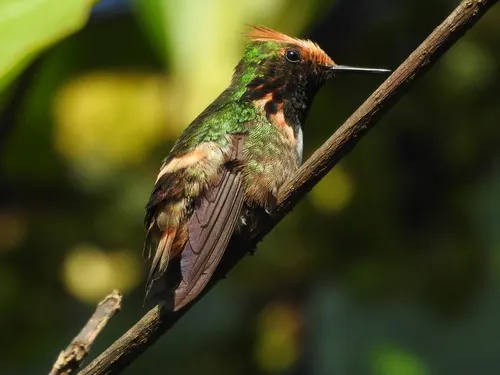
It's tiny, 7 to 7.5 cm, with a short, straight black bill. The male has emerald-green upperparts, a short rufous crest, a glittering green throat and short orange cheek tufts tipped with green. The underparts are pale cinnamon and the tail is reddish cinnamon with black tips.
The female has no crest or cheek tufts and is paler green above, with a whitish throat. Young birds look like females. It's the northernmost of the 11 coquette species in the genus Lophornis.
Where it lives
The species is found only in Mexico, in the Sierra Madre del Sur northwest of Acapulco. Most records come from a road of about 25 km between Atoyac, Paraíso and Puerto del Gallo. American Bird Conservancy puts its range at about 44 square miles, and the IUCN assessment gives an elevation of 900 to 1,800 m.
It uses semi-deciduous forest, humid evergreen forest, cloud forest with pines and plantations. A 2020 study led by Roberto Carlos Almazán-Núñez at the Autonomous University of Guerrero showed that it uses more habitat types than previously known, including pine-containing forest.
Pins are Wikidata “endemic to” fields. Orange dots, when present, are GBIF occurrence tiles — survey bias included.
How it lives
It feeds on nectar from small flowering plants and on small arthropods, reportedly catching insects in short sallies from a perch. Researchers have also seen it pierce fruit to reach nectar. It tends to give way to bigger hummingbirds.
The bird is thought to be mostly resident, with probable movement up and down the mountains. Breeding is probably from November to February, and little else is known. It's usually silent, but gives sharp chips while feeding and a low humming sound in flight.
Why it is in trouble
Clearing for farming and livestock is the main cause of decline, and the 2018 assessment rates small-holder farming as affecting more than 90 percent of the population. American Bird Conservancy reports that about a quarter of the woodland in the Sierra de Atoyac has been lost, and fire and climate change are further risks. The assessment counts the whole population as occupying a single location, with an estimated 250 to 999 mature individuals and a decreasing trend.
What is being done
No part of its range was protected until 2023. That year four community reserves were declared, the first for this bird, and two more were expected in 2024. Once all six are in place they would cover nearly 22,000 acres.
The reserves are run by local ejidos and communities and sit within Mexico's protected areas network. Residents monitor wildlife, prevent forest fires and manage native conifers, with support from American Bird Conservancy and the Autonomous University of Guerrero.
Sources
Written for this catalog in our own words from the sources below, checked against them on 12 November 2026. Population figures are estimates and carry the year they were made. Status and assessment year: IUCN. 2026. The IUCN Red List of Threatened Species. Version 2026-1. iucnredlist.org.




