Endangered
Long-billed bush warbler
Locustella major
The long-billed bush warbler (Locustella major) is a small brown songbird of high Himalayan and Kunlun-region scrub and farmland in India, Pakistan, China and Tajikistan. It was long listed as Near Threatened, but the IUCN Red List moved it to Endangered in 2025, with a decreasing population.
How to recognise it
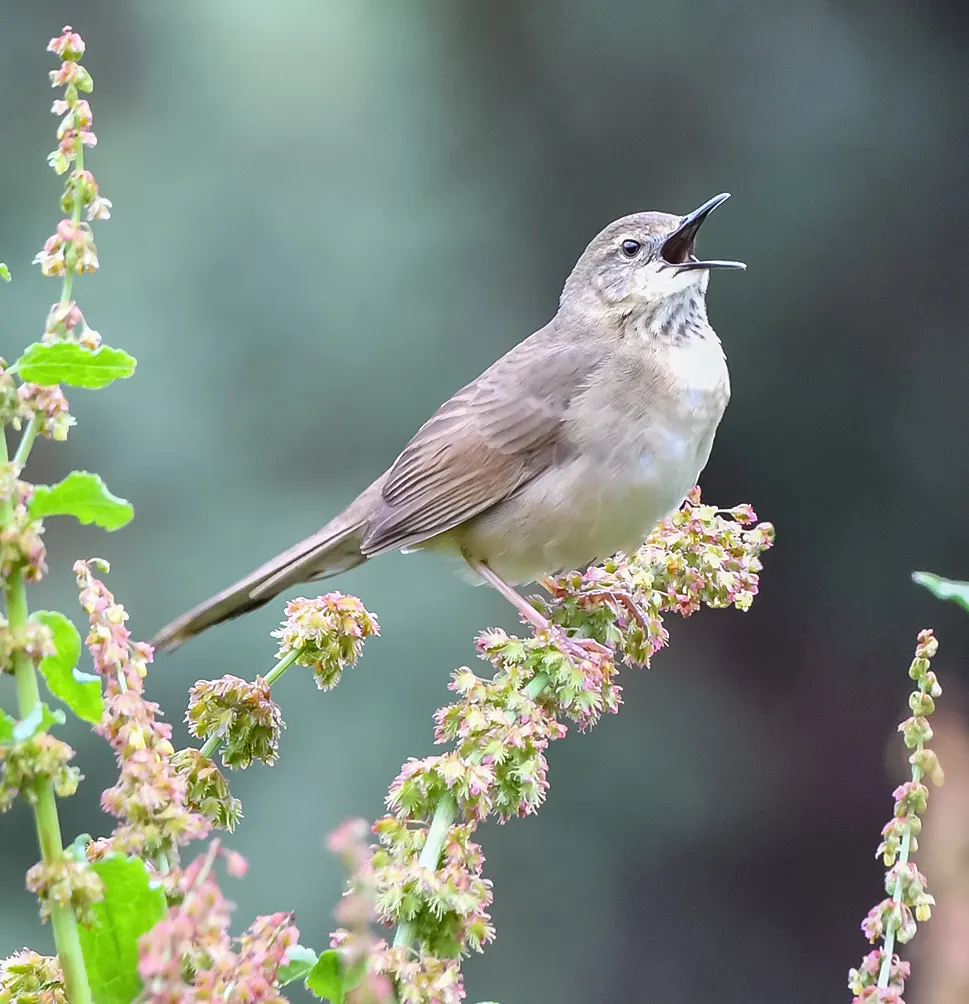
It is a small brown bird with a pale throat, breast and eyebrow stripe, a fairly long black bill, brown eyes and pink legs. Its song is a repetitive clicking, often compared with an insect's. A birding team that found one in Ladakh in 2025 located it by its click-click-click call.
It belongs to the grassbird family, Locustellidae, and is also called the long-billed grasshopper warbler. William Edwin Brooks described it in the early 1870s from Kashmir. Two subspecies are recognised. The nominate form lives in the Himalaya, and L. m. innae in the Kunlun Mountains of Xinjiang, China, which has not been recorded since its type specimens were collected in 1874. A survey in 2003 failed to find it.
Where it lives
The nominate population is found in Tajikistan, northern Pakistan and the Kashmir and Ladakh region of India. The IUCN lists India, China and Pakistan, and gives an elevation range of 2,400 to 3,600 m. It treats the species as an altitudinal migrant, moving up and down the mountains rather than making long journeys.
Its habitats are temperate grassland, temperate shrubland and arable land. It is said to favour long grass and thickets with a dense understorey. The 2025 Ladakh bird was seen perched in a willow at 3,200 m, in terraced farmland at Sankoo village in the Suru Valley.
Pins are Wikidata “endemic to” fields. Orange dots, when present, are GBIF occurrence tiles — survey bias included.
Why it is in trouble
Old accounts call it common, even abundant. Since the mid-twentieth century records have been sparse, with gaps of years, and sites where it once occurred have turned up empty. The IUCN assessment lists nomadic grazing, small-holder farming and grazing, and herbicides and pesticides as threats, and records a continuing decline in the area it occupies. No population estimate is given.
Overgrazing, especially in Kashmir, has reportedly almost removed its preferred habitat there. The assessment's criterion A2c+4c points to a population reduction linked to habitat loss.
Recent sightings and protection
Search for Lost Birds reports that the last documented record before 2022 was from July 1977 in Ladakh, and the bird was photographed again in June 2022. In 2022 and 2023 it was documented in two river valleys in Gilgit-Baltistan, Pakistan. Rising Kashmir reported in July 2025 that the Suru Valley find was the first confirmed Indian sighting since 1979, so the stated last Indian date differs between sources.
The IUCN notes that conservation sites have been identified across its range, but the species is not known to occur in a protected area, and there is no recovery plan or systematic monitoring. Habitat protection and management are the actions it lists as needed. The species was rated Near Threatened in assessments from 2004 to 2017 before the 2025 change.
Sources
Written for this catalog in our own words from the sources below, checked against them on 12 November 2026. Population figures are estimates and carry the year they were made. Status and assessment year: IUCN. 2026. The IUCN Red List of Threatened Species. Version 2026-1. iucnredlist.org.




