Endangered
Lobophyllia hemprichii
Lobophyllia hemprichii
Lobophyllia hemprichii, the largebrain root coral, is a big, fleshy stony coral found on shallow reefs from the Red Sea and East Africa across the Indo-Pacific. Colonies can be several metres wide. The IUCN Red List moved it from Least Concern to Endangered in 2024, because of projected heat-driven bleaching.
How to recognise it
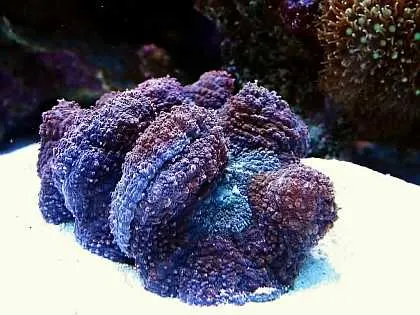
This is a colonial coral with thick, fleshy polyps that sit in large skeletal cups. The cups either rise as separate tubes from a shared base or run together in winding valleys. The edges of the internal plates carry tall, sharp teeth. Colonies range from flat to dome-shaped and can exceed 5 m across, and neighbouring colonies sometimes fuse into one larger stand.
Colour varies a lot. Grey, pink, violet and yellowish brown are all recorded, and some colonies show two or more contrasting colours that radiate from the cup mouths or valley walls. Christian Ehrenberg described the species in 1834, and it is named for his colleague Wilhelm Hemprich, a fellow naturalist of the Red Sea.
Where it lives
Its range covers the Red Sea, the Gulf of Aden, the East African coast, the Indian Ocean, Southeast Asia, Japan, Australia and the western and central Pacific, reaching as far east as Pitcairn and Easter Island. The Red List record names more than 60 countries and territories, from Egypt, Kenya and Madagascar to Indonesia, Fiji and French Polynesia.
It grows on coral reefs and on rocky reef in shallow water, from about 1 to 50 m deep, although most colonies are found between roughly 9 and 15 m. On upper reef slopes it is often a dominant coral and can form extensive stands of a single species.
Pins are Wikidata “endemic to” fields. Orange dots, when present, are GBIF occurrence tiles — survey bias included.
How it lives
Like other reef-building corals, it houses symbiotic algae called zooxanthellae in its tissue. It is hermaphroditic. Eggs and sperm are spawned through the mouth, and the fertilised egg grows into a free-swimming larva that eventually settles on the reef and starts a new colony. The Red List uses a generation length of 10 years.
Why it is in trouble
For years the species looked secure. It was rated Least Concern in 2008 and again in 2014, thanks to its huge range and how common it was. The 2024 assessment changed that. The coral is common, but highly susceptible to bleaching. Coral cover monitoring pointed to a suspected decline of under 25 percent since 1989. Projections of when severe bleaching will strike every year led assessors to suspect a decline of at least 62 percent over the next three generations, about 30 years, to 2050. The area it occupies is also still shrinking.
The threat list is long. Temperature extremes and storms come first, followed by coastal development, sediment and runoff, shipping lanes, tourism and recreation, and small-scale harvest. It is also collected for the aquarium trade, reportedly with Indonesia as the main exporter, and like all stony corals it is on CITES Appendix II. SeaLifeBase records high bleaching sensitivity and high estimated mortality for it in Palau.
What is being done
The Red List lists site protection and management, habitat restoration, captive propagation, gene banking and species recovery among the actions needed, and it is unknown whether the species occurs in a protected area. Its decline sits within a larger pattern.
When the IUCN announced its reassessment of 892 reef-building corals in November 2024, it found 44 percent threatened, against about a third in 2008, and named climate change as the main driver. It called for deep cuts to greenhouse gas emissions plus local action on pollution, disease and fishing.
Sources
Written for this catalog in our own words from the sources below, checked against them on 12 November 2026. Population figures are estimates and carry the year they were made. Status and assessment year: IUCN. 2026. The IUCN Red List of Threatened Species. Version 2026-1. iucnredlist.org.




