Endangered
Little Sumba Hawk-Owl
Ninox sumbaensis
The little Sumba hawk-owl (Ninox sumbaensis), also called the least boobook, is a small, yellow-eyed owl found only on the Indonesian island of Sumba. Scientists described it in 2002. The IUCN Red List lists it as Endangered (2017 assessment) because its forest home is small, scattered and still shrinking.
How to recognise it
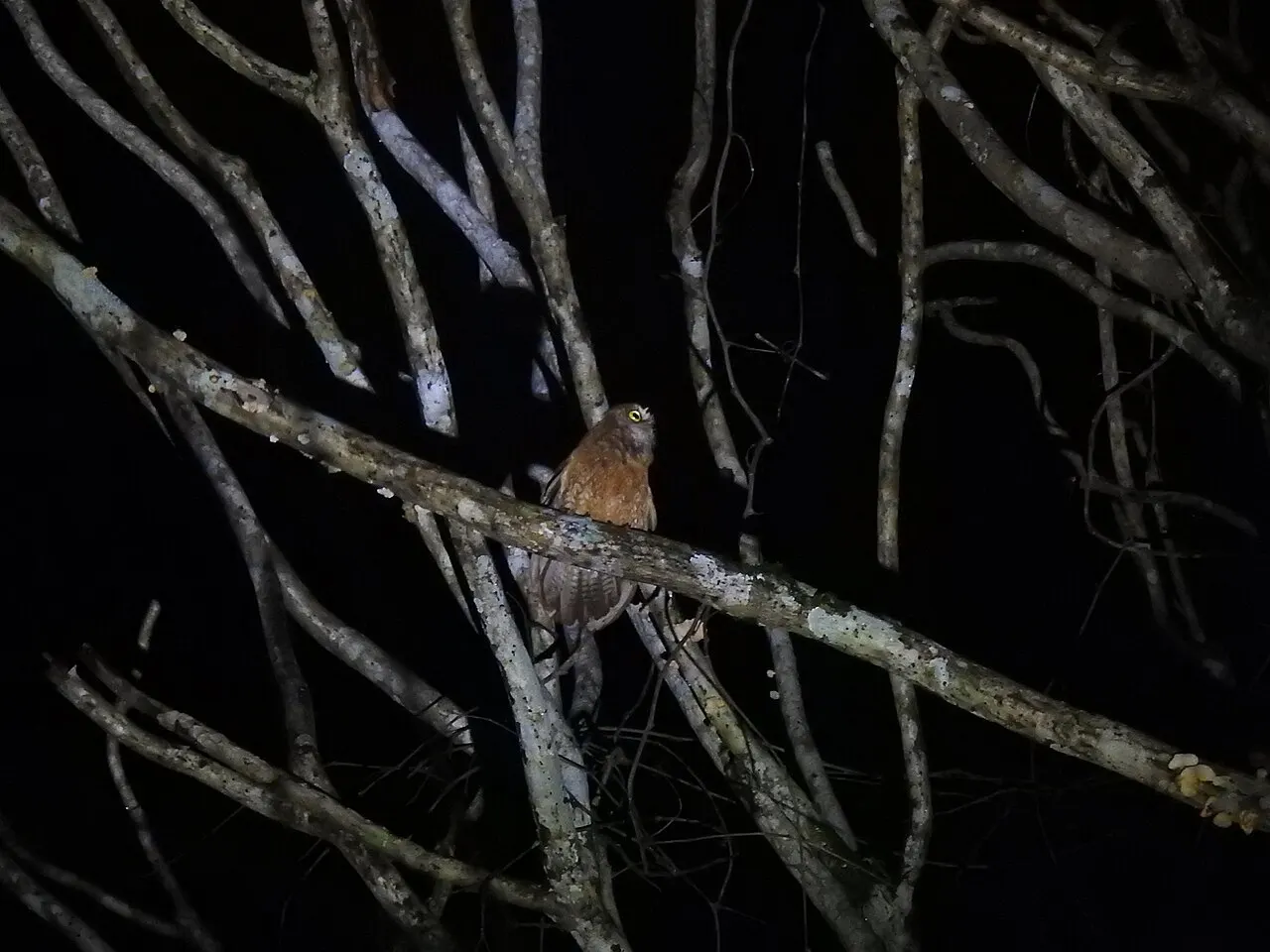
It's a small owl without ear tufts and with only a faint facial disc. The crown is grey with fine, close barring, and bold white eyebrows stand out on the grey face. The back is light brown with widely spaced dark wavy lines, the throat is rufous, and the lower breast is white with fine dark chevrons. The eyes, bill tip and feet are yellow, and the tail carries 12 or 13 dark bars.
Its voice is the quickest clue. It gives a single low, whistled "who" or hoot, repeated every few seconds (observers have timed it at roughly 2.5 to 4 seconds). The much larger Sumba boobook (Ninox rudolfi), a different owl that shares the island, sounds nothing like it and instead gives a repeated "cluck-cluck-cluck".
Where it lives
The owl occurs nowhere but Sumba, in the Lesser Sunda Islands. The IUCN gives its elevation range as roughly 600 to 950 m and counts three locations. It uses mostly moist lowland forest, and may use heavily degraded former forest too. When it was described, it was known from primary and secondary forest at around 600 m, and the observers found it only in remnant forest patches, never perching or hunting in the open country outside the forest.
Pins are Wikidata “endemic to” fields. Orange dots, when present, are GBIF occurrence tiles — survey bias included.
How it lives
Very little is known. On the evening of 20 December 2001 a pair answered a recording at a forest patch and two more pairs were found in adjacent forest near the Lewa road. On 24 December a fledged young bird, lighter reddish and lacking the adult's barring, was seen begging for food with two adults calling nearby. The IUCN lists it as a non-migrant.
A bird found by its voice
Birders had reported an unidentified owl on Sumba since the late 1980s, and most assumed it was a scops owl. In December 2001 a team from Australia played a recording at a forest patch and the owls responded. A bird shot by a local hunter on 30 December gave feathers for DNA analysis, which placed the owl in the genus Ninox. The result was published in 2002 as a new species, with Little Sumba Hawk-Owl as its English name.
Why it is in trouble
Closed forest covered less than 11 percent of Sumba when the owl was described, and was split into small pockets by clearing and repeated burning. The IUCN lists farming, both large agro-industry and small-holder, accidental effects of harvesting, and more frequent or intense fire as ongoing threats, and records a continuing decline in its habitat. The population is estimated at 10,000 to 19,999 birds (2017) and described as decreasing.
The listing has moved over time. The IUCN rated it Near Threatened in assessments from 2004 to 2016, then Endangered in 2017.
What is being done
Protection is limited. At the time of the assessment the owl was not known from any protected area, no recovery plan or monitoring scheme existed, and the main recommendation was to protect significant areas of suitable forest, through both strict reserves and community-run multiple-use areas. Surveys to clarify where it lives and how many there are remain a stated research need. The IUCN says the species is subject to international trade controls, and it is reportedly listed in CITES Appendix II.
Sources
Written for this catalog in our own words from the sources below, checked against them on 12 November 2026. Population figures are estimates and carry the year they were made. Status and assessment year: IUCN. 2026. The IUCN Red List of Threatened Species. Version 2026-1. iucnredlist.org.




