Endangered
Winter skate
Leucoraja ocellata
The winter skate (Leucoraja ocellata) is a large, flat, bottom-living skate of the north-west Atlantic, ranging from the Gulf of St. Lawrence to North Carolina. The IUCN Red List rated it Endangered in 2020. Slow growth, late maturity and heavy bycatch have cut some populations by more than 90 percent.
How to recognise it
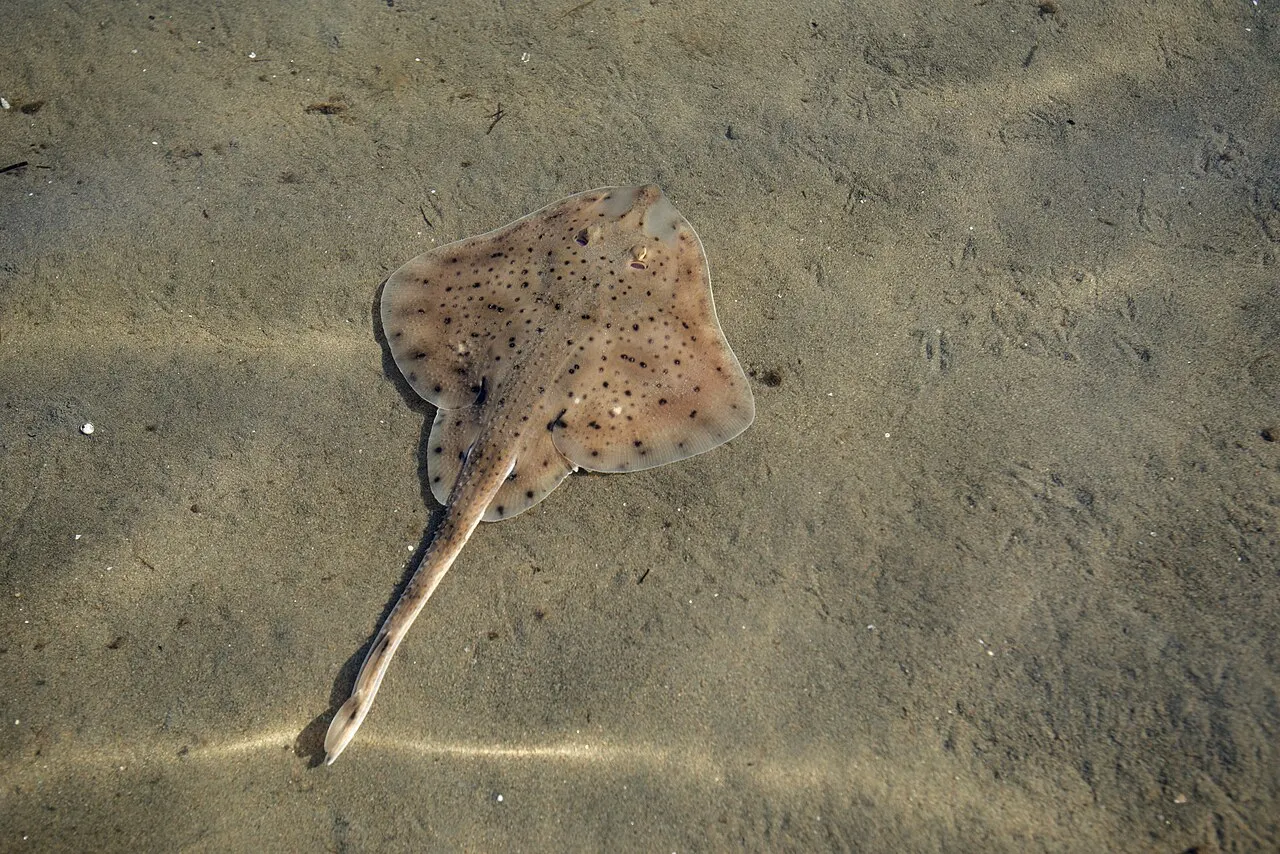
It's a big skate, reaching about 109 cm. The disc is light brown above with blackish spots, rough with thorn-like spines, and most fish have one to four white-edged eyespots near the pectoral fins. The underside is white.
Small winter skates under about 30 to 35 cm are hard to separate from little skates. Winter skates have a wider, less arched mouth and 63 or more tooth rows in the upper jaw. Genetic testing is the most reliable check.
Where it lives
It's found only in the north-west Atlantic, from the south coast of Newfoundland and the Gulf of St. Lawrence through the Scotian Shelf, Bay of Fundy and Georges Bank to Cape Hatteras, North Carolina. It reaches waters where little skates are absent.
It lives on or near the sea floor, mostly over sand or gravel at depths under about 111 m, though it has been caught at 371 m. The Red List gives a depth range of 5 to 725 m. It has been caught in water from about minus 1.2 to 15 degrees C, and in the Bay of Fundy it appears to move inshore in autumn and offshore in summer.
Pins are Wikidata “endemic to” fields. Orange dots, when present, are GBIF occurrence tiles — survey bias included.
How it lives
Young skates eat mostly small crustaceans called amphipods and marine worms, and fish such as sand lance matter more in the diet of larger ones. Females lay egg cases. In the Gulf of Maine egg laying peaks from September to November, and hatchlings are about 11 to 13 cm long.
It grows slowly, matures late and lives long. Females mature at about 12.5 years in the north-eastern United States and 13.4 years on the eastern Scotian Shelf, and skates in the southern Gulf of St. Lawrence mature at a significantly smaller size. The Red List gives a generation length of 10 to 18 years.
Why it is in trouble
There is no commercial fishery for it in the Gulf of St. Lawrence, where all catches must be returned to the water. Declines there in the 1970s and 1980s may have come from bycatch in fisheries aimed at other bottom fish. In 2015 COSEWIC, Canada's wildlife assessment body, reported that mature numbers in the Gulf had fallen about 99 percent since the early 1980s, and on the eastern Scotian Shelf and off Newfoundland by about 98 percent since the early 1970s. The Red List assessment estimates a past reduction of 50 to 79 percent and a decreasing trend.
Slow reproduction means recovery is slow even when fishing pressure drops. COSEWIC names high non-fishing mortality, possibly from grey seal predation, as the main current threat in both regions, with bycatch an added pressure on the eastern Scotian Shelf.
What is being done
A directed winter skate fishery on the eastern Scotian Shelf was closed after COSEWIC first assessed the species there in 2005. In May 2015 COSEWIC rated the Gulf of St. Lawrence group and the Eastern Scotian Shelf and Newfoundland group Endangered, and the Western Scotian Shelf and Georges Bank group Not at Risk. The Red List notes harvest management, a monitoring scheme and presence in at least one protected area, but no species recovery plan.
Sources
Written for this catalog in our own words from the sources below, checked against them on 12 November 2026. Population figures are estimates and carry the year they were made. Status and assessment year: IUCN. 2026. The IUCN Red List of Threatened Species. Version 2026-1. iucnredlist.org.




