Critically Endangered
Leptolebias opalescens
Leptolebias opalescens
The opal pearlfish (Leptolebias opalescens, now usually Leptopanchax opalescens) is a tiny annual killifish from the lowlands of Rio de Janeiro state, Brazil. The IUCN Red List rated it Critically Endangered in 2022, with a decreasing population. It was recorded again in 2020 after eight years without a record.
How to recognise it
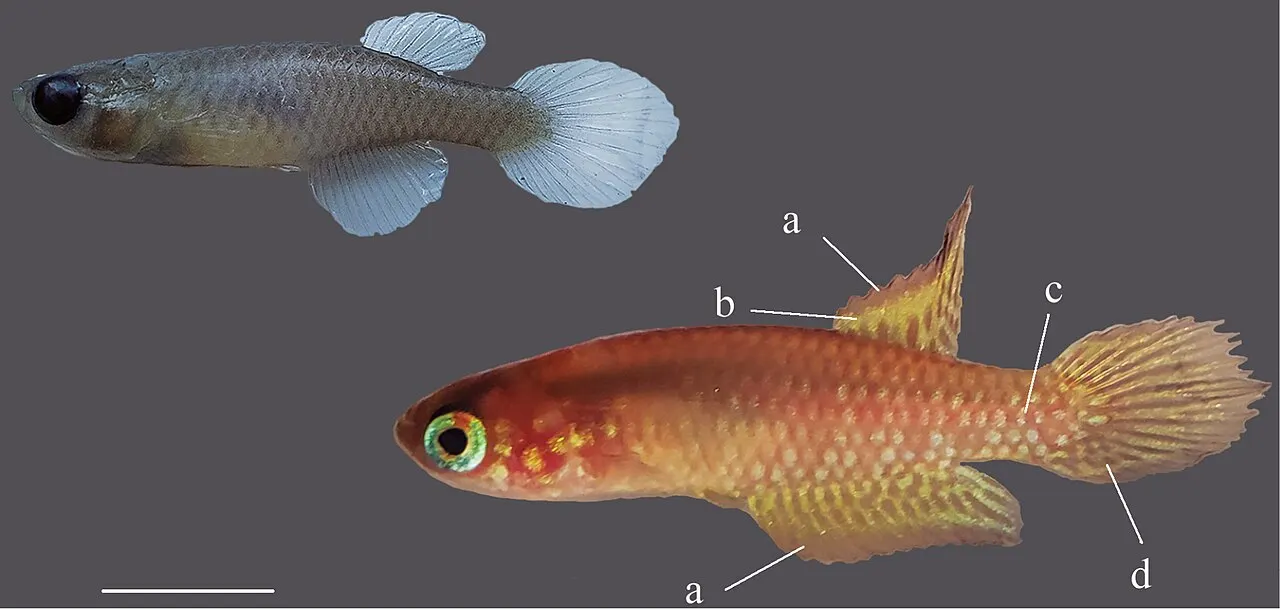
This is a very small fish. In a 2020 study of the recaptured population, males measured about 2.1 to 2.9 cm in total length and females about 1.7 to 3.1 cm, and males were on average larger. Females are light brown with clear fins. Males are showier, with a reddish body marked by diffuse pale spots, a dark red band along the edges of the dorsal and anal fins, and a golden band below the red band on the dorsal fin.
George S. Myers described it in 1942 as Cynolebias opalescens, from the base of the Serra de Petropolis near Imbarie, in the municipality of Duque de Caxias. It has carried several other names since, including Cynolebias nanus. The IUCN now lists it as Leptopanchax opalescens, in the family Rivulidae.
Where it lives
The IUCN records it only from Rio de Janeiro state, Brazil, at a single location, with an estimated area of occupancy of 4 square kilometres. It is a seasonal fish of temporary pools in open wet ground, and the assessment also lists moist montane forest as a suitable habitat.
The place where it was recaptured is a swampy area of shallow pools at an industrial site in Seropedica, in the Guandu River basin, at about 34 m above sea level. The pools were 2 to 41 cm deep, acidic (pH 3.9 to 6.3), warm (24.6 to 27.7 degrees C) and low in oxygen. The researchers estimated that the fish occupied only about 8,200 square metres there.
Pins are Wikidata “endemic to” fields. Orange dots, when present, are GBIF occurrence tiles — survey bias included.
How it lives
Annual killifish live in pools that dry out each year, and the Seropedica pools dry completely from May until the next rainy season, which runs from October to April. Monthly sampling began in November 2019. No fish turned up in November or December, and catches peaked from January to March 2020. Of 86 fish caught, 18 were males, 51 were females and 17 were of undetermined sex. Catches averaged 0.89 fish per square metre, a low density. Little else is known of its life history.
Why it is in trouble
Before 2020 it had not been recorded since 2012. The site of the 2012 record was later earmarked for the Rio de Janeiro International Autodrome, and the fish was not found there during licensing. The researchers pointed to habitat loss from urban growth, industry, farming, drainage and landfill as the main threats. The IUCN assessment lists housing and urban areas and other ecosystem modification as ongoing threats, and tourism and recreation areas as a possible future one.
The Seropedica pools sit about 2 km from a site where a single male was collected in 1984. Brazil's national Red Book, maintained by ICMBio, also lists the species as Critically Endangered.
What is being done
The IUCN assessment lists habitat protection, site protection and management, and action at national and state level as the measures needed. After the 2020 discovery, the managers of the industrial enterprise reportedly reworked its legal reserve area to protect the remaining habitat.
Sources
Written for this catalog in our own words from the sources below, checked against them on 12 November 2026. Population figures are estimates and carry the year they were made. Status and assessment year: IUCN. 2026. The IUCN Red List of Threatened Species. Version 2026-1. iucnredlist.org.




