Critically Endangered
Leptogyra inflata
Leptogyra inflata
Leptogyra inflata is a tiny sea snail from the deep floor of the southwest Pacific, living on hydrothermal vents at depths of roughly 1,750 to 1,800 m. It has no common name. The IUCN Red List rated it Critically Endangered in 2021 because its known range is very small and seabed mining is a future threat.
How to recognise it
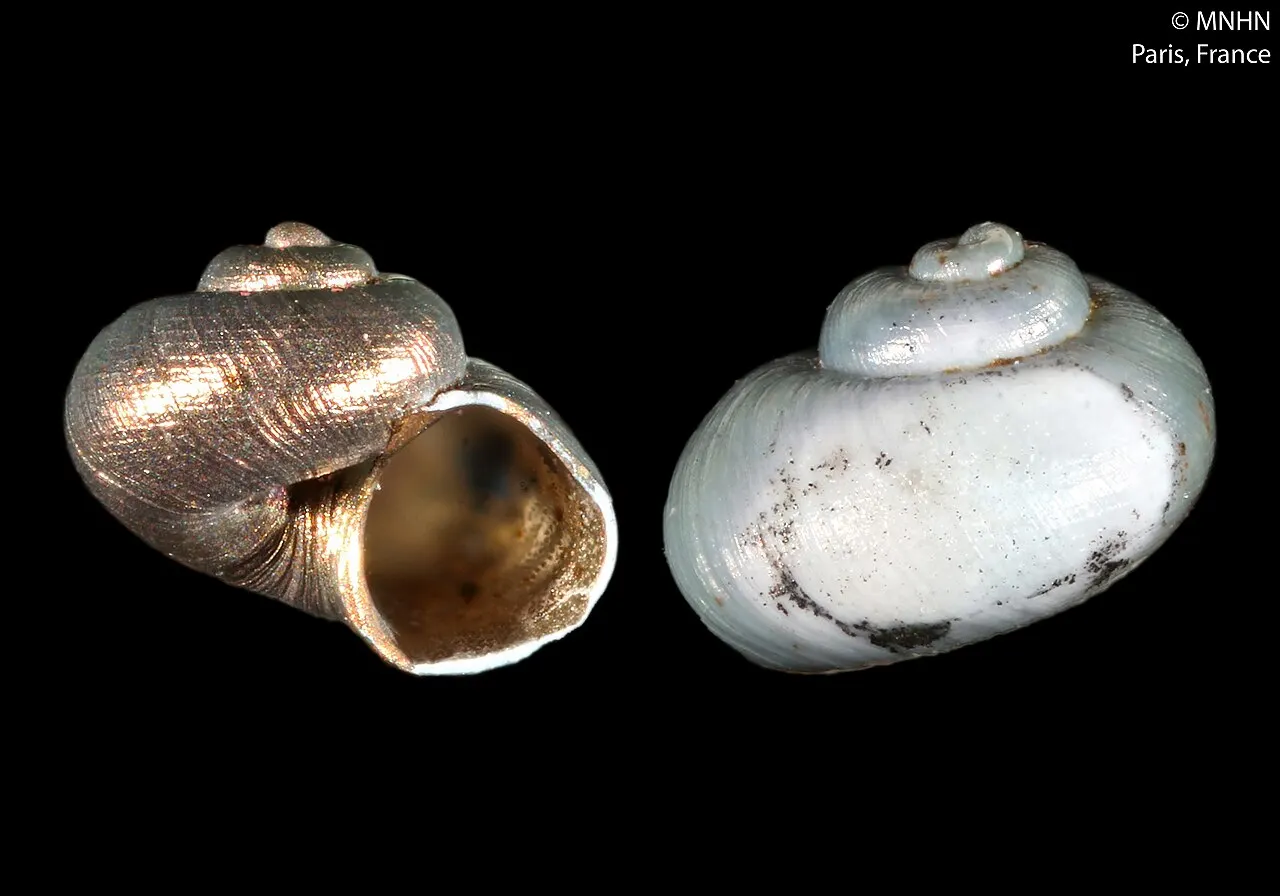
This is a very small animal. The shell reaches only about 1.3 mm in length, so it is a species for a microscope, not a dive light. It has a wide, deep opening at the base of the coil (the umbilicus), and the thin, brownish operculum that seals the shell mouth is made of many whorls. The species name comes from the Latin for inflated, a nod to the swollen shape of the shell.
It belongs to the family Melanodrymiidae, a small group of 18 living species in four genera. The IUCN places the family in the order Neomphalida. Anders Warén and Philippe Bouchet described the species in 1993, and the original specimen is held at the Muséum national d'Histoire naturelle in Paris.
Where it lives
Sources disagree on the country. The IUCN structured data lists a single country, Tonga, and a single location, in the western central Pacific, while a general reference article places the snail off Fiji. Both agree it is a seafloor animal of the southwest Pacific.
The IUCN gives its habitat as deep hydrothermal vents and a depth of about 1,750 to 1,817 m. A fish and invertebrate database gives a wider range of 1,764 to 2,703 m, so the true depth limits are uncertain.
Pins are Wikidata “endemic to” fields. Orange dots, when present, are GBIF occurrence tiles — survey bias included.
Why it is in trouble
The one threat the IUCN names is mining, affecting most of the population and expected in the future rather than under way. Polymetallic sulfide deposits form at the same kind of vents, and exploration licences have been granted in Tongan waters. A 2018 study in Frontiers in Marine Science by Cherisse Du Preez and Charles Fisher, which followed other vent animals in the Lau Basin off Tonga, noted that its five study sites lay inside exploration licences held by Nautilus Minerals, due for renewal in 2019.
The same study found vent structures and communities remarkably stable from 2006 to 2016, which bears on how well such communities might cope with mining. With one known location, a single operation could affect the whole species. The Critically Endangered listing (criteria B1ab(iii)+2ab(iii)) rests on that tiny range and expected habitat decline. The population trend is unknown and there is no population estimate.
What is being done
Very little is in place. The 2021 assessment records no recovery plan, no monitoring scheme, no protected area covering the population and no captive breeding. The action needs it lists are national and international policy, protection of the resource and habitat, and research. Almost nothing is published on how this snail feeds or breeds.
Sources
Written for this catalog in our own words from the sources below, checked against them on 12 November 2026. Population figures are estimates and carry the year they were made. Status and assessment year: IUCN. 2026. The IUCN Red List of Threatened Species. Version 2026-1. iucnredlist.org.




