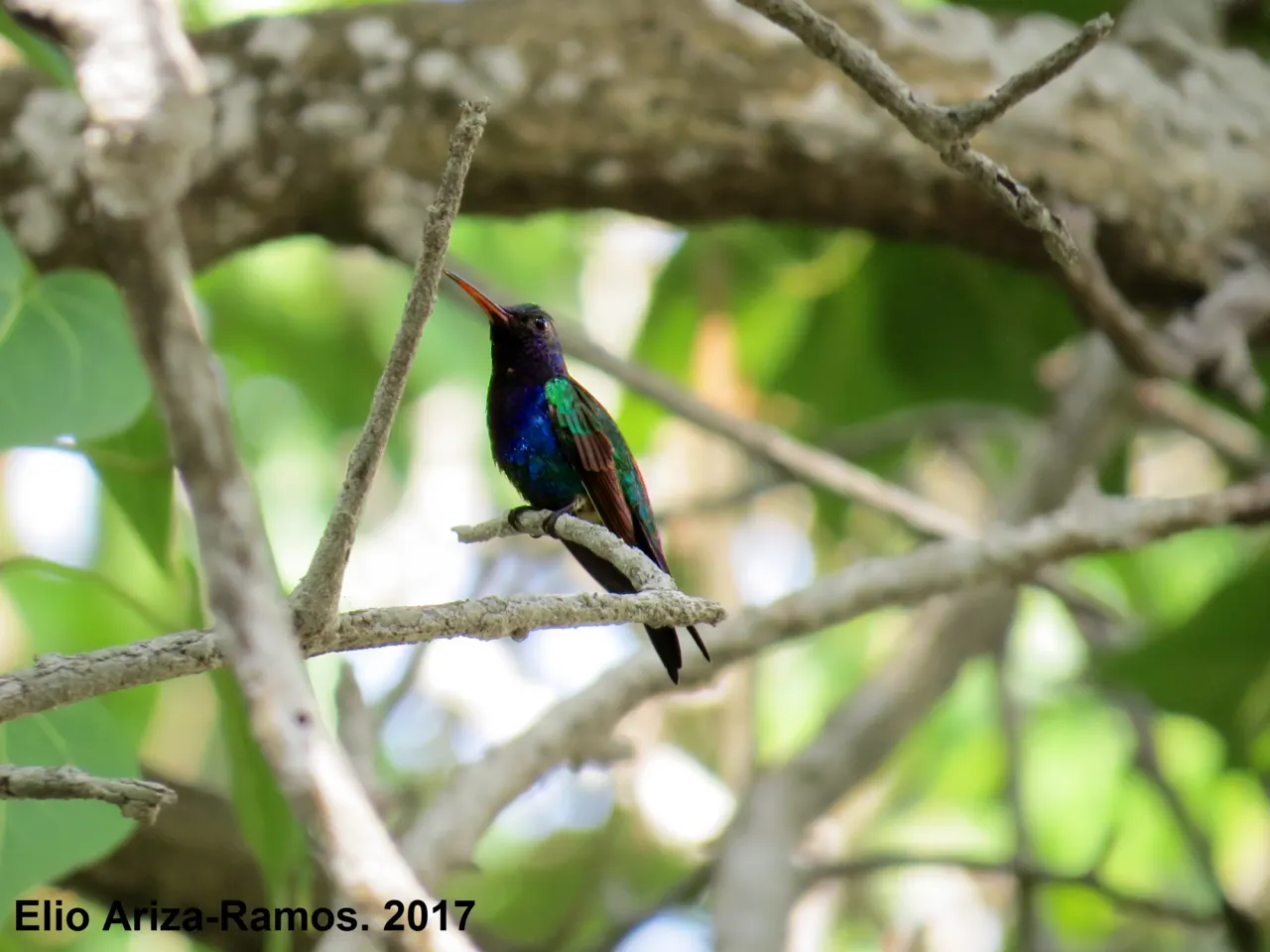
Endangered
Sapphire-bellied hummingbird
Lepidopyga lilliae
The sapphire-bellied hummingbird (Chrysuronia lilliae, formerly Lepidopyga lilliae) is a tiny glittering hummingbird found only in the mangroves and dry scrub around Ciénaga Grande de Santa Marta on Colombia's Caribbean coast. The IUCN Red List rated it Endangered in 2021, having rated it Critically Endangered in earlier assessments.
How to recognise it
It is a very small bird, 8.9 to 9.4 cm long, and a male weighs about 4.3 g. The male has a shining green crown, back and rump, a glittering purple throat, blue underparts and a forked blue-black tail. The upper bill is black, and the lower is pinkish with a dark tip. Females have not been fully described, though they are thought to look similar with greyer underparts. In shade the plumage can look dark, and the colour shows in sunlight.
Where it lives
Colombia is the only country on the IUCN list. The bird lives in a small stretch of mangrove forest and the arid scrub next to it, at elevations up to about 100 m. The IUCN puts it at 2 to 5 locations, and the habitats it uses are tropical dry shrubland and mangrove forest above the high-tide line.
It is recorded from two protected areas, though records are few at Vía Parque Isla de Salamanca.
Pins are Wikidata “endemic to” fields. Orange dots, when present, are GBIF occurrence tiles — survey bias included.
How it lives
Much of its life is poorly documented. It seems to prefer the nectar of tea mangrove (Pelliciera rhizophorae) flowers, has been seen on the flowers of a coral tree (Erythrina fusca) in nearby scrub, and also takes insects and spiders. It hovers at flowers as other hummingbirds do. Nothing is known about its breeding season, and recordings of its voice, a series of short chatters, are scarce. It is not a migrant, though local seasonal movements are possible.
Why it is in trouble
The IUCN assessment gives a population of 285 to 440 mature individuals (2021) and a decreasing trend. A 2022 One Earth article gives a lower figure, 50 to 249 mature individuals. Housing, roads, utility lines, tourism development, small dams, sewage and small-scale harvesting are listed as threats. One Earth adds that large areas of Colombian coastal mangrove have been cleared for farming and cattle pasture, or damaged by industrial pollution.
The IUCN also records continuing decline in the area the bird occupies, and a single population with all individuals in one group.
What is being done
The IUCN lists site protection and management, habitat restoration, awareness work, policy and regulation, and livelihood alternatives for local communities as conservation actions. The assessment records that conservation sites have been identified over its whole range and that it occurs in at least one protected area. The species is on CITES Appendix II, which covers all hummingbirds.
Sources
Written for this catalog in our own words from the sources below, checked against them on 12 November 2026. Population figures are estimates and carry the year they were made. Status and assessment year: IUCN. 2026. The IUCN Red List of Threatened Species. Version 2026-1. iucnredlist.org.




