Endangered
Lepidogalaxias
Lepidogalaxias salamandroides
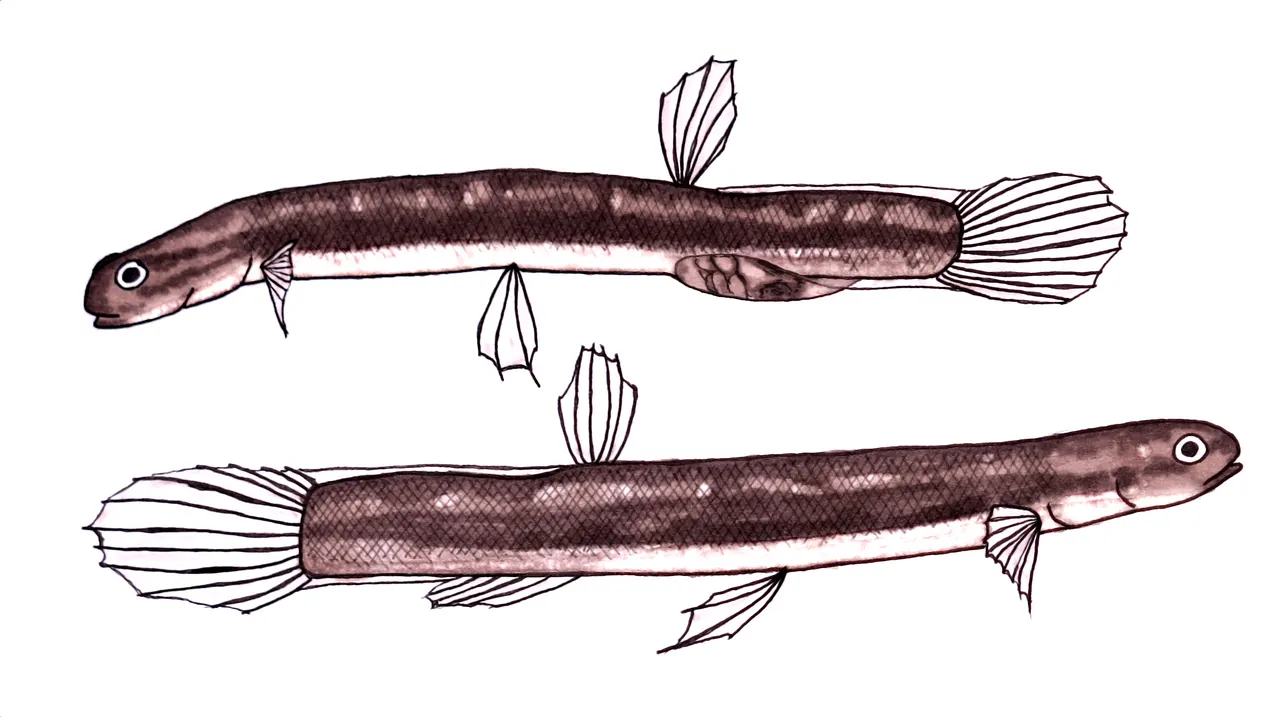
The salamanderfish (Lepidogalaxias salamandroides) is a tiny freshwater fish of southwest Western Australia, found nowhere else. It survives the summer drought by burrowing into damp sand. The IUCN Red List assessed it as Endangered in 2019, with its habitat threatened by drought, fire and shifting conditions.
How to recognise it
It's a small, slender fish, up to about 7.5 cm in total length. Females grow larger than males, which reach about 5.5 cm. The back and sides are greenish brown with black blotches and the belly is silvery white. Males have a dark stripe through the eye and along the side, and an anal fin modified for mating.
It has an unusual trick for a fish. Its eyes are fixed, so it bends its neck to look around. Gerlof Mees described it in 1961. It was first grouped with the galaxiid fishes but is now placed in a family of its own, and molecular studies reportedly show an old, isolated lineage.
Where it lives
The species is known only from heathland peat flats between the Blackwood and Kent Rivers in the far southwest, reportedly a span of about 180 km, and it is said to be common around Northcliffe. The IUCN counts a single location, about 5 subpopulations, an extent of occurrence of 2,636 square kilometres and an area of occupancy of 84 square kilometres. Conservation sites cover part of its range, and 81 to 90 per cent of the population is recorded as protected.
It lives in small, shallow, semi-permanent pools and streams, reportedly often no deeper than 10 cm. The water is stained by tannins and acidic, with a pH of roughly 3 to 6.5 depending on the source. Daily temperatures can swing from about 16 to over 30 degrees Celsius.
Pins are Wikidata “endemic to” fields. Orange dots, when present, are GBIF occurrence tiles — survey bias included.
How it lives
The pools dry up by late summer, and the fish goes underground. It burrows into sand that stays damp, breathes through its skin and lives on stored fat. A wedge-shaped skull and flexible backbone help it dig, and it rests in a mucous cocoon until rain returns.
It eats mainly aquatic insect larvae. Spawning happens in winter, when water levels are highest, with internal fertilisation. Females produce 100 to 400 eggs. Larvae reportedly grow quickly to build fat for the next drought. Individuals can live up to about 5 years.
Why it is in trouble
The IUCN names three ongoing threats, each covering more than 90 per cent of the range: more frequent or intense fires, drought, and shifting or altered habitat. Drought and habitat change are rated as causing rapid declines.
The overall trend is decreasing, assessed under criteria B1ab and B2ab. The assessment projects a population reduction of about 30 per cent in each of the past, present and future periods it considers.
What is being done
Part of the range lies within identified conservation sites, and the species has been the subject of education and awareness programmes. The assessment lists site protection, species recovery work and captive breeding as actions, but it also records that no individuals are held in captivity, and that there is no recovery plan, no systematic monitoring and no invasive species control.
Sources
Written for this catalog in our own words from the sources below, checked against them on 12 November 2026. Population figures are estimates and carry the year they were made. Status and assessment year: IUCN. 2026. The IUCN Red List of Threatened Species. Version 2026-1. iucnredlist.org.




