Endangered
Lepidochrysops praeterita
Lepidochrysops praeterita
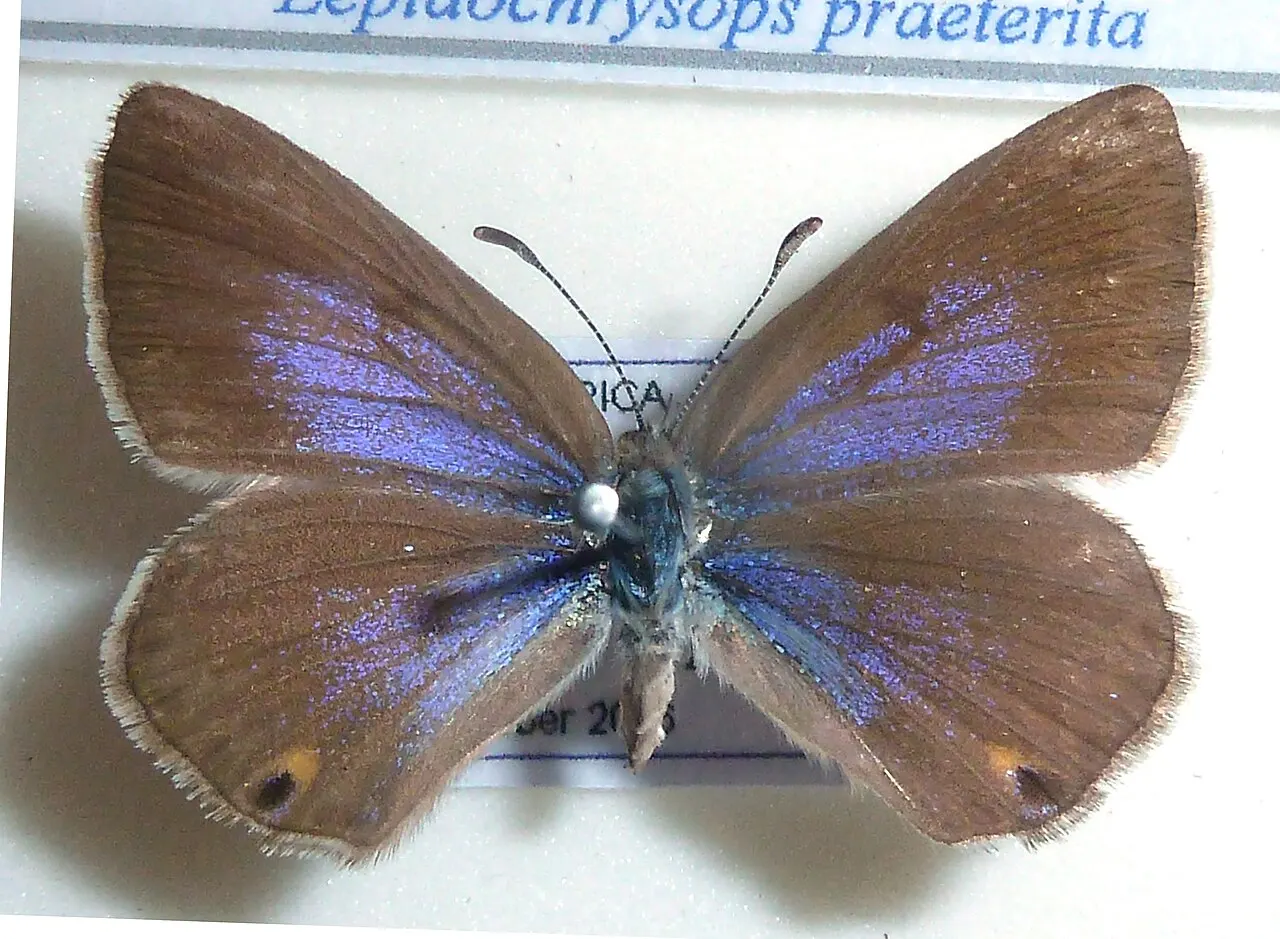
The Highveld blue (Lepidochrysops praeterita) is a small butterfly found only in South Africa, on rocky grassland and savanna in Gauteng, the Free State and North West. The IUCN Red List assessed it as Endangered in 2020, with four locations, about 10 subpopulations and a decreasing trend.
How to recognise it
It's a member of the blues, the family Lycaenidae. Males reportedly have a wingspan of 36 to 42 mm and females 38 to 44 mm. The butterfly was described by Swanepoel in the early 1960s, and sources differ on whether the year is 1962 or 1963.
Where it lives
The Highveld blue is found nowhere outside South Africa. Records come from Gauteng, the Free State and North West, with localities named from Potchefstroom to Walkerville and Sasolburg. The IUCN assessment puts its extent of occurrence at about 1,336 square kilometres and the area it actually occupies at 44 square kilometres, across four locations. A 2024 environmental report for a development site, citing a 2018 regional assessment by Dobson, gives the same figures.
Its preferred habitat is rocky, grassy south-facing slopes between 1,500 and 1,750 m. The IUCN lists dry savanna, high-altitude grassland and rocky areas, and counts about 10 subpopulations.
Pins are Wikidata “endemic to” fields. Orange dots, when present, are GBIF occurrence tiles — survey bias included.
How it lives
There's one generation a year, and adults fly from early September to November. The caterpillars feed on a plant recorded as Becium grandiflorum in one source and Ocimum obovatum in the 2024 report. Plant names differ between sources.
The same report says the butterfly also depends on a host ant, though it names an ant only for a related species. Detailed life history is thin, and the IUCN lists it among the research needs.
Why it is in trouble
The IUCN lists housing and urban areas, grazing by roaming livestock, drought and a suppression of fire frequency and intensity as ongoing threats, each rated low impact. Commercial and industrial development is listed as a future threat. The assessment, under criteria B1ab and B2ab, records continuing decline in the area occupied, the extent of occurrence, habitat quality and the number of subpopulations.
No population size is given. The overall trend is decreasing.
What is being done
The assessment lists site protection and awareness work as conservation actions, and calls for research on threats, life history, habitat trends and population trends. It records no conservation measures in place.
Sources
Written for this catalog in our own words from the sources below, checked against them on 12 November 2026. Population figures are estimates and carry the year they were made. Status and assessment year: IUCN. 2026. The IUCN Red List of Threatened Species. Version 2026-1. iucnredlist.org.




