Endangered
Leopard whipray
Himantura leoparda
The leopard whipray (Himantura leoparda) is a large stingray of shallow Indo-West Pacific seas, listed from East Africa and the Red Sea region to Japan and northern Australia. Adults wear dark brown rings on a yellowish-brown back. The IUCN Red List rated it Endangered in 2024, because it is caught for meat, skin and medicine.
How to recognise it
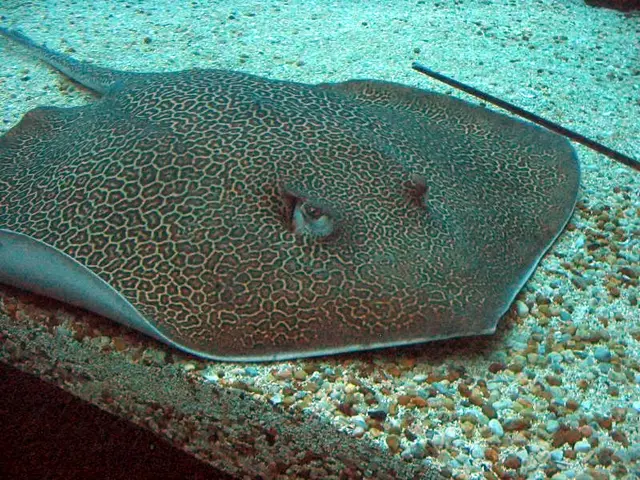
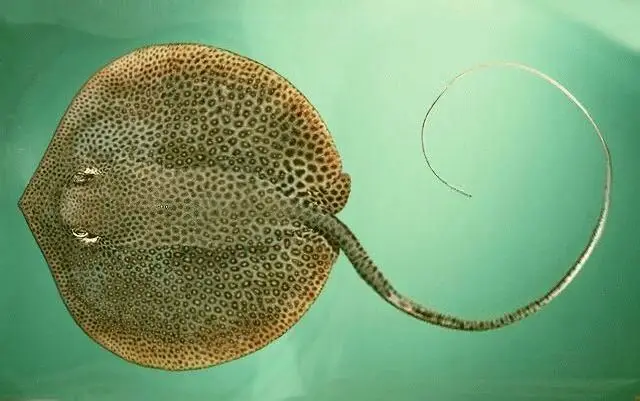
The body is a diamond-shaped disc, wider than long, ending in a pointed snout. The tail is very thin and whip-like, 2.5 to 3.8 times as long as the disc, with no fin folds and usually a single serrated stinging spine. The underside is plain white.
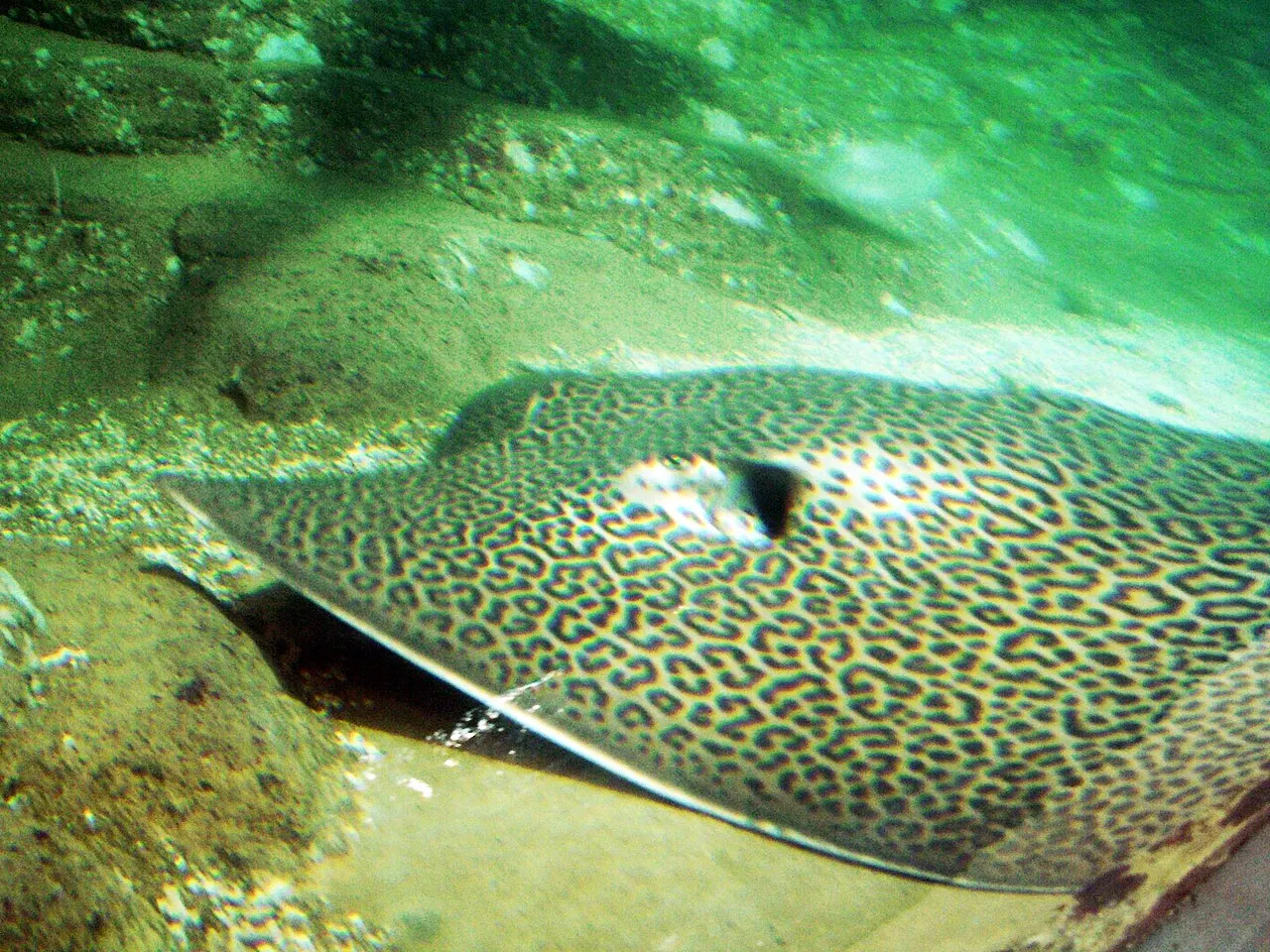
Adults have dark brown rings on a yellowish brown back and a row of up to 15 enlarged, heart-shaped bumps (dermal denticles) down the middle of the disc. Newborns and small juveniles carry large solid dark spots instead, and the spots begin to hollow into rings once the disc reaches about 55 cm across.
Size is reported inconsistently. Most accounts give a maximum disc width of about 1.4 m, while FishBase lists 110.5 cm and a largest recorded weight of 55 kg.
Where it lives
The species was formally described only in 2008. The type specimen, a female 1.1 m across, came from 46 m of water north-west of Weipa in the Gulf of Carpentaria, Queensland. For years Australian records were mixed up with the reticulate whipray (Himantura uarnak) and the honeycomb whipray (Himantura undulata). Genetic work later split off a hidden relative, now named Himantura tutul.
Because of that muddle, its true range is still being sorted out. The IUCN lists it from East Africa and the Arabian Gulf region through India, Southeast Asia and Indonesia to Papua New Guinea, Taiwan and Japan, and in Australia from Coral Bay in Western Australia to the Great Barrier Reef. Some Indian Ocean records, for example from Bangladesh, Sri Lanka and South Africa, have reportedly not been checked with genetics and may be other rays.
It keeps close to shore, over sand and sandy mud, in estuaries, lagoons, mangrove roots and coral reef areas. The IUCN gives a lower depth limit of 81 m, while FishBase and Fishes of Australia give 70 m.
Pins are Wikidata “endemic to” fields. Orange dots, when present, are GBIF occurrence tiles — survey bias included.
How it lives
Its natural history is poorly known. Aquarium keepers list small fishes, bivalves, squid, crustaceans and worms as food. Young are reportedly born alive, nourished inside the mother on uterine fluid, and are about 20 cm across at birth. Males mature at 70 to 80 cm. The IUCN puts a generation at about 20 years, so numbers are likely to recover slowly once they are knocked down.
Why it is in trouble
The IUCN lists fishing, both targeted and accidental, at scales from subsistence to industrial, as an ongoing threat. It suspects the population has fallen by 50 to 79 percent in the past, and the trend is still decreasing. The ray is used for food, for skin in apparel and accessories, and in medicine.
It is reportedly heavily fished in parts of Indonesia, mainly for meat, using bottom trawls, tangle nets and longlines. Most of the animals landed in eastern Indonesia are juveniles, which cuts into the next generation.
What is being done
Protection is thin. The IUCN records that the ray occurs in at least one protected area, but there is no recovery plan, no systematic monitoring scheme, no harvest management plan and no international trade controls. The assessment lists harvest management, trade management, species recovery, site protection and national-level action as conservation needs.
Sources
Written for this catalog in our own words from the sources below, checked against them on 12 November 2026. Population figures are estimates and carry the year they were made. Status and assessment year: IUCN. 2026. The IUCN Red List of Threatened Species. Version 2026-1. iucnredlist.org.