Critically Endangered
Birdwing pearlymussel
Lemiox rimosus
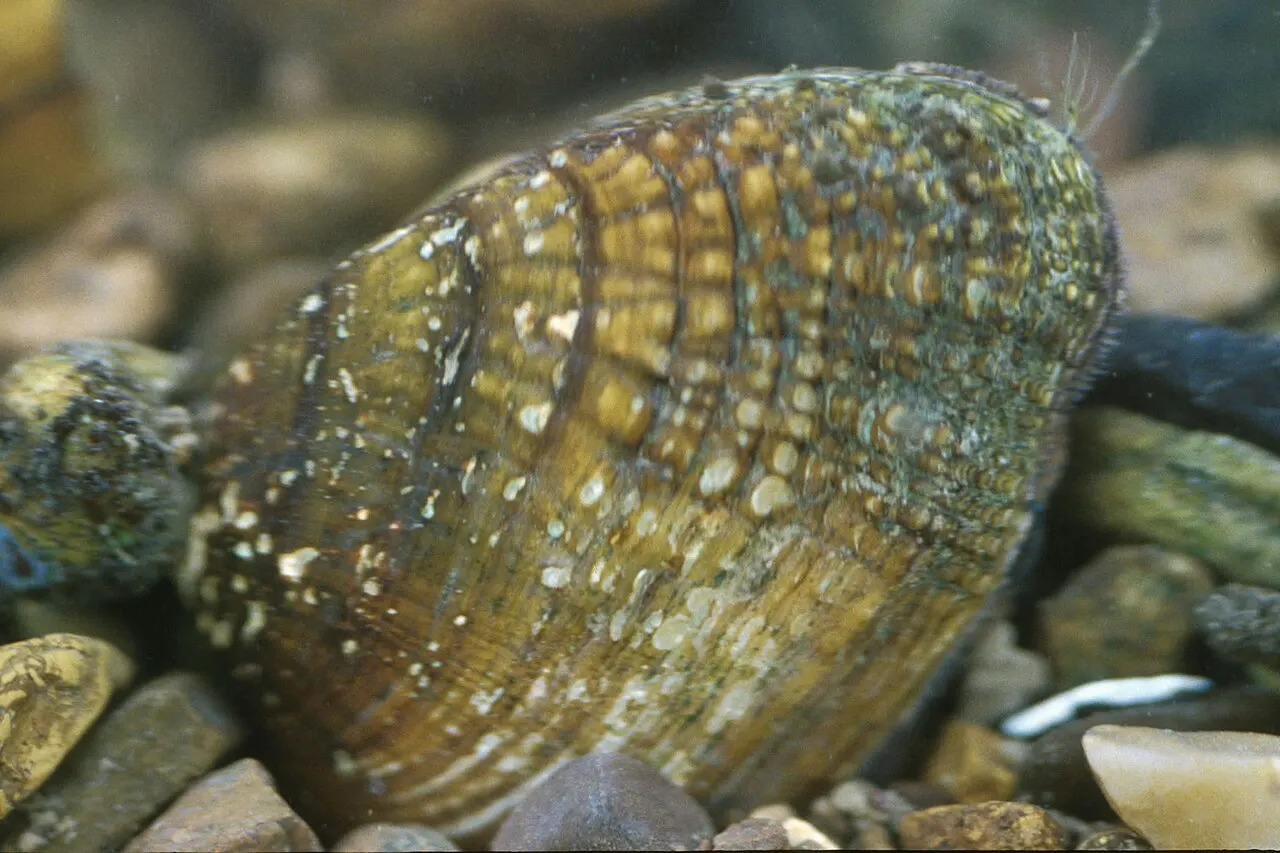
The birdwing pearlymussel is a small freshwater mussel, about the size of a wine cork, that was once widespread in the Tennessee River system but never common. Reproducing populations now survive only in the Clinch, Powell and Duck rivers, and the IUCN has rated it Critically Endangered since 2012.
How to recognise it
It is a small mussel, up to about 50 mm long. Young mussels are often olive green and darken to blackish brown with age. The species was first described by Rafinesque in 1831.
Where it lives
It lives in riffles, the shallow fast stretches of small to medium rivers, usually on stable sand and gravel in moderate to fast current. The IUCN counts over 125 historical occurrences, mostly in the Tennessee River drainage of Virginia and Tennessee, and says it now holds about 10 percent of its former range. Reproducing populations are known only from the Clinch, Powell and Duck rivers, and the IUCN counts three locations with a severely fragmented population. Older accounts add one Cumberland River site, which the IUCN doubts.
In Alabama it is extirpated, with no reports since the Tennessee River was impounded, though it once lived downstream to Muscle Shoals. A reintroduction programme is underway in the tailwaters of Wilson Dam.
Pins are Wikidata “endemic to” fields. Orange dots, when present, are GBIF occurrence tiles — survey bias included.
How it lives
Mussels in this family rely on fish to host their larvae, and this one appears to use a lure. Females are long-term brooders, typically carrying larvae from October to May. They have been seen displaying a bump of mantle tissue that resembles a small snail, presumably to attract host fish. Laboratory tests confirmed five darters as hosts, including the greenside darter, Etheostoma blennioides, and four other Etheostoma species. The larvae attach to the fish's gills and drop off as juveniles after roughly a month and a half to two months.
A USGS study of eight gravid females estimated 4,132 to 58,700 larvae per mussel. Shells from the Clinch and Duck rivers showed ages of 3 to 15 years, and males grew faster and reached a larger size than females.
Why it is in trouble
The IUCN names damming of the Tennessee River and its tributaries as the greatest cause of decline, followed by silt from strip mining, dredging, farming, logging and road building, and then pollution from municipal, agricultural and industrial waste. The introduced Asian clam has also turned up in the Clinch River, though its effect has not been measured. The mussel needs clean riffles, so it is sensitive to water quality and disturbance.
Densities are low. Clinch River surveys from 2004 to 2007 found roughly 0.07 to 0.27 mussels per square metre, and Duck River surveys from 2004 to 2006 found 0.6 to 1.0. A 2014 Defenders of Wildlife account says the U.S. Fish and Wildlife Service reported a decline from 1992 to 2004 tied to coal mining pollution and impoundments, has reported the species stable since, and still rates the threat as high and recovery potential as low.
What is being done
The mussel has been federally protected under the Endangered Species Act since 1976, and a recovery plan followed. Attempts to move mussels away from the half-built Columbia Dam on the Duck River failed, and construction of the dam ended in 1983. Defenders of Wildlife counts that as removing the most immediate threat to the largest known population.
The USGS study links rising Duck River numbers since 1988 to better minimum flows and dissolved oxygen from a reservoir upstream, and Defenders of Wildlife credits oxygen injection at Normandy Dam. The IUCN records a recovery plan, monitoring, captive breeding, a genome resource bank and reintroductions.
Sources
Written for this catalog in our own words from the sources below, checked against them on 12 November 2026. Population figures are estimates and carry the year they were made. Status and assessment year: IUCN. 2026. The IUCN Red List of Threatened Species. Version 2026-1. iucnredlist.org.




