Critically Endangered
Larimichthys crocea
Larimichthys crocea
The large yellow croaker (Larimichthys crocea) is a golden, drum-family fish of the shallow seas off East Asia, once among China's most heavily fished species. The IUCN Red List rated it Critically Endangered in 2020, with harvest the main threat listed and the population trend decreasing.
How to recognise it
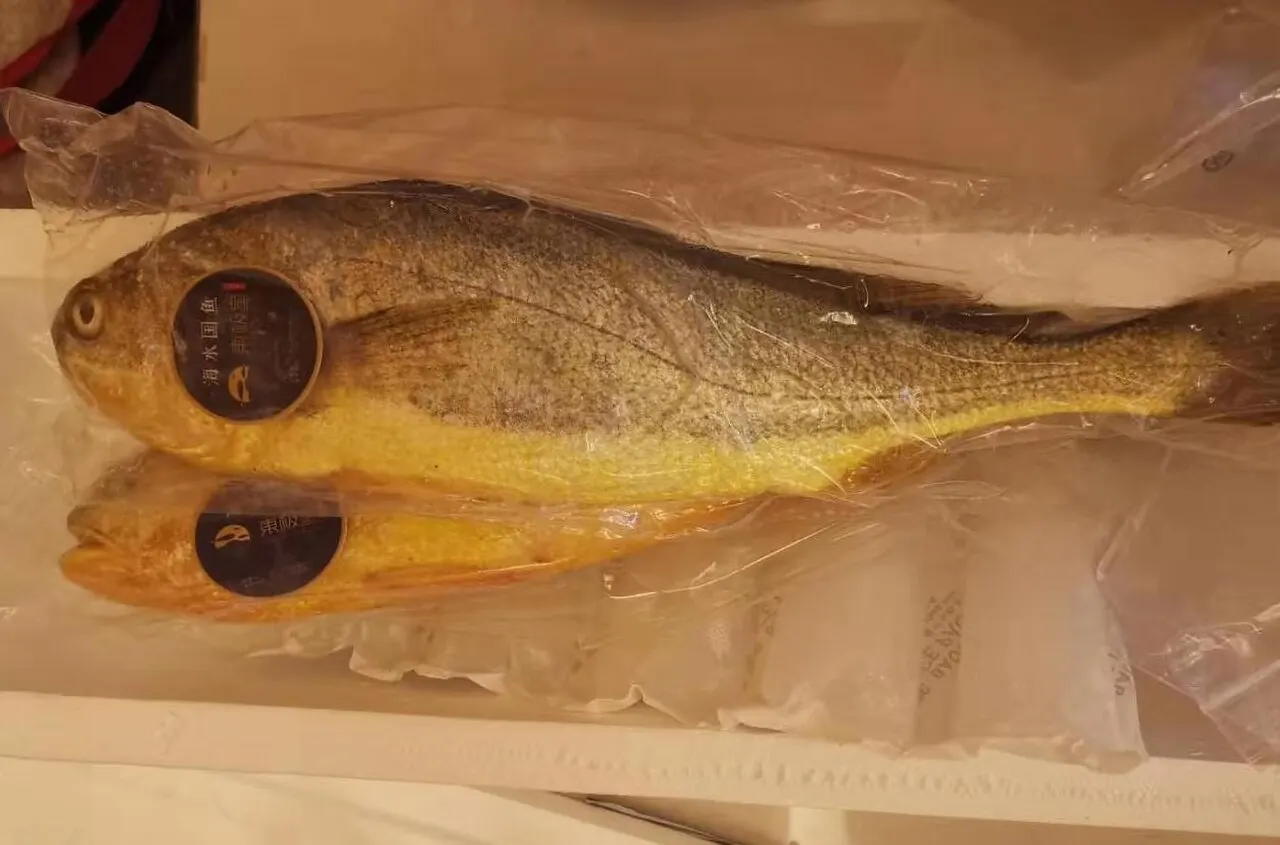
Fresh fish are gold, which explains the yellow in the name. It belongs to the croaker and drum family (Sciaenidae). The longest recorded fish reached 80 cm in total length.
The dorsal fin carries 9 or 10 spines followed by 30 to 35 soft rays, and the soft-rayed parts of the fins are mostly covered in scales. John Richardson described the species in 1846 from specimens collected at Canton.
Where it lives
Its range runs through the marginal seas of East Asia, from western Japan and Korea through the Yellow Sea and East China Sea to the Taiwan Strait and the northern South China Sea. The IUCN lists China, Hong Kong, Macao, Taiwan, Japan, South Korea and Viet Nam. It favours muddy or sandy seabed in coastal water, and it also enters brackish estuaries.
The IUCN gives a depth range of roughly 10 to 100 m and classes it as a full migrant.
Pins are Wikidata “endemic to” fields. Orange dots, when present, are GBIF occurrence tiles — survey bias included.
How it lives
In the East China Sea the yearly cycle is well mapped. Fish gather to spawn from April to June in shallow water, about 10 to 20 m deep, around the islands of the Zhoushan Archipelago. From August to October they spread out to feed. Between December and February they move offshore and winter in deeper water, reportedly 50 to 80 m down.
Young fish eat mainly copepods, amphipods and krill. Adults eat small fish and crustaceans. A 2024 modelling study in Frontiers in Marine Science suggested the spawning and wintering grounds may have shifted in recent decades, though those shifts are inferred from sea temperature and catch data rather than measured directly.
The IUCN uses a generation length of 15.5 years, so a stock takes a long time to rebuild once it is cut down.
Why it is in trouble
Fishing is the main cause. In the early years of the fishery the East China Sea supplied more than 98 percent of the national catch, and one population group made up over 80 percent of the total. The wild stock reportedly collapsed in the 1970s. The Red List assessment lists both large-scale and small-scale harvest as threats and records the population trend as decreasing.
Reported landings were 56,000 tonnes in 2008 and 91,000 tonnes in 2013, and Chinese fish farms produced about 105,000 tonnes by 2013. The landing figures are not split into wild and farmed fish, so they say little about the state of the wild stock.
A second threat is genetic. The assessment lists introduced genetic material, which in a fishery that releases hatchery-reared fish may point to released or escaped fish mixing with wild ones.
What is being done
Species recovery is the only conservation action the assessment lists. Hatchery fish are released as part of stock enhancement and marine ranching, and a 2024 Frontiers study cites national protection policies and some indications of resource recovery. It gives no release numbers, and how much the releases help wild fish is not measured there.
Sources
Written for this catalog in our own words from the sources below, checked against them on 12 November 2026. Population figures are estimates and carry the year they were made. Status and assessment year: IUCN. 2026. The IUCN Red List of Threatened Species. Version 2026-1. iucnredlist.org.




