Critically Endangered
Lanza's alpine salamander
Salamandra lanzai
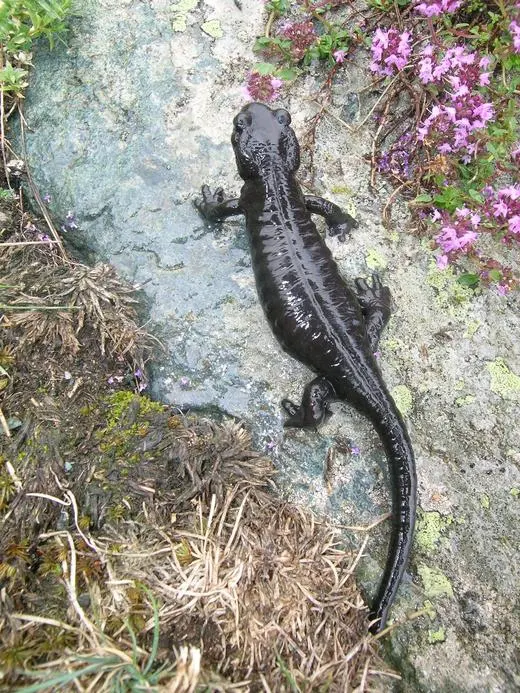
Lanza's alpine salamander (Salamandra lanzai) is a black salamander found only in a small part of the western Alps, in southeastern France and northwestern Italy. The IUCN raised it to Critically Endangered in 2022, as a precaution against a fungal disease that could spread into its range.
How to recognise it
It is a black salamander with a flat head, roughly 115 to 160 millimetres long. It was described as a species in 1988 by Nascetti, Andreone, Capula and Bullini, and its name honours the Italian herpetologist Benedetto Lanza.
When threatened it raises its body, lowers its head and can release a toxic liquid through small openings in its skin, which can irritate the eyes.
Where it lives
The core of its range is the Cottian Alps around Monviso, taking in the Guil Valley in France and valleys such as the Germanasca, Pellice and Po on the Italian side. Whether it occurs in the Chisone Valley is doubtful. The IUCN estimates its extent of occurrence at about 905 square kilometres, while a 2024 modelling study put it at 1,058.
It lives between about 1,200 and 2,600 metres, in temperate forest, mountain grassland and grazed pasture, often among rocks and scree near small streams. Because it gives birth on land, it doesn't need open water to breed.
Pins are Wikidata “endemic to” fields. Orange dots, when present, are GBIF occurrence tiles — survey bias included.
How it lives
It hunts insects, spiders and slugs, and it is mostly active at night, though heavy rain can bring it out by day. Mating takes place on land between May and October. Females give birth to fully formed young, usually 2 to 6 at a time, rather than laying eggs in water.
Radio-tracked adults stayed put. Their average home range over four weeks was only about 50 square metres, and capture and recapture records suggest yearly movements of under 400 metres, so the animals can't easily reach new ground. Birds and vipers are known predators. Generation length is put at 7 to 15 years.
Why it is in trouble
Within its small range the salamander is reported to be common, so the listing is precautionary. The main threat in the IUCN assessment lies in the future: the fungus Batrachochytrium salamandrivorans, or Bsal, which is lethal to many salamanders and has been recorded in Germany. A 2024 paper in the Herpetological Journal cites the 2022 assessment as putting the chance that Bsal drives the species extinct within 45 years at more than 50 percent. The IUCN also infers local declines from habitat change and road deaths in some areas, and rates the population trend as decreasing.
That paper, led by Davide Giuliano, modelled climate suitability and forecast a sharp loss of suitable area within 20 to 40 years, even under an optimistic emissions scenario. Under the worst warming scenario the species would theoretically be gone by 2100. The study points out that the IUCN assessment does not count climate change as a threat, and warned that range loss could worsen other threats such as lethal pathogens.
Tourism developments and roads are listed as ongoing pressures, and road kills are described as severe for some low-elevation Italian populations. A regional summary described the known populations as stable in 2006, with one valley population reduced in 2000 after unusually heavy rain.
What is being done
The salamander occurs in protected areas on both sides of the border and is covered by international legislation, including Annex IV of the EU Habitats Directive. Listed actions include site management, policy and regulation, and control of problem species. Population trend monitoring is the research priority the IUCN names.
The 2024 study urges managers to widen the protected area network, remove additional threats now, and improve habitat quality and connections between populations. It also suggests limiting night-time traffic on roads through suitable habitat and setting up grazing exclusion areas.
Sources
Written for this catalog in our own words from the sources below, checked against them on 12 November 2026. Population figures are estimates and carry the year they were made. Status and assessment year: IUCN. 2026. The IUCN Red List of Threatened Species. Version 2026-1. iucnredlist.org.




