Critically Endangered
Lankanectes pera
Lankanectes pera
Lankanectes pera is a stream-dwelling frog known only from the cloud forests of the Knuckles Mountains in Sri Lanka. Described as a new species in 2018, it was rated Critically Endangered by the IUCN in 2020, with a known range of roughly 89 square kilometres.
How to recognise it
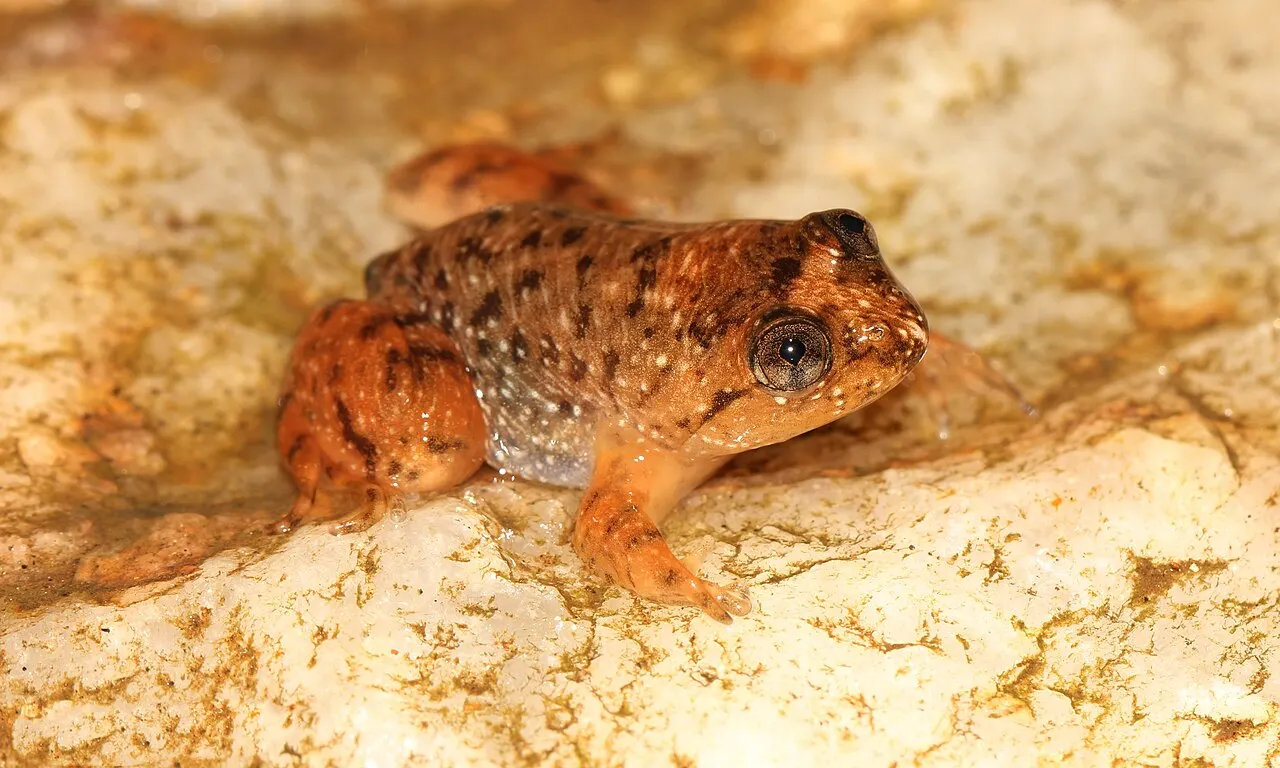
The back is dark chocolate brown with patches and small pale spots, and the skin is corrugated. The belly is greyish, and the throat carries white bumps. A knob sits on top of the head.
Males reach about 66 millimetres, and females about 51 to 56 millimetres. It has no visible eardrum, and its fingertips are rounded and slightly enlarged but have no sticky pads, and the fingers aren't webbed. It's larger than its only relative in the genus, Lankanectes corrugatus.
Where it lives
It's endemic to Sri Lanka and has been recorded mainly in the Knuckles range, with further records from Dothalugala, Bambrella and Riverstone. The IUCN gives an extent of occurrence of about 89 square kilometres, treats it as a single location, and lists an elevation band of 1,260 to 1,600 metres.
The frog lives in clear, shallow, slow streams with rocky beds inside canopy-covered montane forest. Its relative prefers muddy, marshy ground, so the two differ in habitat. The 2018 description paper modelled the climatically suitable area for L. pera at only 360 square kilometres, compared with 14,120 for L. corrugatus.
Pins are Wikidata “endemic to” fields. Orange dots, when present, are GBIF occurrence tiles — survey bias included.
How it lives
It's rarely found, usually as a few individuals at a time. Males sit under rocks or in crevices by the water and call mostly at night, sometimes by day, especially after light rain. The tadpoles are large and stay in deeper parts of the stream where rotting vegetation collects.
The species name honours the University of Peradeniya, whose alumni call the frog Pera.
Why it is in trouble
A tiny range means a single disaster can matter a great deal. The IUCN notes continuing decline in the area it occupies and lists a long set of pressures: small-holder farming, housing and tourism developments, recreation, pesticides and herbicides, acid rain, more frequent fire, and shifting habitat.
In the Knuckles Mountain Forest Reserve, reported threats include illegal cardamom cultivation, resort construction and uncontrolled tourism. Climate change has also brought less rainfall, longer dry spells, higher temperatures and more forest fires. The Knuckles range shelters eight other micro-endemic frog species, most of them threatened as well.
What is being done
The frog does occur in at least one protected area, and the IUCN lists site management and habitat protection as the actions needed. The team that described the species in 2018 said it needs immediate conservation attention because of its restricted range, specialised habitat and small population. Protecting the mountain's forests and streams is central to conserving it and the other frogs there.
Sources
Written for this catalog in our own words from the sources below, checked against them on 12 November 2026. Population figures are estimates and carry the year they were made. Status and assessment year: IUCN. 2026. The IUCN Red List of Threatened Species. Version 2026-1. iucnredlist.org.




