Critically Endangered
Lampsilis virescens
Lampsilis virescens
The Alabama lampmussel (Lampsilis virescens) is a freshwater mussel from the Tennessee River system in the southeastern United States. The IUCN Red List rated it Critically Endangered in 1996. It now survives only in a few small streams in Alabama and Tennessee, helped along by hatchery-raised juveniles.
How to recognise it
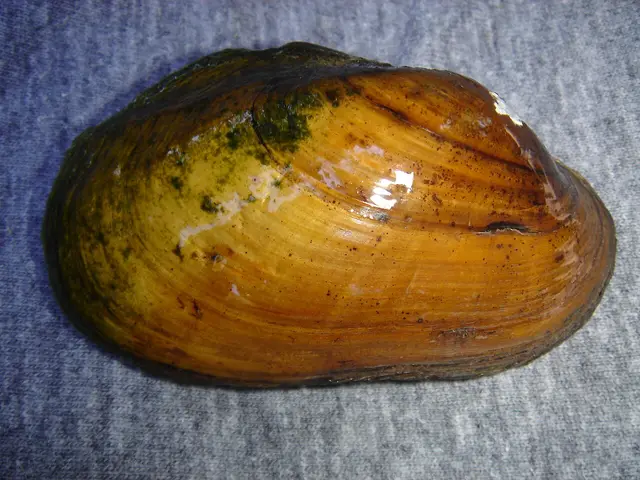
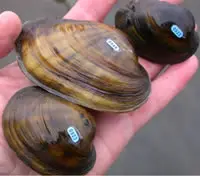
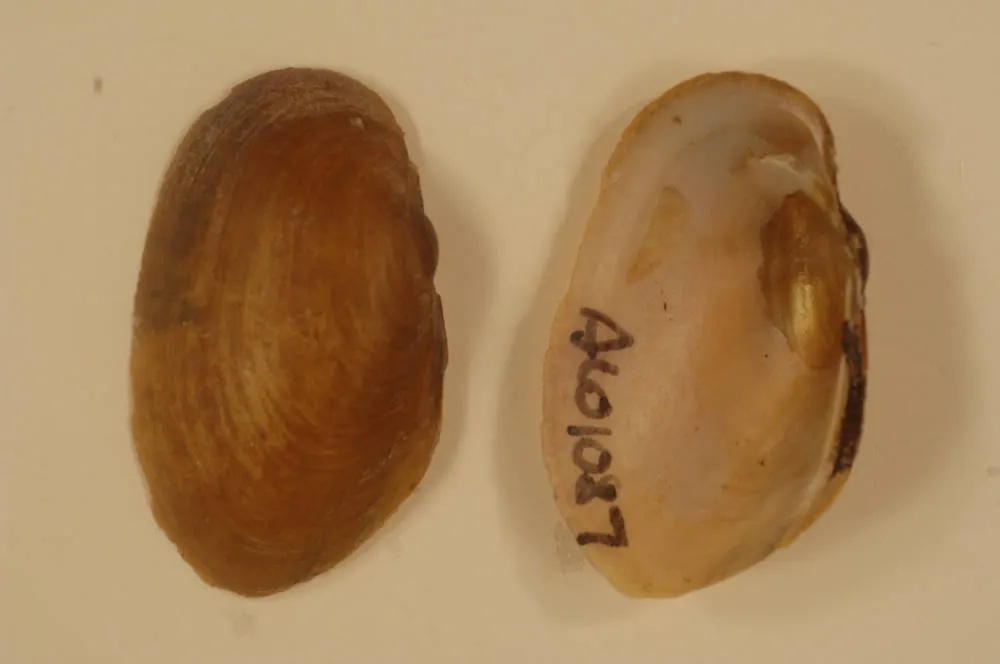
It is a medium-sized mussel, usually under about 75 mm (3 inches) long, with an elliptical shell that runs from tawny to greenish yellow. The surface is often shiny, sometimes with thin green rays, and the inside is bluish white. The sexes differ in shape. Males are more pointed at the rear, while females are rounder and more inflated.
Where it lives
The species is endemic to the Tennessee River drainage and was described by Lea in 1858 from specimens collected at Tuscumbia, Alabama. It once lived from small creeks to large rivers, including the shoals at Muscle Shoals before the river was dammed. Outdoor Alabama, run by the state's conservation agency, says it has been lost from more than 95 percent of that range.
Today the natural populations are the upper Paint Rock River system in Jackson County, Alabama (including Estill Fork and Hurricane Creek) and a stretch of the upper Emory River in Morgan County, Tennessee. It seems to cope now only in small to moderate streams, in slow to moderate current over sand and gravel.
Pins are Wikidata “endemic to” fields. Orange dots, when present, are GBIF occurrence tiles — survey bias included.
How it lives
Like other freshwater mussels it filters food from the water. It is a long-term brooder: females are gravid from late summer or autumn into the following summer. The larvae, called glochidia, must attach to a fish to develop. Captive work by Tennessee Aquarium and Alabama hatchery biologists has transformed them on several sunfish-family fish, including largemouth, smallmouth, spotted and redeye bass, rock bass and green sunfish.
Why it is in trouble
The Paint Rock River was straightened and cleared of snags in the 1960s, and its riffles and shoals have never recovered. A 1995 survey found 100 sources of habitat damage at 85 sites, most often missing streamside vegetation (47 percent), followed by cattle access (19 percent) and vehicle fords (14 percent). Illegal gravel removal, mining silt and farm runoff add to the load. In the Emory River, livestock access is now the visible problem.
Numbers are very low. A 2008 survey of 47 Paint Rock sites found the lampmussel at only three, where it made up 0.22 percent of the mussels counted. A 2002 survey of 52 sites found no live animals at all, and its author asked whether extinction was close. Because each population is small and confined to one stream, a single spill or similar event could wipe one out.
What is being done
The species was listed as endangered under the US Endangered Species Act on 14 June 1976. A 2018 federal review judged its status stable and recovery partly achieved, with no recovery criterion fully met yet.
Hatcheries have done the most. The Tennessee Aquarium released 1,654 cultured mussels into Estill Fork in 2004. The Alabama Aquatic Biodiversity Center has since released nearly 8,500 into the lower Paint Rock River between 2010 and 2014, over 11,000 in Bear Creek since 2011, and close to 13,000 in Tennessee's Elk River between 2010 and 2018. Follow-up checks have found only a few tagged survivors, such as two at the Elk River in 2013 and one at Bear Creek in 2016, so whether these groups are breeding on their own is still unknown. The 2011 rediscovery of the Emory River population, the first there since the late 1920s, was a rare piece of good news, though surveys in 2015 found none there and monitoring has not been repeated since.
Sources
Written for this catalog in our own words from the sources below, checked against them on 12 November 2026. Population figures are estimates and carry the year they were made. Status and assessment year: IUCN. 2026. The IUCN Red List of Threatened Species. Version 2026-1. iucnredlist.org.