Endangered
Lampedusa imitatrix
Lampedusa imitatrix
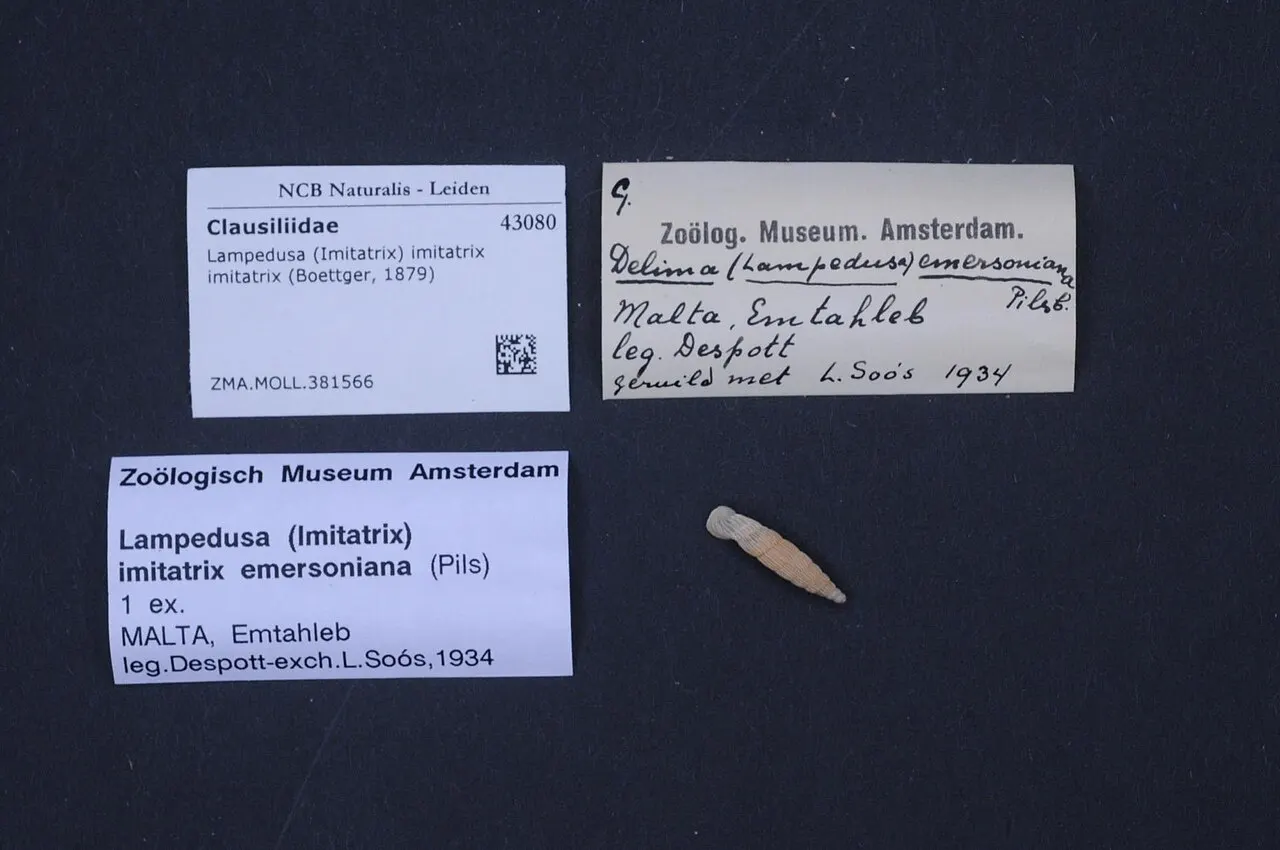
Lampedusa imitatrix, the Maltese door snail, is a tiny, slender, air-breathing land snail found only on the island of Malta and the islet of Filfla. The IUCN Red List rated it Endangered in 2017. It lives on a few rocky cliff areas that together cover about 20 sq km.
How to recognise it
It belongs to the door snails (Clausiliidae), which have a long, spindle-shaped shell and a small hinged plate, the clausilium, that closes the opening. This one is whitish cream, finely ribbed, with 8 to 10 whorls, and measures about 13 to 19 mm long by 3 to 4 mm wide.
It differs from the Maltese snail Muticaria macrostoma, whose shell is usually broken at the tip, and from its close relative Lampedusa melitensis, which has a shorter clausilium plate.
Where it lives
The species occurs in two isolated areas of western Malta and on Filfla, a rocky islet about 5.2 km south of the main island. The IUCN assessment lists two to nine locations, an area of occupancy of about 20 sq km, and elevations between 60 and 200 m. Its habitats are rocky ground and sea cliffs, including offshore rocky islands.
Land snails in Malta live only on lime-rich ground, because they need calcium to build their shells. This species does not migrate, and the IUCN gives its generation length as one year.
Pins are Wikidata “endemic to” fields. Orange dots, when present, are GBIF occurrence tiles — survey bias included.
Why it is in trouble
The assessment names small-holder farming as the threat and records a continuing decline in the area the snail occupies. It projects a future reduction of about 50 percent, based on loss of area and habitat quality. Its range is so small that a single event, natural or human, could hit a large share of the population.
A 1996 assessment under the older IUCN criteria rated it Vulnerable. It has been listed as Endangered since a 2012 assessment, confirmed in 2017.
What is being done
The two Maltese Lampedusa species are listed on Annexes II and IV of the EU Habitats Directive, added after Malta joined the EU in 2004. Annex II calls for special conservation areas and Annex IV for strict protection, and the rules are also part of Maltese law. The IUCN estimates that 71 to 80 percent of the population lives inside protected areas. Listed actions include awareness work, site protection, habitat protection and habitat restoration. No systematic monitoring scheme was in place at the time of the assessment.
Is the Filfla snail a different species?
The Filfla snails were described under their own name, Lampedusa gattoi, after Count Alfredo Caruana Gatto, who discovered them. A 2017 genetic study names them as the subspecies L. imitatrix gattoi, and one reference article says the Filfla population might be a subspecies or a species in its own right. That study did not sample the Filfla form, so its status is still open.
The same study found that L. imitatrix and L. melitensis differ by an average of 0.12 in a mitochondrial gene (HKY distance), and confirmed them as distinct species. In a small area of a few tens of square metres on Malta, Lampedusa snails have hybridised with Muticaria.
Sources
Written for this catalog in our own words from the sources below, checked against them on 12 November 2026. Population figures are estimates and carry the year they were made. Status and assessment year: IUCN. 2026. The IUCN Red List of Threatened Species. Version 2026-1. iucnredlist.org.




