Endangered
Lampadia webbiana
Lampadia webbiana
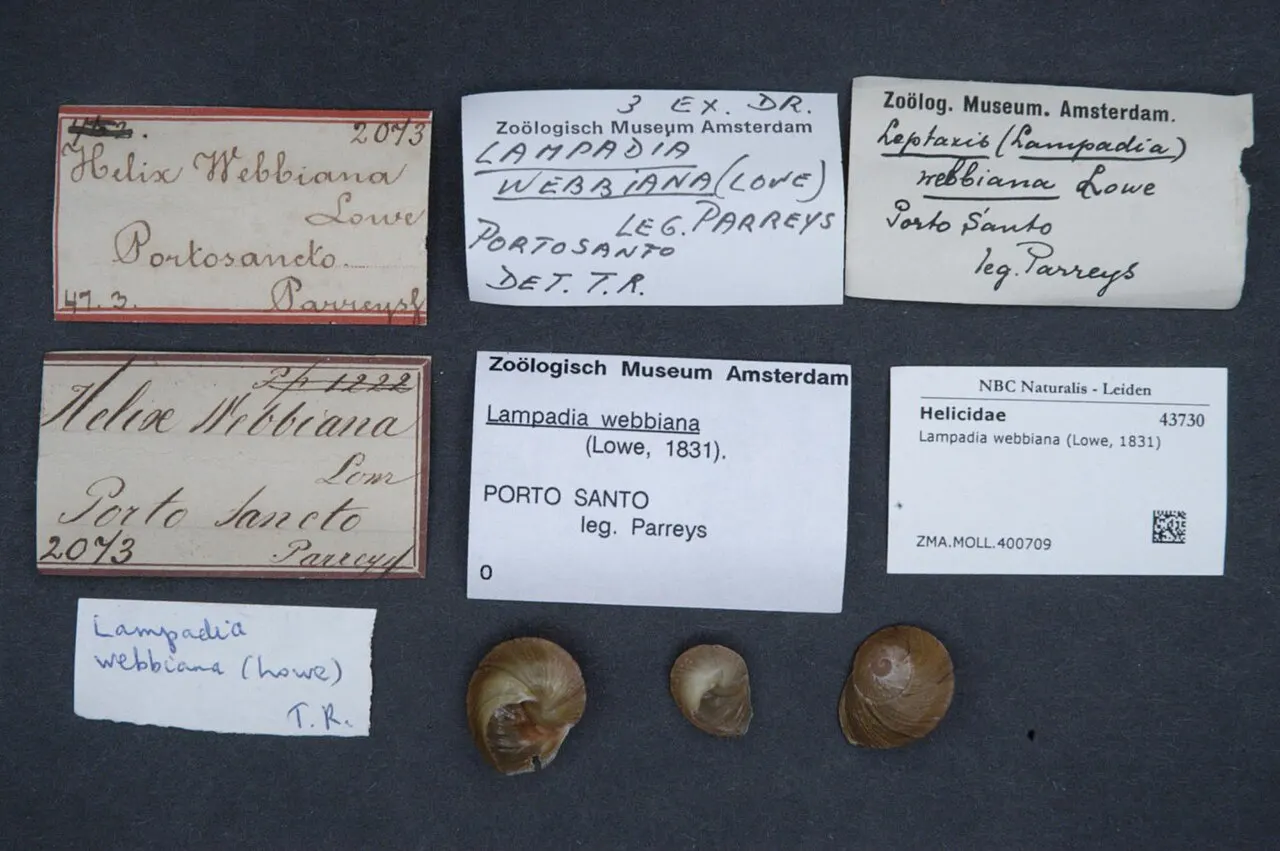
Lampadia webbiana is a land snail found only on the Madeira archipelago of Portugal, where it survives on the eastern side of Porto Santo island. The IUCN Red List classes it as Endangered (assessed in 2024, published 2025) because its range is tiny and still shrinking.
What it is
This is a true snail in the family Helicidae, the same family as the familiar garden snails. Richard Thomas Lowe described it in 1831 as Helix webbiana, and the name honours the botanist Philip Barker-Webb.
Where it lives
It is endemic to Madeira, a Portuguese island group in the Atlantic. Within it, the snail is known only from Porto Santo and the small islet of Ilhéu de Cima nearby. The islet population hasn't been refound and may be extinct there.
On Porto Santo itself it has been reported from three hills on the east side of the island. The latest Red List assessment counts five locations, at roughly 50 to 360 m above sea level, with an occupied area estimated at just 16 square kilometres. Its habitat is temperate grassland and rocky ground, and it shelters under rocks in grassy areas.
The high ground in the east of Porto Santo is open country, and the island's open-habitat snails there include this species. Porto Santo as a whole holds about 116 land snail species, 97 of them found nowhere else.
Pins are Wikidata “endemic to” fields. Orange dots, when present, are GBIF occurrence tiles — survey bias included.
Why it is in trouble
The 2025 assessment lists introduced rodents as the main pressure, with introduced rabbits also named. Growth in tourism and recreation areas threatens its grassland habitat, and landslides are listed as a further risk. The Red List records a continuing decline in the snail's occupied area.
What is being done
Between 2010 and 2015 an EU-funded LIFE project removed rabbits and mice and other introduced rodents from some of Porto Santo's offshore islets, and increased vegetation cover there. Its target snails were four other species, not this one. The project reported that the targeted snails increased in number and range.
For Lampadia webbiana, the assessment records a monitoring scheme, and between 21 and 30 percent of its population lies inside protected areas. Invasive species control is listed as a conservation action, but no species-specific recovery plan is mentioned.
Sources
Written for this catalog in our own words from the sources below, checked against them on 12 November 2026. Population figures are estimates and carry the year they were made. Status and assessment year: IUCN. 2026. The IUCN Red List of Threatened Species. Version 2026-1. iucnredlist.org.




