Endangered
Mauritius cuckooshrike
Lalage typica
The Mauritius cuckooshrike (Lalage typica) is a secretive canopy bird found only on the island of Mauritius, mostly in the wet southwest uplands. The IUCN Red List assessed it as Endangered in 2025, with at most about 420 mature individuals, and a small continuing decline is inferred.
How to recognise it
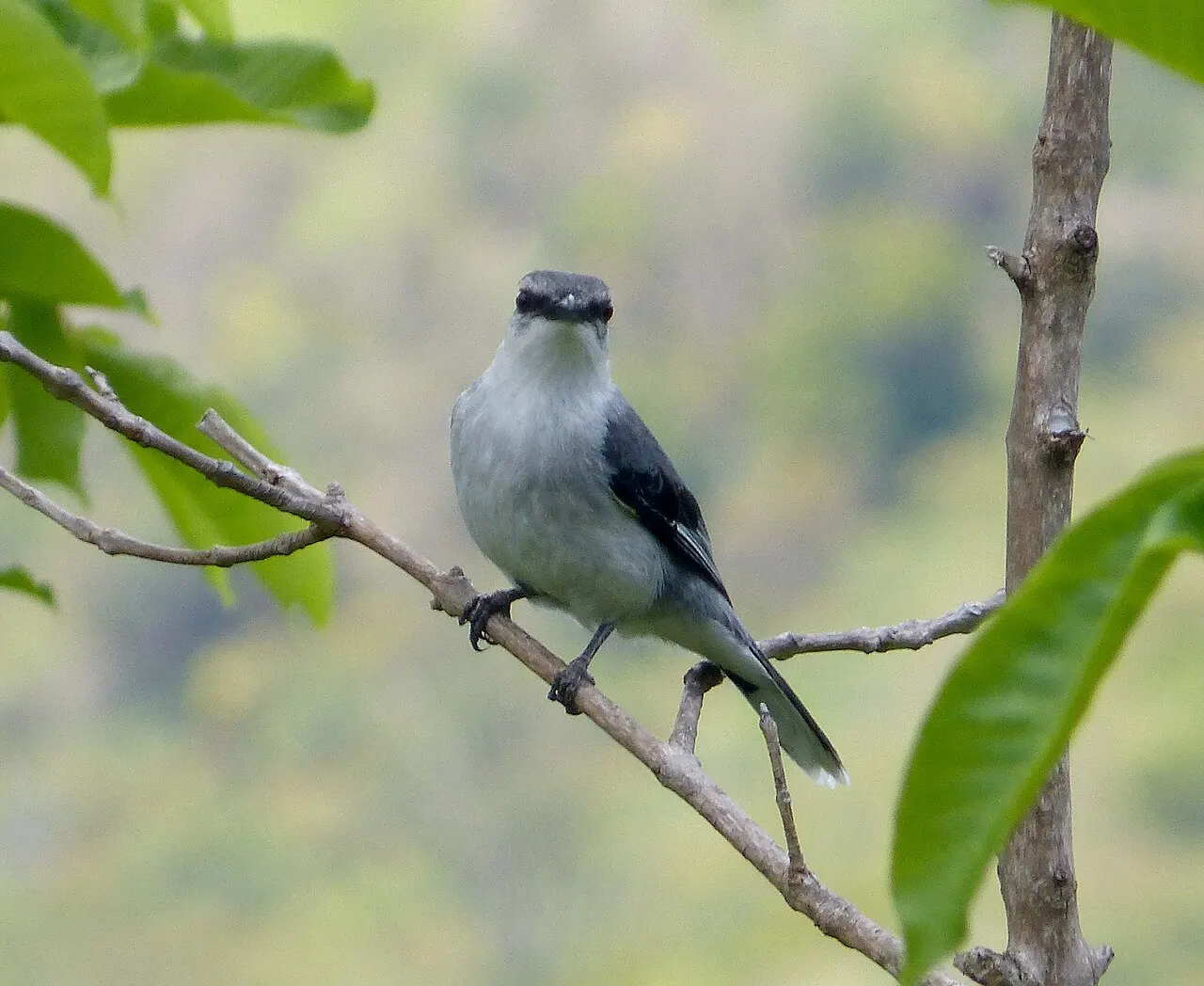
It is a small songbird, up to about 22 cm long, and the sexes look very different. Males are grey above and white below. Females are brownish above with rich reddish-brown underparts. The bird is unobtrusive and keeps to the forest canopy, so it is easily missed.
Birders usually find it by voice. Its song is a melodic trill of short whistles ending in sharper, faster notes, and it also gives a harsher call. When scolding, it gives a short note followed by an aggressive squeak.
Where it lives
It occurs nowhere else but Mauritius. The densest population is in the Brise Fer and Macchabee area of the southwest. Other birds live around Black River Peak and the Bel Ombre gorges, and in the adjacent Chamarel and Case Noyale areas, on both protected and privately owned land. Black River Gorges National Park holds most of the range. Birds along the southern slope towards Combo are reported at very low densities at most.
The IUCN gives an elevation range of 250 to 820 m, though another account puts the native forest it prefers above 460 m. It uses moist lowland and upland forest, plus shrubby and degraded former forest nearby. It tolerates some non-native plants in the forest, but density falls as their share rises, and it is absent from forest made up only of non-native plants.
Pins are Wikidata “endemic to” fields. Orange dots, when present, are GBIF occurrence tiles — survey bias included.
How it lives
Adults are not migrants and are thought to hold territories all year, usually in pairs. They hunt large tree-dwelling arthropods and geckos. Breeding runs from about September to late February, with two or three eggs in a nest.
Why it is in trouble
Invasive non-native plants keep spreading through the forest despite control work, and habitat on the edges of its range is being lost to development, deer ranching and construction. The IUCN also lists storms and, in the past, herbicides and pesticides. Organochlorine pesticides used in the 1950s and 1960s are blamed for earlier losses. Introduced predators eat eggs and young, and the common myna may compete for food.
Counts have been revised. Surveys in 2011 to 2014 probably underestimated the population because the bird is hard to detect. Later territory mapping put the maximum at 210 pairs (420 mature individuals), extrapolated from about 70 pairs (140 individuals) in the Brise Fer and Macchabee core, roughly a third of the total. A BirdLife proposal in 2024 inferred a small continuing decline, and the species was assessed as Endangered in 2025.
What is being done
Managers have carried out large-scale control of invasive plants at Brise Fer, and run intensive rat control over 10 hectares there, overlapping one of the densest areas, to improve breeding success. The IUCN lists habitat restoration, benign introduction and captive breeding among its conservation actions. A reintroduction in the Ferney Valley stopped in 2019 with no birds recorded there in the following three years. A further attempt is planned but is not a priority. The bird is also absent from the Bambou Mountains in the east.
Sources
Written for this catalog in our own words from the sources below, checked against them on 12 November 2026. Population figures are estimates and carry the year they were made. Status and assessment year: IUCN. 2026. The IUCN Red List of Threatened Species. Version 2026-1. iucnredlist.org.




