Endangered
Eleutherocaulis haroldi
Laevicaulis haroldi
Laevicaulis haroldi, the caterpillar slug or Purcell's hunter slug (some authorities place it in Eleutherocaulis), is a leatherleaf slug native to KwaZulu-Natal in South Africa. The IUCN Red List rated it Endangered in 2013. Oddly, it is also a spreading agricultural pest in India, far from home.
How to recognise it
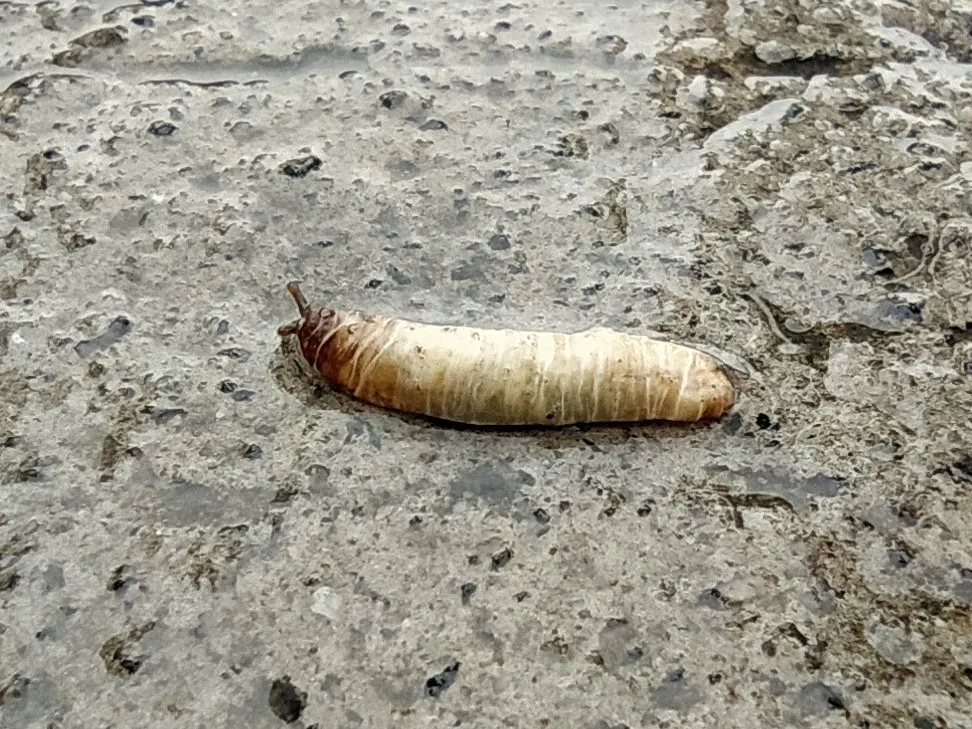
It's a shell-less, land-living slug in the family Veronicellidae, the leatherleaf slugs. Indian observers describe a wheat-brown or creamy-yellowish back crossed by irregular white bands, which gives a wrinkled look, with black or blackish-brown patches at both ends. The foot is narrow, and there are two pairs of tentacles at the front, the upper pair brown and tipped with eyes.
A single specimen found in a Delhi-region garden in 2018 was 48 mm long and 10 mm wide. The wrinkles smooth out when the slug is fully hydrated. Its pattern can recall the common slug Laevicaulis alte, though the two differ in detail.
Where it lives
The home range is KwaZulu-Natal, in south-eastern South Africa. Harold Dundee collected the first specimens in 1977 in a marshy lot in Durban, and D. S. Dundee described the species in 1980. The IUCN assessment lists KwaZulu-Natal as its only native location.
Outside Africa the slug has spread widely. It was first recognised in India in Maharashtra, and records now come from Rajasthan, Gujarat, Delhi, Kolkata and the Sundarbans region of West Bengal, where it was seen in December 2023. It is said to favour marshy ground and areas around watersheds, especially farmland and gardens.
Pins are Wikidata “endemic to” fields. Orange dots, when present, are GBIF occurrence tiles — survey bias included.
How it lives
Leatherleaf slugs are plant eaters. This one has been seen feeding on the leaves of shrubs on Gangasagar Island in the Sundarbans, and it reportedly damaged mulberry in Maharashtra. Little else is recorded about its biology in its native range.
Why it is in trouble
In South Africa, habitat loss is reportedly the main concern. The 2013 assessment gives a population trend of unknown, and no population estimate exists.
Outside Africa its fortunes look very different. Researchers describe it as a serious crop and garden pest in India that is still spreading into interior regions, possibly carried with plants imported from other countries. That doesn't make the native population any safer.
What is being done
The IUCN assessment lists no conservation actions. The Endangered listing rests on the South African population, and the Indian records are treated as an invasion.
Sources
Written for this catalog in our own words from the sources below, checked against them on 12 November 2026. Population figures are estimates and carry the year they were made. Status and assessment year: IUCN. 2026. The IUCN Red List of Threatened Species. Version 2026-1. iucnredlist.org.
- IUCN Red List assessment, Laevicaulis haroldi (2013)
- Zoo's Print 34(7), Alien in my garden: a new record of an exotic Laevicaulis slug in northern India (2019)
- Zoo's Print 40(2), Additional sighting of the invasive Purcell's Hunter Slug from Gangasagar, West Bengal (2025)
- Eleutherocaulis haroldi, Wikipedia




