Critically Endangered
Konye
Konia eisentrauti
The konye (Konia eisentrauti) is a small cichlid fish found only in Lake Barombi Mbo, a crater lake in western Cameroon. It grows to about 9 cm and incubates its eggs in its mouth. The IUCN Red List assessed it as Critically Endangered in 2010, because it lives in a single lake.
How to recognise it
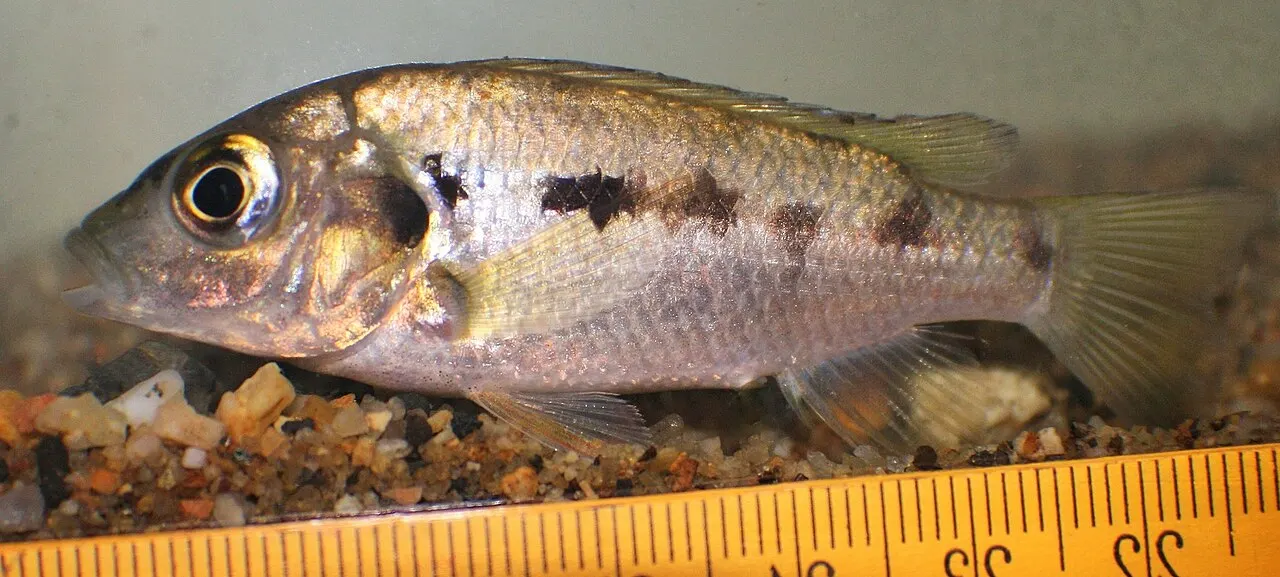
The konye is a slim, side-flattened fish with a horizontal mouth and a sloping forehead. It is pale, with dark blotches along the back and each flank, and its fins are colourless. The head is mostly bare of scales, the cheeks have a few scales, and the body is fully scaled.
The largest recorded length is 9.3 cm. Konia dikume, the only other species in its genus, lives in the same lake. Trewavas described the konye in 1962 as Tilapia eisentrauti, and the name honours the German zoologist Martin Eisentraut, who led the expedition that collected the type specimen.
Where it lives
Barombi Mbo lies near Kumba in Cameroon's Southwest Region. It is a volcanic crater lake roughly 2 km across, up to 111 m deep, at about 300 m above sea level. Fifteen fish species have been recorded there, 11 of them cichlids found nowhere else.
The konye stays in the warm upper water, around 26 degrees C, and lives near the bottom and in open water. The lake was named a Ramsar wetland in 2006, and commercial fishing there is banned. The Red List gives the fish's extent and area of occupancy as 7 square kilometres.
Pins are Wikidata “endemic to” fields. Orange dots, when present, are GBIF occurrence tiles — survey bias included.
How it lives
It eats plant matter and algae. It also takes mayflies, other small invertebrates and fish eggs, and reportedly steals food gathered by the lake's freshwater crabs.
The konye is a mouthbrooder, and either parent may carry the fertilised eggs. Incubation takes 7 to 10 days, and the young usually leave after about three weeks. A brooding fish tends to stay quietly near the lakebed. Females tend to raise more young than males do.
Why it is in trouble
The Red List names soil erosion and sedimentation, tourism and recreation development, and volcanic activity among the threats. Clearing of forest and farming around the lake, including slash-and-burn plots and oil palm, send silt and pollution into the water.
There is also concern that more wind exposure after forest loss could make the lake turn over, bringing oxygen-poor deep water to the surface. An episode of this sort is thought to have occurred in 2007, when many deep-water fish were found floating. Carbon dioxide from the lake floor has been suggested as a risk, though studies found no excess gas. The Red List records no conservation actions in place and the population trend as unknown.
Sources
Written for this catalog in our own words from the sources below, checked against them on 12 November 2026. Population figures are estimates and carry the year they were made. Status and assessment year: IUCN. 2026. The IUCN Red List of Threatened Species. Version 2026-1. iucnredlist.org.




