Critically Endangered
Kinglet Calyptura
Calyptura cristata
The kinglet calyptura (Calyptura cristata) is a tiny olive and yellow bird of the Atlantic Forest in southeastern Brazil, best known for going unrecorded for about a century. The IUCN's 2025 assessment lists it as Critically Endangered, with a population put at 1 to 49 birds and a trend recorded as unknown.
How to recognise it
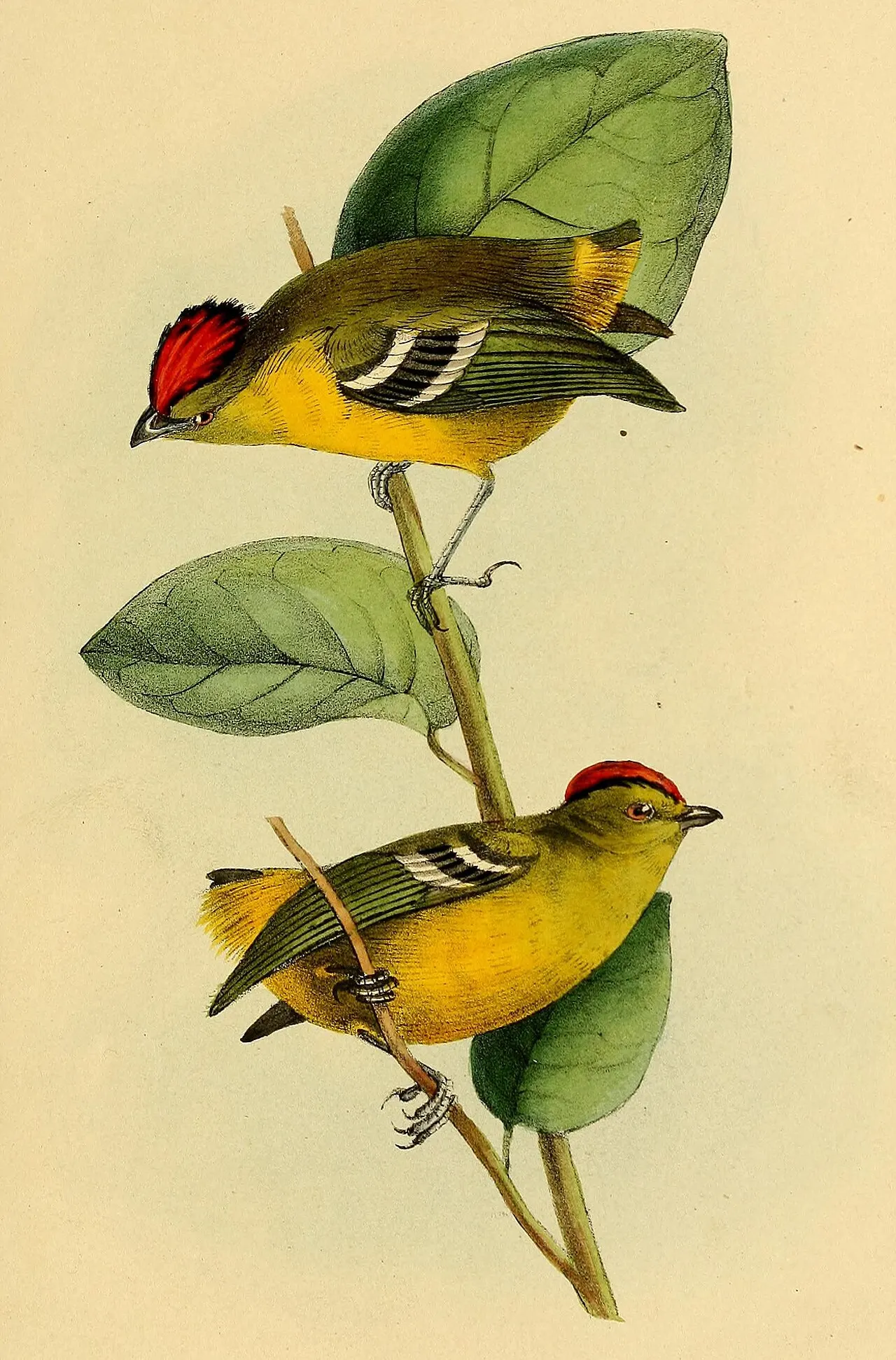
It's a very small bird, 7.5 to 8 cm long. The male has a large orange-red patch on the crown, bordered in black, set against a bright olive head. The female's patch is smaller. The upperparts are olive with a yellow rump, the dusky wings show two strong white bars, the underparts are mostly yellow with an olive wash on the breast, and the tail is very short.
The bird was long filed with the cotingas. A 2012 study reportedly placed it among the tyrant flycatchers, and a 2023 specimen inventory in Papéis Avulsos de Zoologia classes it in the family Platyrinchidae. Other authorities have listed its family as uncertain.
Where it lives
Louis Pierre Vieillot described the species in 1818 from a specimen collected near Rio de Janeiro. The 2023 inventory counts 104 specimens in 47 museums, most of them in European collections and collected in the 19th century.
In the 19th century the bird was thought to be fairly common in humid forest up to about 900 m. The IUCN lists it only from Brazil, as a resident of lowland moist forest from sea level to 900 m, and not a migrant. Some authors have suggested it may move up and down slopes with the seasons, but that is a suggestion, not an observation.
Pins are Wikidata “endemic to” fields. Orange dots, when present, are GBIF occurrence tiles — survey bias included.
How it lives
Very little has been seen of its daily life. Birds are usually found in pairs, climbing in all directions along lianas and taking insects or small berries depending on the season. They favour the fruit of two shrubs known in Brazil as marianeira, and have been watched probing bromeliad rosettes where dew collects.
Nothing is known about its breeding. Its call is described as brief, hoarse and loud for such a small bird, but as of early 2025 neither xeno-canto nor the Macaulay Library held a recording.
Why it is in trouble
For roughly a century after the 1800s collecting, the bird was not definitely seen, and it was feared extinct. In late October 1996 two birds were seen on several days in the Serra dos Órgãos, near Teresópolis in Rio de Janeiro state, and several observers saw them.
No reliable record has followed. Searches in Rio de Janeiro state in 2006 and in October 2016 turned up nothing, and a handful of claimed sightings by single observers around Ubatuba in São Paulo state (1990, 1997, 2006 and 2008) were not documented. Some authors now suspect the species may already be extinct, and BirdLife assumes a tiny population of fewer than 50 birds.
Forest clearance is the core problem, driven historically by gold and diamond mining and by coffee plantations. The IUCN lists mining and quarrying, habitat shifting and alteration, and unintended effects of other activities. Building around the edges of Serra dos Órgãos National Park, including near the rediscovery site, is a concern, as is the collecting of bromeliads, mistletoes and orchids, which may reduce food and change the forest's structure.
What is being done
The IUCN records an action recovery plan and conservation sites identified across the bird's range, and lists site and area protection as an action needed. It records no systematic monitoring scheme, no captive population and no education programme, and it isn't known whether the bird occurs in a protected area.
Sources
Written for this catalog in our own words from the sources below, checked against them on 12 November 2026. Population figures are estimates and carry the year they were made. Status and assessment year: IUCN. 2026. The IUCN Red List of Threatened Species. Version 2026-1. iucnredlist.org.




