Critically Endangered
Kaplan's Thestor
Thestor kaplani
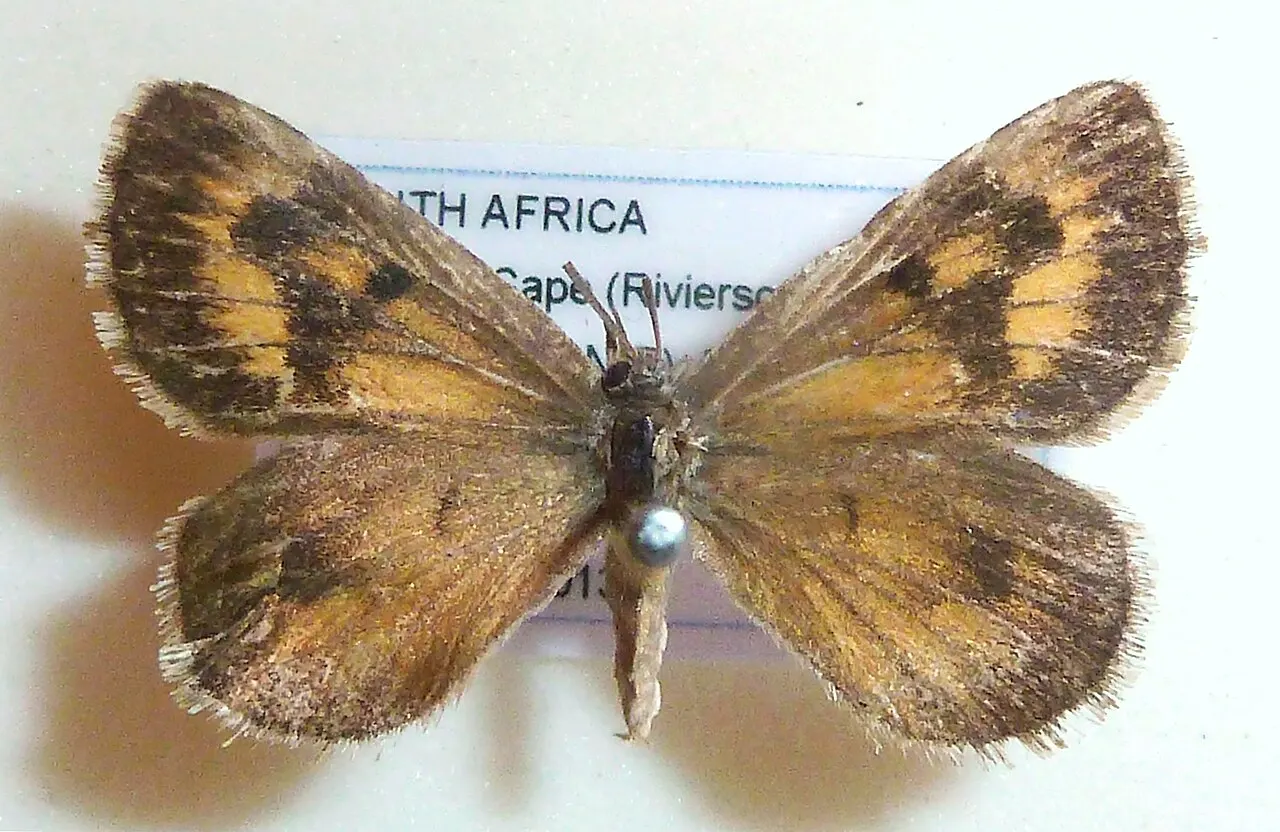
Kaplan's thestor (Thestor kaplani), also called Kaplan's skolly, is a small butterfly of the family Lycaenidae found only in South Africa. It lives on fynbos slopes above Greyton in the Western Cape. The IUCN Red List assessed it as Critically Endangered in 2020, on the strength of a range of about 16 square kilometres.
How to recognise it
This is a small gossamer-winged butterfly. Males have a wingspan of 26 to 28 mm and females 27 to 29 mm, so the two sexes are close in size.
It belongs to Thestor, a genus of 27 species credited to Jacob Hübner (dated 1819). Several members carry the common name skolly. Kaplan's thestor was described much later, in 1971, by Dickson and Stephen.
Where it lives
The species is endemic to South Africa. It is known from fynbos, the shrubby Mediterranean-type vegetation of the Cape, on the slopes of the Riviersonderend Mountains above the town of Greyton. The IUCN assessment also lists rocky areas such as cliffs and peaks as suitable habitat.
The assessed range is very small. The IUCN puts both the extent of occurrence and the area of occupancy at 16 square kilometres, and treats the butterfly as a single subpopulation at a single location. Only 32 occurrence records for it appear in the Global Biodiversity Information Facility.
Pins are Wikidata “endemic to” fields. Orange dots, when present, are GBIF occurrence tiles — survey bias included.
How it lives
Adults fly from December to January, and there is one generation a year. The IUCN gives a generation length of one year.
Little else about its biology is on record.
Why it is in trouble
A butterfly confined to 16 square kilometres has little margin for error. The IUCN records a continuing decline in the area its habitat covers and rates the population trend as unknown.
Listed threats are all scored as low impact but ongoing. They include recreational activities on the mountain and invasive alien plants, named in the assessment as pines and hakea. The assessment's stress categories point to ecosystem degradation and disturbance of the animal itself.
The assessment lists no species-specific conservation actions in place.
Sources
Written for this catalog in our own words from the sources below, checked against them on 12 November 2026. Population figures are estimates and carry the year they were made. Status and assessment year: IUCN. 2026. The IUCN Red List of Threatened Species. Version 2026-1. iucnredlist.org.




