Endangered
Juliana's golden mole
Neamblysomus julianae
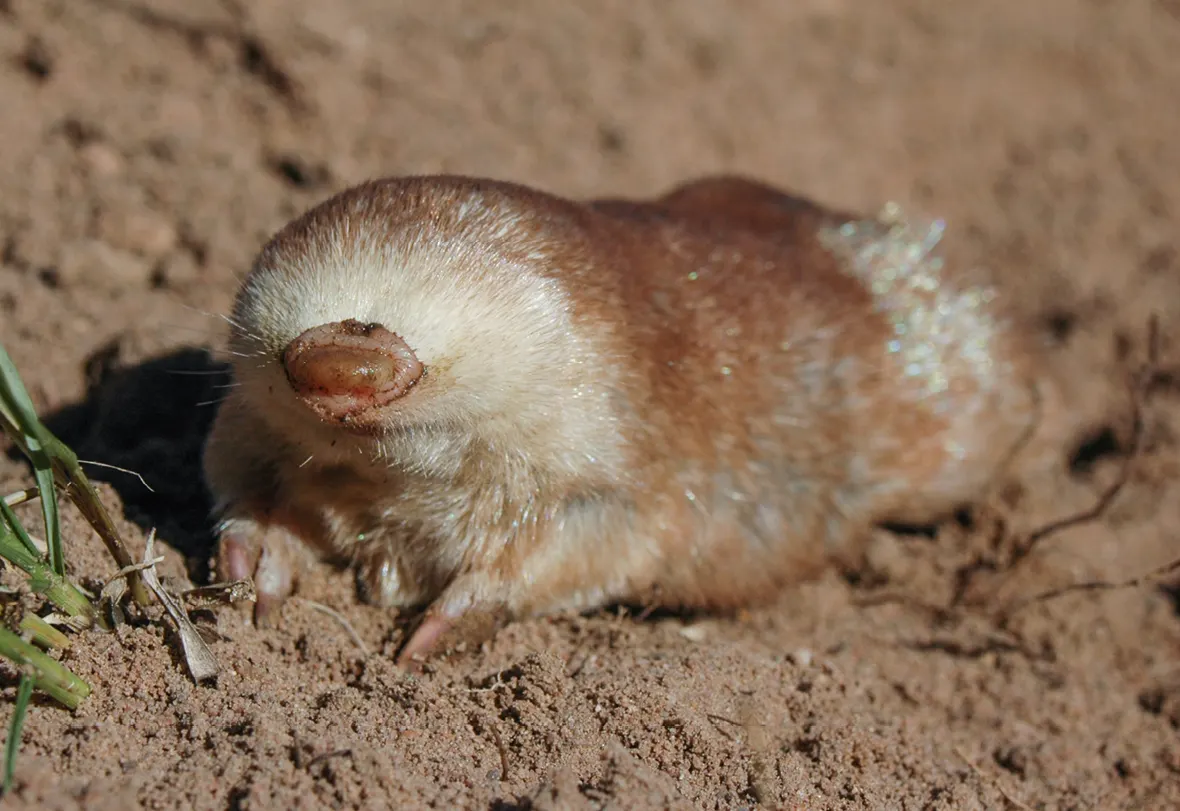
Juliana's golden mole (Neamblysomus julianae) is a small, eyeless, burrowing mammal found only in South Africa, in scattered patches in Gauteng, Limpopo and Mpumalanga. The IUCN Red List assessed it as Endangered in 2015. Its habitat is split into small, isolated fragments, and one local group is rated Critically Endangered.
How to recognise it
It has a dense, shiny golden coat and a streamlined body weighing 21 to 75 g. The eyes are covered by furred skin and no ears are visible. A strong nose and big front claws do the digging, and the feet are webbed.
Meester described the species in 1972. It is named after Juliana Meester, wife of the zoologist who named it. It was first placed in Amblysomus before being moved to Neamblysomus, a genus that also holds Gunning's golden mole.
Where it lives
Known populations are widely separated, sometimes by hundreds of kilometres. They sit near Pretoria in Gauteng, near Nylstroom in Limpopo, and in Kruger National Park in Mpumalanga. The IUCN counts about 10 locations in three subpopulations, with an area of occupancy of roughly 160 square kilometres inside an extent of about 44,000, and calls the range severely fragmented.
It favours hard, free-draining sandy or gritty soil, with good tree cover, on weathered quartzite or granite ridges. The IUCN lists dry savanna and dry grassland as suitable habitat, along with farmland, pasture and rural gardens. Plantations and urban areas rate only as marginal.
Pins are Wikidata “endemic to” fields. Orange dots, when present, are GBIF occurrence tiles — survey bias included.
How it lives
It lives alone, mostly underground, just below the surface. It forages late in the afternoon and at night for insects, earthworms and snails, and drops into a daily torpor through the morning and early afternoon. Tunnels are hard to spot except for the openings pushed up in the summer rains. Females usually have two young, sometimes one, in a grass-lined chamber below ground.
Why it is in trouble
The IUCN lists commercial and industrial development, mining and quarrying, housing, roads and railways, and several kinds of farming and grazing, all ongoing. Urban growth and mining threaten the Bronberg Ridge area east of Pretoria, where the local population is rated Critically Endangered, and conversion to farmland has altered habitat. Fragmentation stops animals moving between patches, which can lead to inbreeding.
What is being done
The IUCN records a monitoring scheme, some public awareness work, and at least one protected area within the range, though no formal recovery plan. Reportedly two of the three known populations lie on protected land. Research has been limited, and the population trend is recorded as unknown.
Sources
Written for this catalog in our own words from the sources below, checked against them on 12 November 2026. Population figures are estimates and carry the year they were made. Status and assessment year: IUCN. 2026. The IUCN Red List of Threatened Species. Version 2026-1. iucnredlist.org.




