Endangered
Juan Fernández Tit-Tyrant
Anairetes fernandezianus
The Juan Fernandez tit-tyrant is a small crested flycatcher found only on Robinson Crusoe Island, about 670 km off the coast of central Chile. The IUCN listed it as Endangered in 2023, up from Near Threatened, because its numbers are small and falling.
How to recognise it
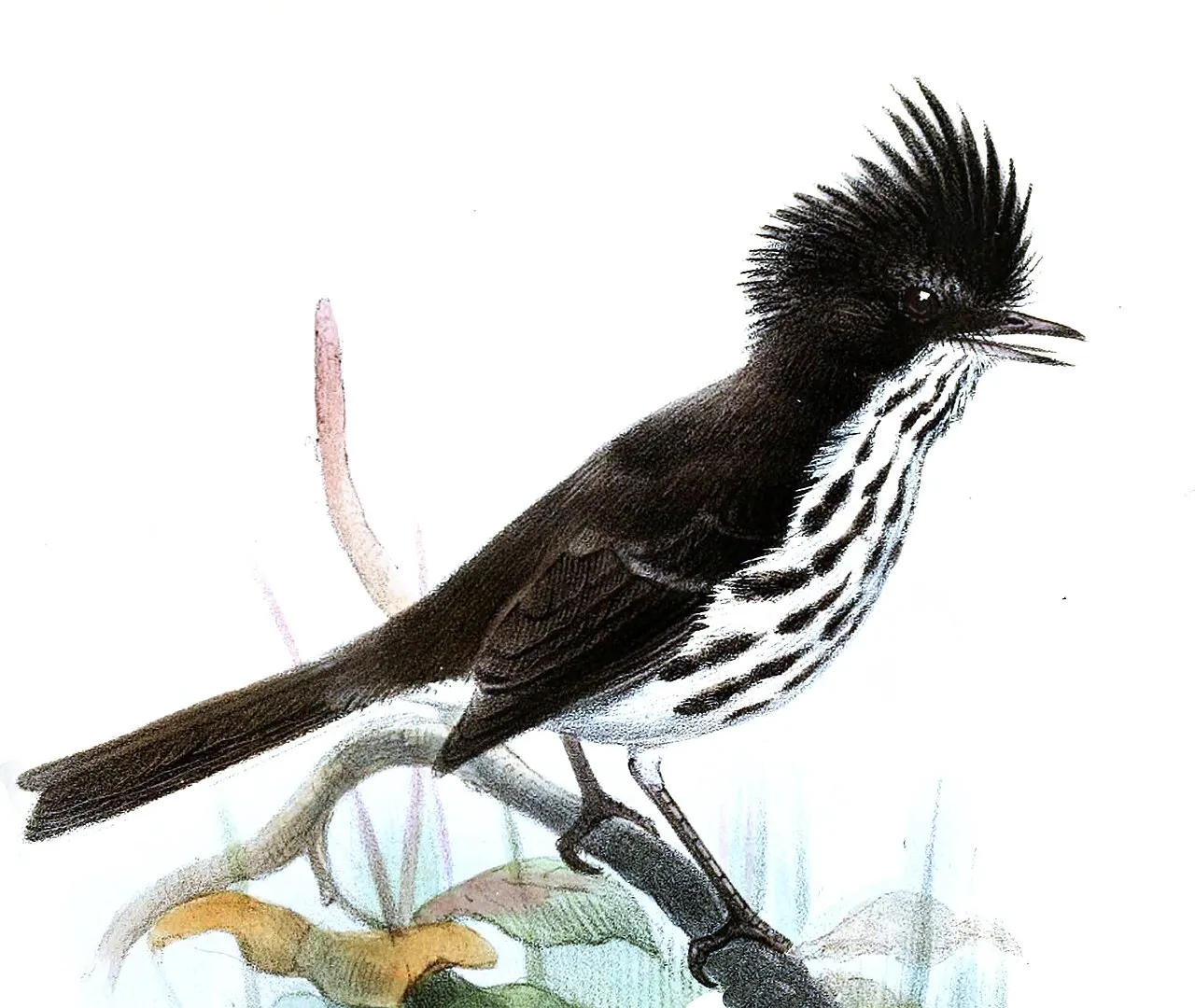
It's a small bird, around 12.5 cm long. Adults have a black crest of elongated feathers on a blackish crown, a thin white eyebrow stripe, and a white face streaked with black. The back is dusky grey, and the wings are blackish with two white bars. The underparts are white with bold black streaks on the throat, breast and flanks, and the eyes are pale yellow.
Males and females look alike, though females are a little smaller and have a shorter crest.
Where it lives
The whole species lives on one island, Robinson Crusoe, in the Juan Fernandez archipelago in the South Pacific. It uses woodland, scrub, regrowth and gardens, from sea level up to about 900 m.
Birds are most often found in native forest. A radio-tracking and mist-netting study published in 2013 followed a single male whose home range stayed entirely inside core native forest. In the netting data, birds were more numerous at damp sites dominated by the giant-leaved plant Gunnera peltata and near stands of introduced shrubs, and scarcer close to human-made clearings.
Pins are Wikidata “endemic to” fields. Orange dots, when present, are GBIF occurrence tiles — survey bias included.
How it lives
It stays on the island all year. It forages in pairs or family groups, picking insects and other small prey from foliage while perched, hovering briefly, or snatching food in the air. Its diet has never been studied in detail, but it is thought to be mostly insects.
Breeding is reported to run from about August to December, though one source puts it at October to December. Nests are thought to sit in dense canopy or the middle layer of trees. Little else is known.
Why it is in trouble
The Red List gives a best estimate of 520 mature birds, within a range of 250 to 1,550. That figure is modelled, not counted. The population is shrinking, and the assessment infers a fall of about 39 percent over the past ten years and a further 30 to 39 percent over the next ten, projecting forward from earlier survey trends.
Several introduced species are involved. The assessment names cats, rats and the red-backed hawk, a bird of prey brought in from Alejandro Selkirk, another island in the archipelago. Invasive plants such as blackberry and maqui have spread through much of the island's native forest, and goats and cattle have grazed it. Forest conversion has slowed since about 2000, but it hasn't stopped.
What is being done
Between 91 and 100 percent of the population lives inside protected areas, and an area-based management plan and invasive species control are in place. A habitat restoration programme run by the Chilean government has been under way since 1997. There is no species recovery plan and no systematic monitoring scheme, and the assessment lists a full census and regular monitoring among the research needs.
Sources
Written for this catalog in our own words from the sources below, checked against them on 12 November 2026. Population figures are estimates and carry the year they were made. Status and assessment year: IUCN. 2026. The IUCN Red List of Threatened Species. Version 2026-1. iucnredlist.org.