Endangered
Jocotoco Antpitta
Grallaria ridgelyi
The Jocotoco antpitta (Grallaria ridgelyi) is a large antpitta of high Andean cloud forest in south-eastern Ecuador and northern Peru. It was unknown to science until 1997. The IUCN Red List rated it Endangered in 2021, with an estimated 480 to 600 adults in a very small range.
How to recognise it
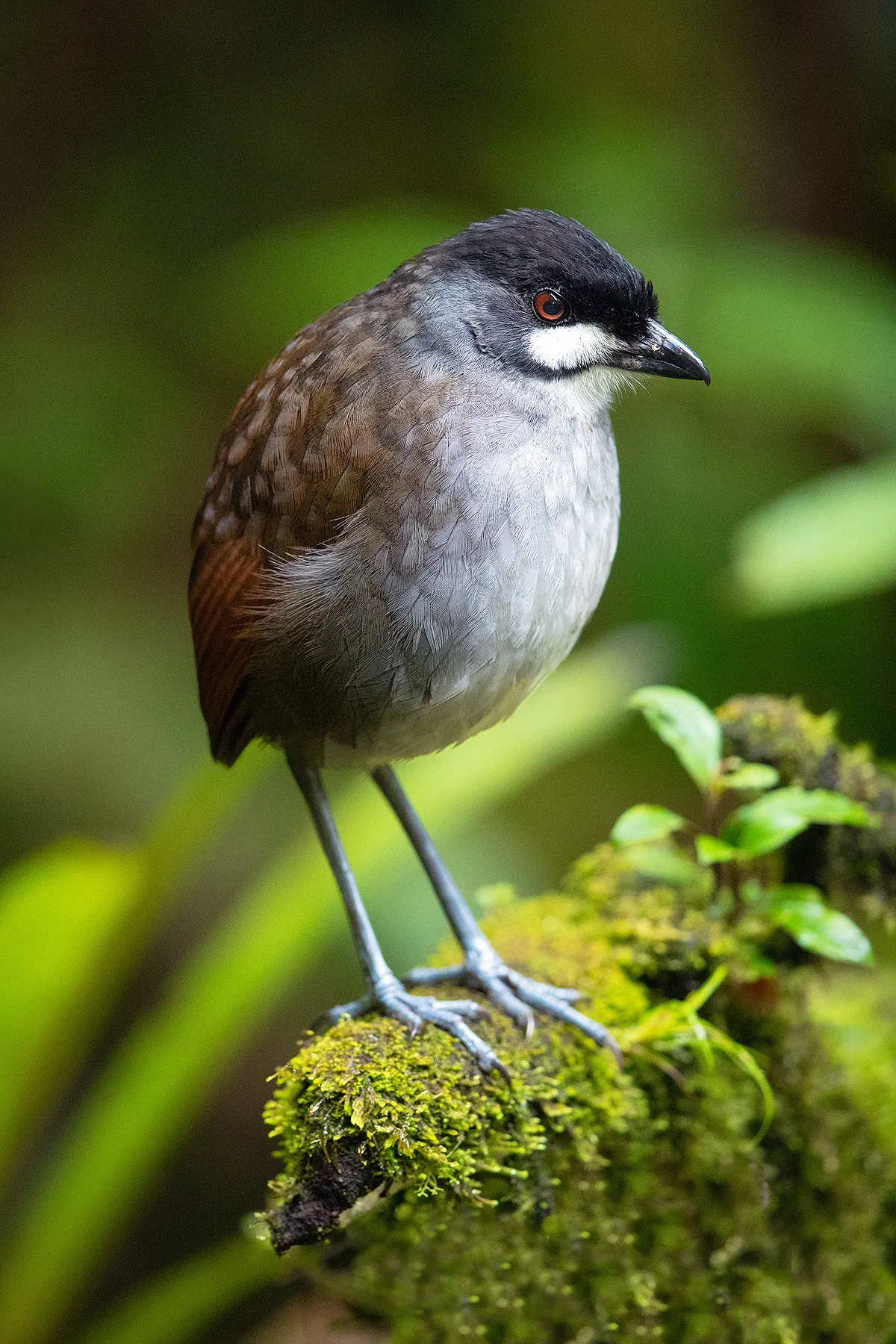
It is about 22 cm long and is reportedly the largest antpitta, weighing roughly 150 to 200 g. The crown is black, the nape and much of the face dark grey, and a bold white stripe marks the side of the face. The back is grey-brown with rustier wings, the underparts are whitish grey, the legs grey and the eyes reddish.
Its voice is the easiest clue. The song is a series of 6 to 10 or more low notes spaced one to two seconds apart, lower in pitch than the songs of its closest relatives. The local name, jocotoco, imitates the call.
Where it lives
The bird lives on the eastern slope of the Andes in south-eastern Ecuador. A population was also reported in 2006 in the Cordillera del Condor of northern Peru. The IUCN records it between about 2,300 and 2,680 m, in wet, mossy montane forest, where dense Chusquea bamboo is typical.
The range is very small. The IUCN estimates an extent of occurrence of roughly 1,300 square km and an area actually occupied of about 252 square km, split across four subpopulations.
Pins are Wikidata “endemic to” fields. Orange dots, when present, are GBIF occurrence tiles — survey bias included.
How it lives
It is a permanent resident, usually seen alone or in pairs. It forages on the ground, probing leaf litter and flipping over vegetation. Stomach contents of collected birds held earthworms, beetles, ants and millipedes, and it may follow army ant swarms to catch the insects they disturb.
Breeding is poorly known. The first nest, found in 2008, was an open cup of dead leaves about 3.5 m above the ground, wedged against a rotting trunk and supported by bromeliads. Both adults fed a single nestling.
Why it is in trouble
The 2021 assessment estimates 480 to 600 mature individuals, with the largest subpopulation holding 260 to 325. An earlier estimate of 150 to 700 appears in an American Bird Conservancy summary. The IUCN lists the population as decreasing, with a small estimated loss (1 to 9 percent) in the past, present and future.
The main pressures on its forest are farming by small holders, roads and mining, with some accidental harm from local harvesting. Logging and gold mining also threaten parts of the range, including areas of Podocarpus National Park.
What is being done
Fundacion Jocotoco was founded in 1998, the year after the bird's discovery, and established the Tapichalaca Reserve to protect the core of the range. American Bird Conservancy material describes the reserve as covering more than 9,000 acres and protecting almost the entire known population. With support from that group and World Land Trust, the foundation has also replanted more than 830 acres with nearly 225,000 trees.
Feeding stations baited with worms let visitors see the bird, and a lodge on the reserve brings in visitor support. The IUCN lists habitat restoration and awareness work as needed actions, and records no recovery plan, no systematic monitoring scheme and no recent awareness programme.
Sources
Written for this catalog in our own words from the sources below, checked against them on 12 November 2026. Population figures are estimates and carry the year they were made. Status and assessment year: IUCN. 2026. The IUCN Red List of Threatened Species. Version 2026-1. iucnredlist.org.