Critically Endangered
Jellybean Tetra
Ladigesia roloffi
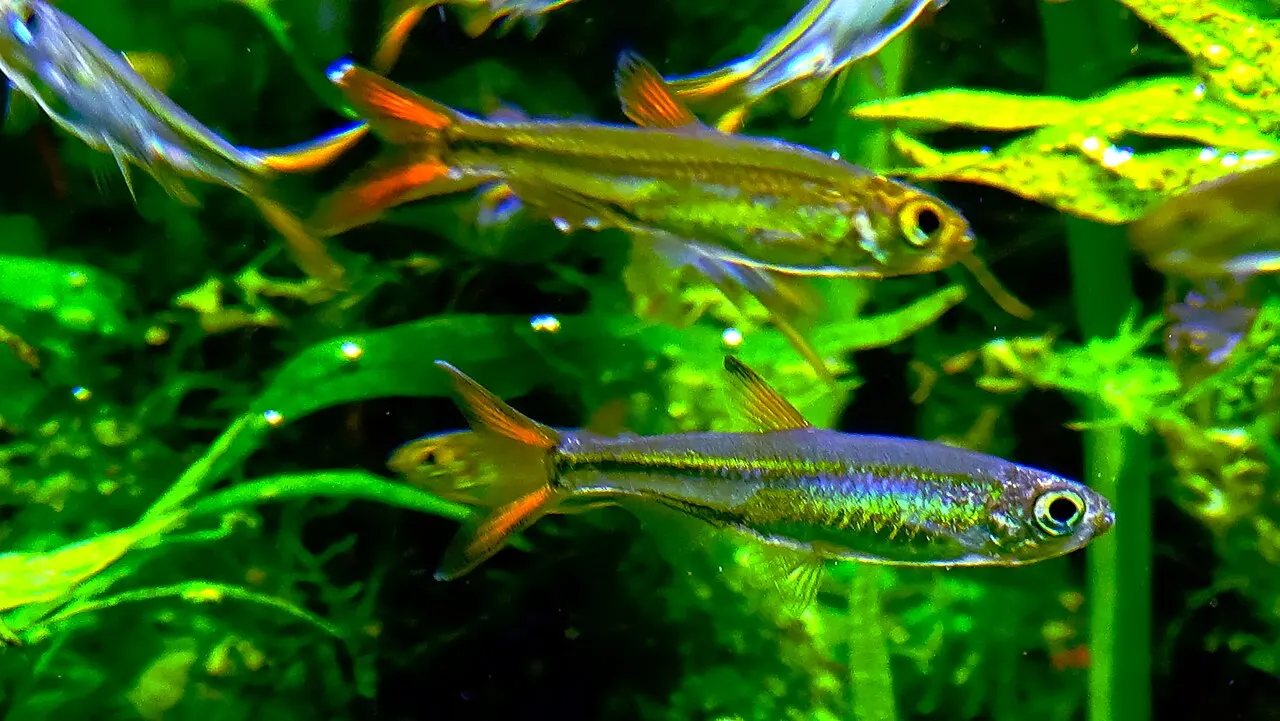
The jellybean tetra (Ladigesia roloffi), also called the Sierra Leone dwarf characin, is a tiny schooling fish from the small forest streams of West Africa. The IUCN Red List rated it Critically Endangered in 2020. It is known from Sierra Leone and Liberia, and its rivers are losing their forest.
How to recognise it
This is a very small, slim fish. The largest recorded male measured 31 mm standard length, and one reference article gives 3 to 4 cm overall. It has a short anal fin, a small adipose fin, and a dorsal fin set well behind the middle of the body.
Living wild adults are bright vermilion on the body and fins, with black on the unbranched dorsal and tail rays. Males have slightly extended front rays on the anal fin, and females in spawning condition look rounder. Outside breeding time the sexes are very hard to tell apart.
Where it lives
The IUCN assessment lists Sierra Leone and Liberia, treats the whole population as a single location, and gives an area of occupancy of about 4 square kilometres. The fish lives in permanent and seasonal rivers and streams.
The record is patchier than that sounds. It is known with certainty from the type locality in Kasewe Forest, in the upper Gbangbaia river basin of Sierra Leone. Liberia is represented by one 1972 record from the Du River drainage near Harbel. Jacques Géry described the fish in 1968, and it is reportedly named for the German aquarist Erhard Roloff, who collected the type specimen.
Streams in the region are warm and soft. In the nearby Jong River, conductivity ran between 10 and 30 microsiemens per centimetre and water temperatures between about 25 and 31 °C through the year.
Pins are Wikidata “endemic to” fields. Orange dots, when present, are GBIF occurrence tiles — survey bias included.
How it lives
It is a gregarious fish that lives in schools in mid-water and near the surface. In the wild it probably hunts tiny invertebrates and zooplankton. An encyclopedia article gives a lifespan of about five years.
In aquariums it accepts small dried foods but does best with daily live or frozen food such as brine shrimp nauplii and daphnia. Keepers advise groups of at least 8 to 10, because small groups make the fish shy.
Breeding is demanding. Spawning needs very soft water with almost no carbonate hardness, dense plants and a peat layer under a mesh to protect the eggs. The eggs hatch in 24 to 36 hours, and the fry need microscopic food at first.
Why it is in trouble
The IUCN lists small-holder farming, soil erosion and sedimentation, habitat change and drought as threats, and records a continuing decline in the area the species occupies. The listing criteria (B2ab(iii)) reflect a small range, few locations and a shrinking habitat. The population trend is unknown, and no population count exists.
Forest loss in Sierra Leone is severe. One fish reference reports that more than 97 percent of the country's primary forest has been destroyed, with pockets surviving mainly in protected reserves such as Kasewe. A museum reference on African fishes lists mining, urban development and deforestation as drivers of habitat decline.
What is being done
The assessment records that the species occurs in at least one protected area, and that conservation sites have been identified across its whole range, yet it lists none of the population as protected. There is no recovery plan and no monitoring scheme. Some fish are held in captivity, which the assessment counts as ex-situ conservation.
Sources
Written for this catalog in our own words from the sources below, checked against them on 12 November 2026. Population figures are estimates and carry the year they were made. Status and assessment year: IUCN. 2026. The IUCN Red List of Threatened Species. Version 2026-1. iucnredlist.org.




