Endangered
Jankowski's Bunting
Emberiza jankowskii
Jankowski's bunting (Emberiza jankowskii) is a ground-living songbird of dry grassland with scattered shrubs in northeast Asia. The IUCN Red List assessed it as Endangered in 2018 and records a decreasing trend. It has vanished from most of its former breeding range and now breeds at a handful of sites, mainly in Inner Mongolia and western Jilin.
How to recognise it
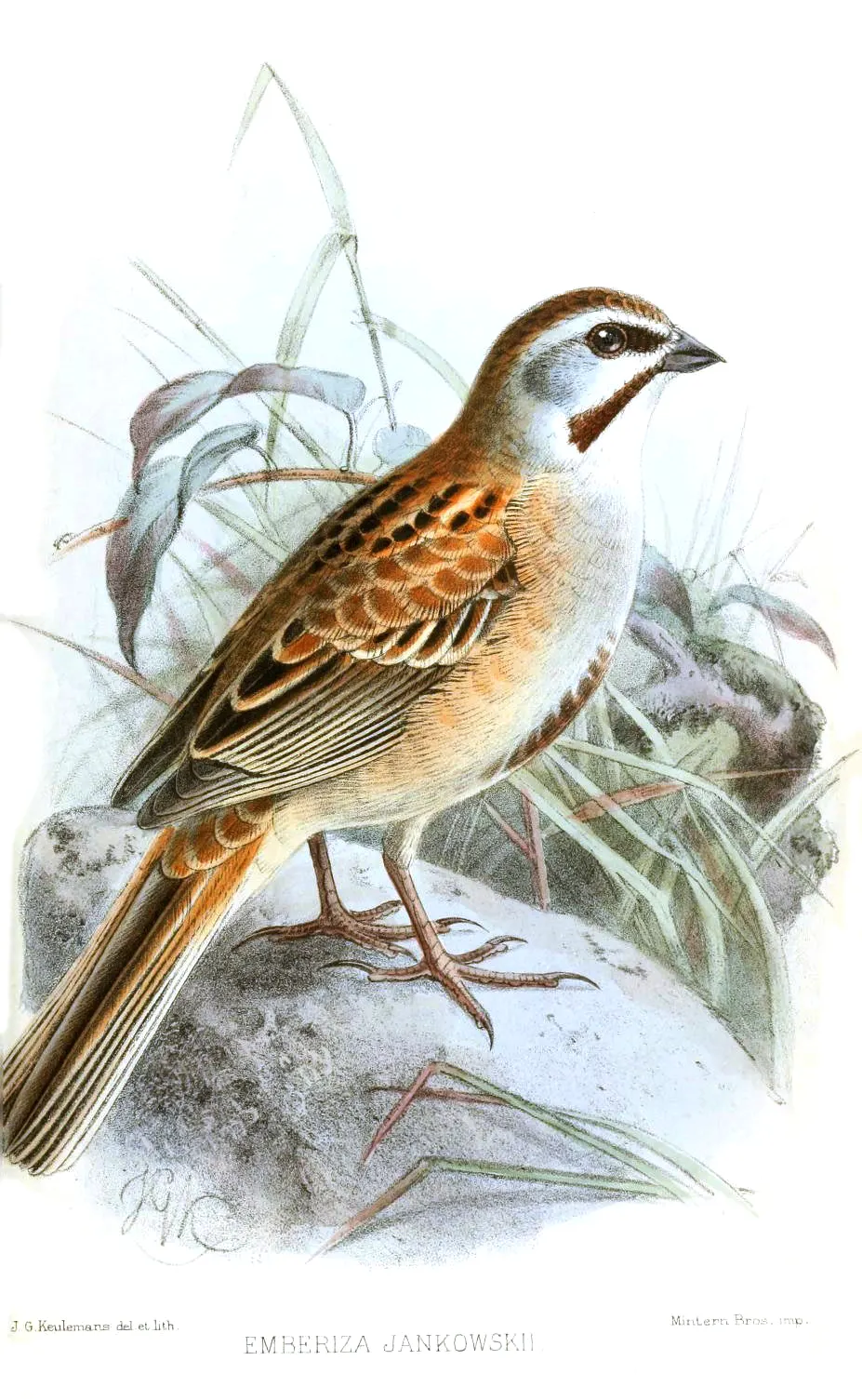
It resembles a paler meadow bunting. Breeding males have a brown belly patch, thick black streaks on the back, clear white wingbars and grey ear patches. A white eyebrow and cheek stripe stand out against black lores and a dark stripe at the side of the throat. Non-breeding males are paler, and females look like them with light streaking on the upper breast.
The song is a simple buzzy trill, delivered from the top of a bush. The alarm call is a sharp 'stlit' and the contact call a soft 'tsik'. Much of its time is spent on the ground, nest included.
Where it lives
It once bred from Inner Mongolia through Heilongjiang and Jilin into adjacent Russia and North Korea, and the IUCN lists China, Russia and North Korea. A survey of 50 sites in northern China, with fieldwork from 2011 to 2016, found it gone from most historical breeding areas. Remaining populations were at Dagang, Xiergen and Tumiji, plus 13 newly found sites in Inner Mongolia. All known populations bred in Mongolian steppe vegetation where Siberian apricot is the main shrub.
It was reportedly found breeding in Mongolia in 2020, which would extend the known range west.
Pins are Wikidata “endemic to” fields. Orange dots, when present, are GBIF occurrence tiles — survey bias included.
How it lives
A study in western Jilin from 1999 to 2002 followed 74 nesting attempts. Breeding began in late April and usually ended in late July. Full clutches averaged about 5 eggs, with a range of 4 to 7, and 41 percent of eggs hatched. Parasitism, predation, human disturbance and abandonment all cost nests, and estimated success to fledging was about 22 percent.
Why it is in trouble
The Dagang population in Jilin was small and fell sharply between 1999 and 2006. That study put habitat loss at about 70 percent since the 1960s, through farming, tree planting and housing, with livestock grazing degrading what remains. The Red List assessment lists farming, grazing, development, more frequent fire and dams among the threats.
The 2011 to 2016 survey, published by Han and colleagues in Bird Conservation International, estimated 9,800 to 12,500 birds in China, far higher than earlier partial counts. The IUCN assessment gives 250 to 999 mature individuals. The figures differ, so the true number is uncertain, but the survey still concluded that the species meets the criteria for Endangered.
What is being done
The bunting reportedly gained China's highest level of legal protection in 2021. The IUCN assessment records site protection, habitat restoration and awareness work as actions, notes that conservation sites are identified over its whole range, and says it occurs in at least one protected area. No recovery plan or systematic monitoring scheme was in place when it was written.
The China survey stresses protecting the remaining steppe shrub habitat, estimated at about 280 square kilometres of suitable breeding ground, and notes that a national forest protection project in Inner Mongolia helps the habitat but its continuation is uncertain.
Sources
Written for this catalog in our own words from the sources below, checked against them on 12 November 2026. Population figures are estimates and carry the year they were made. Status and assessment year: IUCN. 2026. The IUCN Red List of Threatened Species. Version 2026-1. iucnredlist.org.

