Critically Endangered
Jamaican Poorwill
Siphonorhis americana
The Jamaican poorwill (Siphonorhis americana) is a small nightjar known only from Jamaica, with no positive record since 1860. The IUCN Red List (2020) rates it Critically Endangered and possibly extinct, because a few unverified reports leave open the chance that a tiny population survives.
How to recognise it
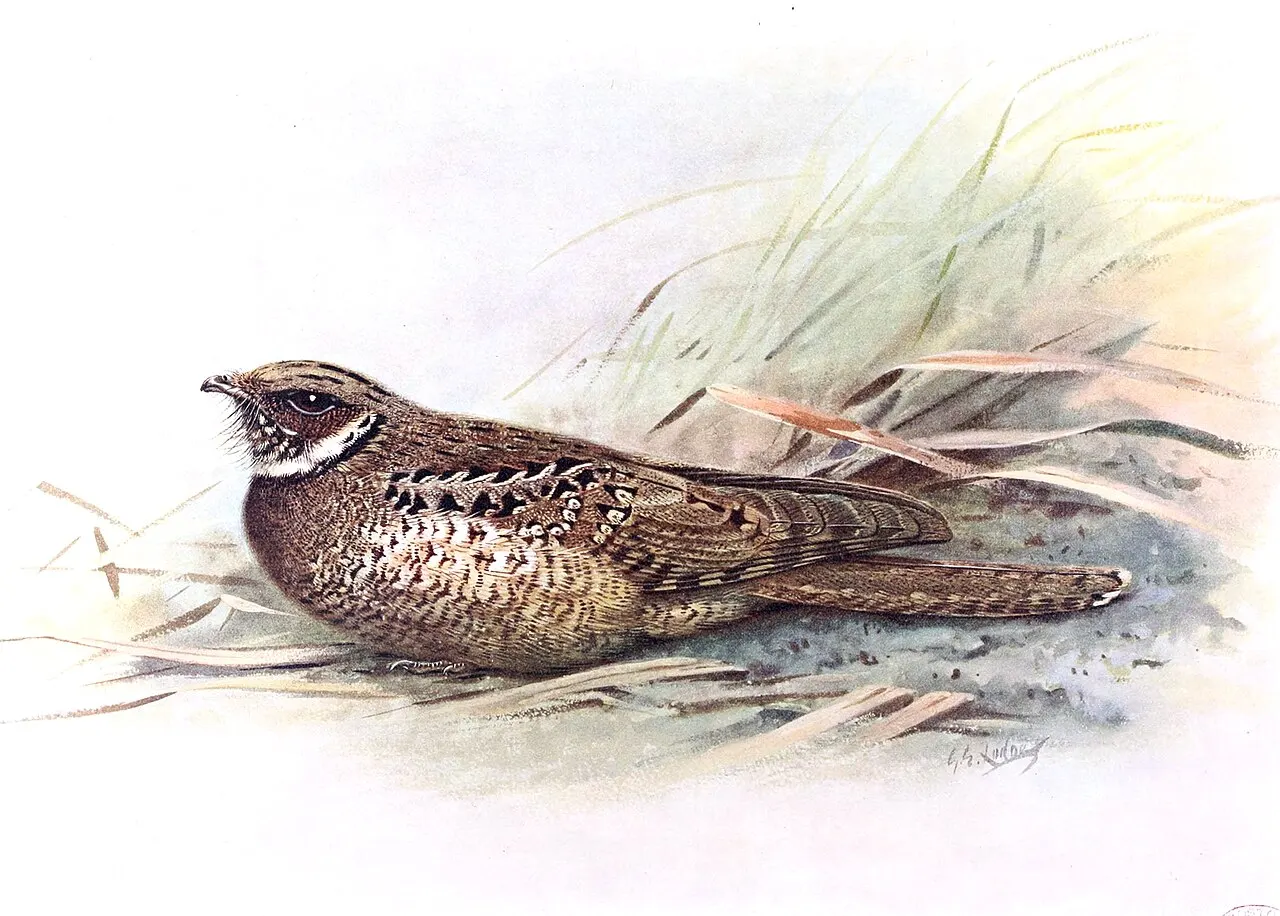
It was a small, long-tailed nightjar, 23 to 25 cm long. The upperparts were rufous-brown with darker streaks, broader blackish streaks on the crown and a faint rufous-buff collar on the hindneck. A white patch marked the throat. The male's tail was tipped white, while the female's markings were mostly buff.
Unlike many nightjars it lacked bold white wing markings. The Antillean nighthawk is larger with a conspicuous white wing band, and the chuck-will's-widow is larger with a proportionally shorter tail. The poorwill's nostrils were short tubes about 2 mm long, a feature that set it apart from mainland relatives. Its call was never described by the collectors who handled it, so what it sounded like is unknown.
Where it lived
Known specimens come from the lowlands of Jamaica's drier south side. The birds were reported from dry limestone forest, semi-open woodland and open country, and in the first half of the 19th century they were described as rare to locally uncommon.
The Red List treats the species as occupying two to five locations, with a possible population of 1 to 49 birds, all in one subpopulation. Those are cautious estimates for a bird no one has verified alive for over 160 years.
Pins are Wikidata “endemic to” fields. Orange dots, when present, are GBIF occurrence tiles — survey bias included.
What little is known about its life
Almost nothing was recorded. The bird was once treated as the same species as the least poorwill (Siphonorhis brewsteri). By comparison with that relative, it is presumed to have hunted flying insects at night and to have laid eggs on bare ground without building a nest. These are inferences, not observations.
Linnaeus described it in 1758. Very few specimens exist (one account counts four), and the most recent was collected in the mid-1800s.
Why it is in trouble
The main suspects are introduced predators. Small Indian mongooses reached Jamaica in 1872, and black and brown rats were also present. A ground-nesting bird would have been very exposed. Habitat loss added to the pressure: logging and conversion to cultivated land reduced its dry forest, and the Red List also cites mining and quarrying, agriculture and future commercial development.
Some recent reports exist, but none has been backed by a specimen or confirmed record. The bird's voice is unknown, which makes it harder to detect, and the Red List calls for surveys, especially at Milk River and the Hellshire Hills.
What is being done
No recovery plan or systematic monitoring was in place at the time of the 2020 assessment. The Red List says conservation sites have been identified across the range and that the bird occurs in at least one protected area. The IOC and Clements checklists treat the species as extinct, while the IUCN keeps it as possibly extinct pending better searches.
Sources
Written for this catalog in our own words from the sources below, checked against them on 12 November 2026. Population figures are estimates and carry the year they were made. Status and assessment year: IUCN. 2026. The IUCN Red List of Threatened Species. Version 2026-1. iucnredlist.org.




