Critically Endangered
Ivell's sea anemone
Edwardsia ivelli
Ivell's sea anemone (Edwardsia ivelli) is a thread-thin burrowing anemone known from a single place on Earth, Widewater Lagoon on the coast of West Sussex, England. It hasn't been recorded since 1983. The IUCN Red List assessed it in 2022 as Critically Endangered and possibly extinct.
How to recognise it
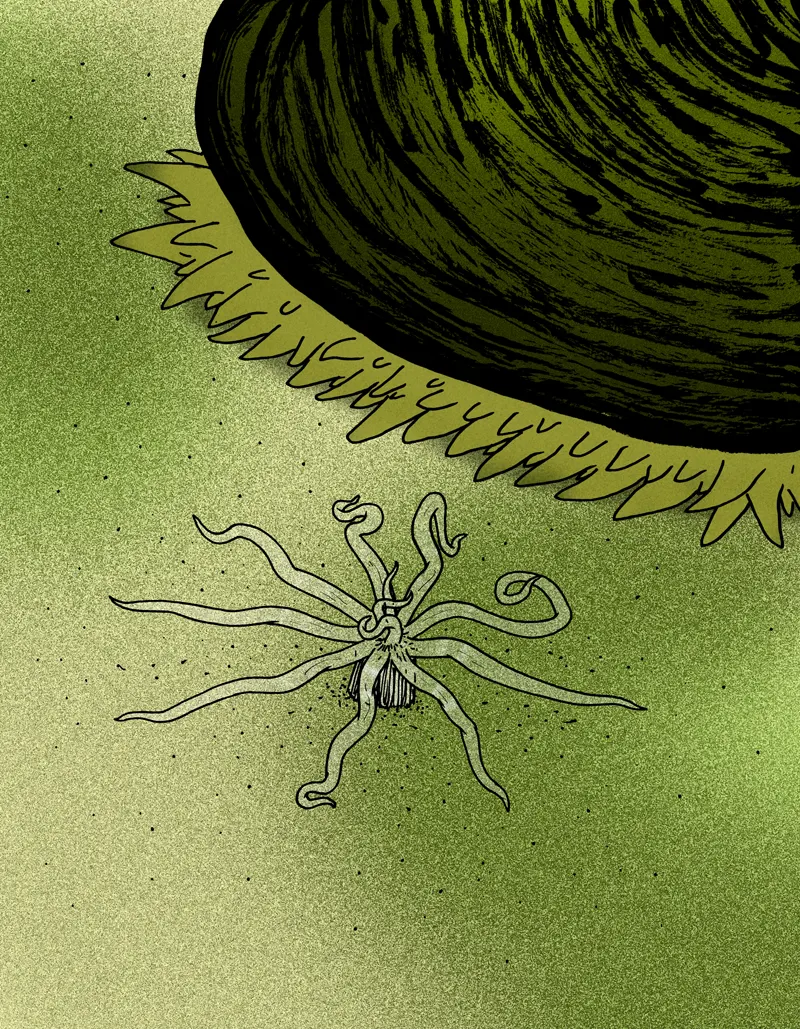
This is a tiny, worm-like anemone, up to about 2 cm long and little more than a millimetre wide when fully extended. It has twelve see-through tentacles in two rings, nine in the outer ring and three in the inner. In life the outer ones lie flat on the mud while the inner ones stand up, often curling over the mouth. The tentacles carry pale cream and brown markings and the disc is buff with orange spots.
It was described in 1975 by Richard Manuel, from animals that Professor Richard Ivell collected at the lagoon in 1973. The species carries his name.
Where it lives
Widewater Lagoon is a brackish lagoon of about 8.8 hectares at Lancing, cut off from the beach by a man-made shingle bank. It is a Local Nature Reserve. The anemone lives in long burrows in deep, soft mud in saline lagoons, and the Red List lists it as non-migratory.
The Red List gives its habitat as coastal brackish and saline lagoons, at depths of 0 to 5 m, with an area of occupancy of 4 square kilometres, treated as a single location. The lagoon's salt content varies considerably between winter and summer, and the species is described as tolerant of large salinity changes.
Pins are Wikidata “endemic to” fields. Orange dots, when present, are GBIF occurrence tiles — survey bias included.
Why it is in trouble
Nobody knows exactly what happened. The 2022 assessment records the threat as of unknown type, in the past and unlikely to return. The Marine Life Information Network reports that water levels in the lagoon have fallen because little seawater reaches it, that the remaining water is hypersaline, that parts of the basin have become exposed, and that the lagoon's communities have changed.
Three later surveys failed to find the anemone, and some conservationists regard it as extinct. It may also survive in numbers too low to detect.
What is being done
The species is protected under the Wildlife and Countryside Act 1981, and it is a UK Biodiversity Action Plan priority and a Species of Principal Importance in England. The Red List records that no recovery plan exists and that the species is not known from a protected area, even though the lagoon itself is a reserve.
The Environment Agency announced in January 2026 that it would refurbish the pipe that lets seawater into the lagoon at high tide, with work from late January to the end of March, to keep water levels suitable for the lagoon's wildlife. Further lagoon surveys are what the species needs. It has also been suggested that it could live in the wider marine environment off West Sussex or elsewhere in England, since most relatives are marine.
Sources
Written for this catalog in our own words from the sources below, checked against them on 12 November 2026. Population figures are estimates and carry the year they were made. Status and assessment year: IUCN. 2026. The IUCN Red List of Threatened Species. Version 2026-1. iucnredlist.org.




