Critically Endangered
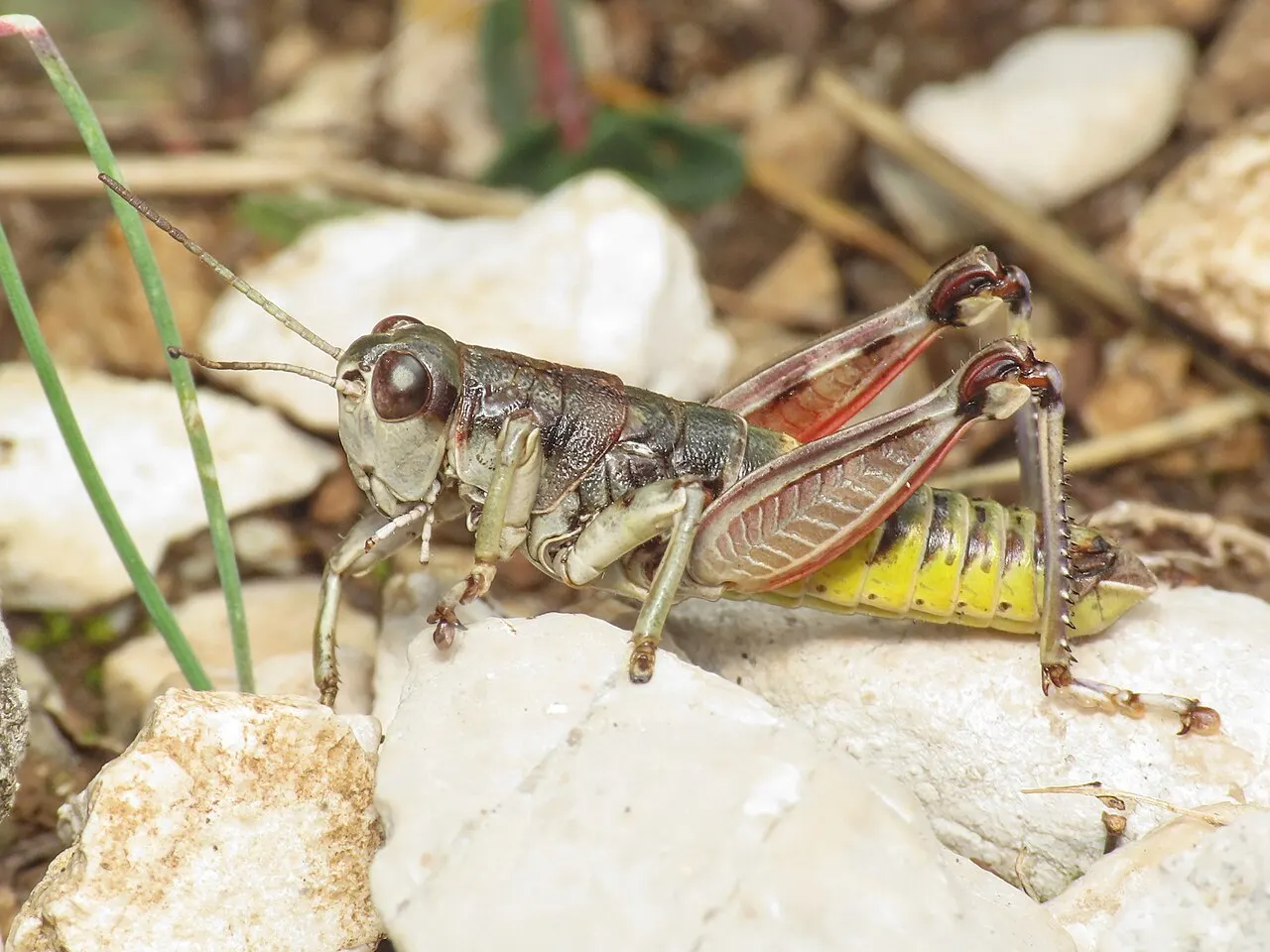
Reatine Apennine Grasshopper
Italopodisma ebneri
The Reatine Apennine Grasshopper (Italopodisma ebneri) is a small grasshopper of Italy's central Apennines, living on stony mountain slopes near Rieti. The Red List assessed it as Critically Endangered in 2016, with one known location, a range of about 4 square kilometres and a declining population.
Where it lives
This grasshopper is found only in Italy. The Red List records it only from the Reatini mountains in Lazio, near Rieti, and counts a single location. Its extent of occurrence and area of occupancy are both given as 4 square kilometres. A specialist photo site calls it a local endemic of Monte Terminillo and the neighbouring summits.
It lives on stony alpine slopes and open grassy ground. The Red List records rocky areas and temperate grassland as its habitats and gives an elevation range of 800 to 1,900 m. The photo site gives 1,650 to 2,200 m, so the exact limits are uncertain.
Pins are Wikidata “endemic to” fields. Orange dots, when present, are GBIF occurrence tiles — survey bias included.
How it lives
Little has been published about its biology. The Red List describes it as abundant within its habitat but rarer than it was a few decades ago, and not a migrant. The photo site says the whole genus is wingless. Naturalists have photographed adults, including mating pairs, on Terminillo in late September.
It shares the mountain with the Reatini mountain grasshopper (Podisma ruffoi), which prefers pastures with few rocks and plenty of juniper. Where the ground turns rockier, I. ebneri partly pushes the other species out, and it is the more widespread of the two.
A name with a history
Entomologist M. La Greca described it in 1954 as Cophopodisma ebneri. The Red List lists that original name as a subspecies of another grasshopper, Cophopodisma costai. It is now an accepted species in the genus Italopodisma.
The genus includes several look-alike species, each confined to its own high massif of the central Apennines. For three related species in the Gran Sasso area, a photo-site account says they can only be separated by genital structures.
Why it is in trouble
The Red List names two ongoing pressures: tourism and recreation areas, and small-scale grazing and farming. Each is rated as affecting 50 to 90 percent of the population and as causing slow, significant declines. The assessment text names skiing and summer tourism, and intensifying cattle grazing, as the main threats.
Terminillo has hosted a ski resort since the 1930s. The Wilderness Society reports that resorts in the Apennines are struggling with less snow and that development proposals have followed. That article does not mention this grasshopper, but a species confined to one mountain has no fallback if its slopes are developed.
What is being done
The species occurs in a nature reserve, and that is the main protection it has. The Red List says no specific conservation measures are in place. It records no recovery plan, no systematic monitoring scheme, no education programme and no captive population.
The assessment calls for more research on its population trend and ecology, monitoring of the population and its habitat, better habitat protection and appropriate management.
Sources
Written for this catalog in our own words from the sources below, checked against them on 12 November 2026. Population figures are estimates and carry the year they were made. Status and assessment year: IUCN. 2026. The IUCN Red List of Threatened Species. Version 2026-1. iucnredlist.org.




