Endangered
Ischnocnema manezinho
Ischnocnema manezinho
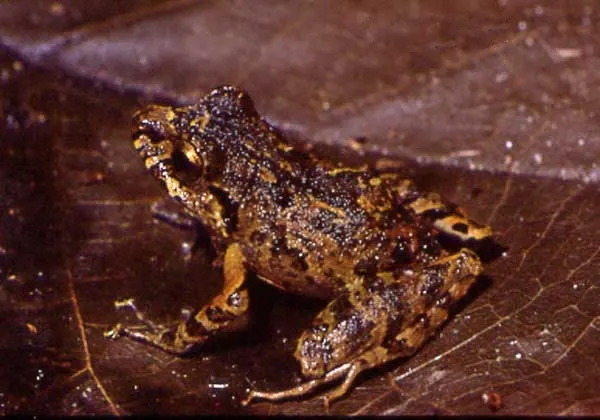
Ischnocnema manezinho is a small leaf-litter frog of the southern Atlantic Forest in Brazil. A 2023 genetic study found it only on Santa Catarina Island, around Florianopolis, in forest patches hemmed in by towns. The IUCN Red List rates it Endangered (2023 assessment), after a Near Threatened rating in 2004.
What it is
This is a frog in the family Brachycephalidae, a group of small, terrestrial frogs. Paulo Garcia described it in 1996 as Eleutherodactylus manezinho, from the Córrego Grande area of Florianópolis. It has since been moved to the genus Ischnocnema.
Where it lives
Inventories had suggested that similar-looking frogs also lived on the mainland, which would have made the species seem more widespread. A 2023 study in PeerJ by Oswald and colleagues compared DNA, body measurements and calls from Santa Catarina Island, Arvoredo Island and the mainland. It concluded that Ischnocnema manezinho itself is restricted to Santa Catarina Island, and that five other lineages need a separate taxonomic review.
The Red List gives its habitat as moist lowland forest, from sea level up to about 450 m, and estimates the area it occupies at about 116 square kilometres. Its population is severely fragmented.
Pins are Wikidata “endemic to” fields. Orange dots, when present, are GBIF occurrence tiles — survey bias included.
Why it is in trouble
The same 2023 study describes a small range, with the frogs living in isolated forest fragments surrounded by expanding urban areas. The Red List says the population is decreasing, and that the area it occupies is still shrinking. It lists roads, housing, commercial and industrial development, mining and quarrying, small-holder farming and plantations, and tourism and recreation areas as threats, along with disturbance from recreational activities.
The Endangered rating, under criteria B1ab(ii,iii)+2ab(ii,iii), rests on a limited range, fragmentation and continuing loss of habitat. In 2004 the species was rated Near Threatened, and that older rating still appears in some references.
What is being done
The 2023 assessment records that 31 to 40 per cent of the population lies inside protected areas. It lists site protection and management, awareness work, and action at national and state level as the measures needed. The 2023 study says protecting and monitoring the species should be a priority, along with describing the candidate species from the mainland and Arvoredo Island.
Sources
Written for this catalog in our own words from the sources below, checked against them on 12 November 2026. Population figures are estimates and carry the year they were made. Status and assessment year: IUCN. 2026. The IUCN Red List of Threatened Species. Version 2026-1. iucnredlist.org.




