Endangered
Iridescent shark
Pangasianodon hypophthalmus
The iridescent shark (Pangasianodon hypophthalmus) is a large freshwater catfish from the Mekong and Chao Phraya basins, not a true shark. Wild fish are listed as Endangered in the 2011 Red List assessment, even though farmed stock is produced in huge numbers for food.
How to recognise it
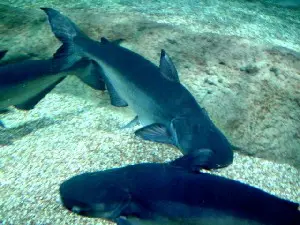
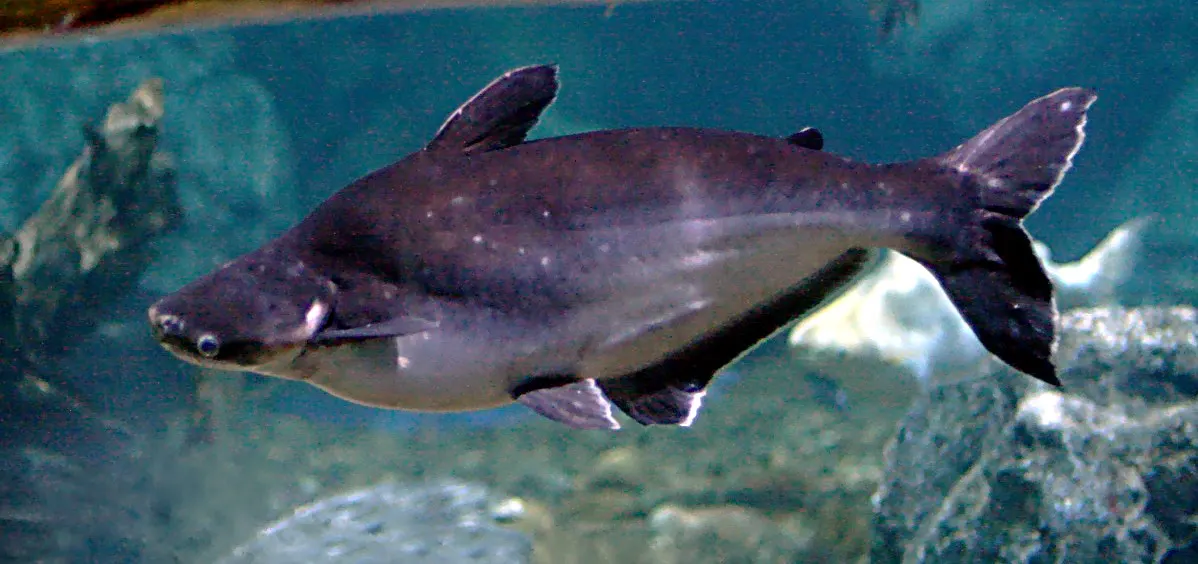
Young fish are silvery and shiny, with a black stripe along the lateral line and a second dark stripe below it. That flash of iridescence and the shark-like body shape explain the name. Adults lose the shine and turn plain grey, with dark grey or black fins.
The species can reach about 130 cm in length. A weight of 44 kg is often quoted, though FishBase traces it to a photograph in a Thai magazine. It is a catfish, unrelated to sharks, and the Red List calls it the striped catfish.
Where it lives
Its native range is the Mekong basin and the Chao Phraya River, with Thailand, Cambodia, Laos and Viet Nam counted as native countries by the Red List. FishBase also gives the Maeklong basin. Adults live in large rivers and lakes, from about 5 to 160 m above sea level.
Farming has spread it well beyond that. The Red List records introduced populations in Indonesia, Malaysia and Myanmar, and in 2015 an environmental group confirmed fish in a tributary of Colombia's Magdalena River, reportedly escapes from illegal farms.
Pins are Wikidata “endemic to” fields. Orange dots, when present, are GBIF occurrence tiles — survey bias included.
How it lives
This is a migratory fish. In the Mekong it moves upstream to spawn, mostly from May to July, and returns downstream to rearing and feeding areas as floodwaters fall, from September to December. South of Khone Falls the upstream run is later, peaking in November and December. Eggs have been collected between Stung Treng and Kandal in Cambodia from March to August.
It eats fish, crustaceans and plant matter. Its swim bladder can work as a breathing organ, so it copes with low-oxygen water better than many fish. The Red List gives a generation length of 10 to 15 years.
Why it is in trouble
The 2011 assessment estimated a wild population decline of 50 to 70 percent, judged from an abundance index, loss of habitat and levels of exploitation. The Red List names dams, existing ones and large ones expected to follow, as a threat because they can block the long migrations between spawning and rearing areas. It also lists harvest by local communities.
The Endangered listing refers to wild fish. Farmed stock is produced in very large numbers, so abundance in ponds and cages says little about the wild population. The entry records no conservation actions in place.
In aquariums and on plates
Juveniles are sold to hobbyists as Siamese shark catfish or sutchi catfish, but FishBase advises against keeping them in home aquariums. They are active schooling fish with poor eyesight, and they reportedly bolt when frightened, which can injure them. Aquarium fish are said to stay at 15 to 30 cm and often die early. For rules on keeping exotic animals, see /exotic-pet-laws-by-state/.
The same fish is the source of the fillets sold as swai, basa or pangasius. FishBase calls it one of Thailand's most important aquaculture species, and young fish from the lower Mekong are collected for rearing in floating cages.
Sources
Written for this catalog in our own words from the sources below, checked against them on 12 November 2026. Population figures are estimates and carry the year they were made. Status and assessment year: IUCN. 2026. The IUCN Red List of Threatened Species. Version 2026-1. iucnredlist.org.