Endangered
Spiny river snail
Io fluvialis
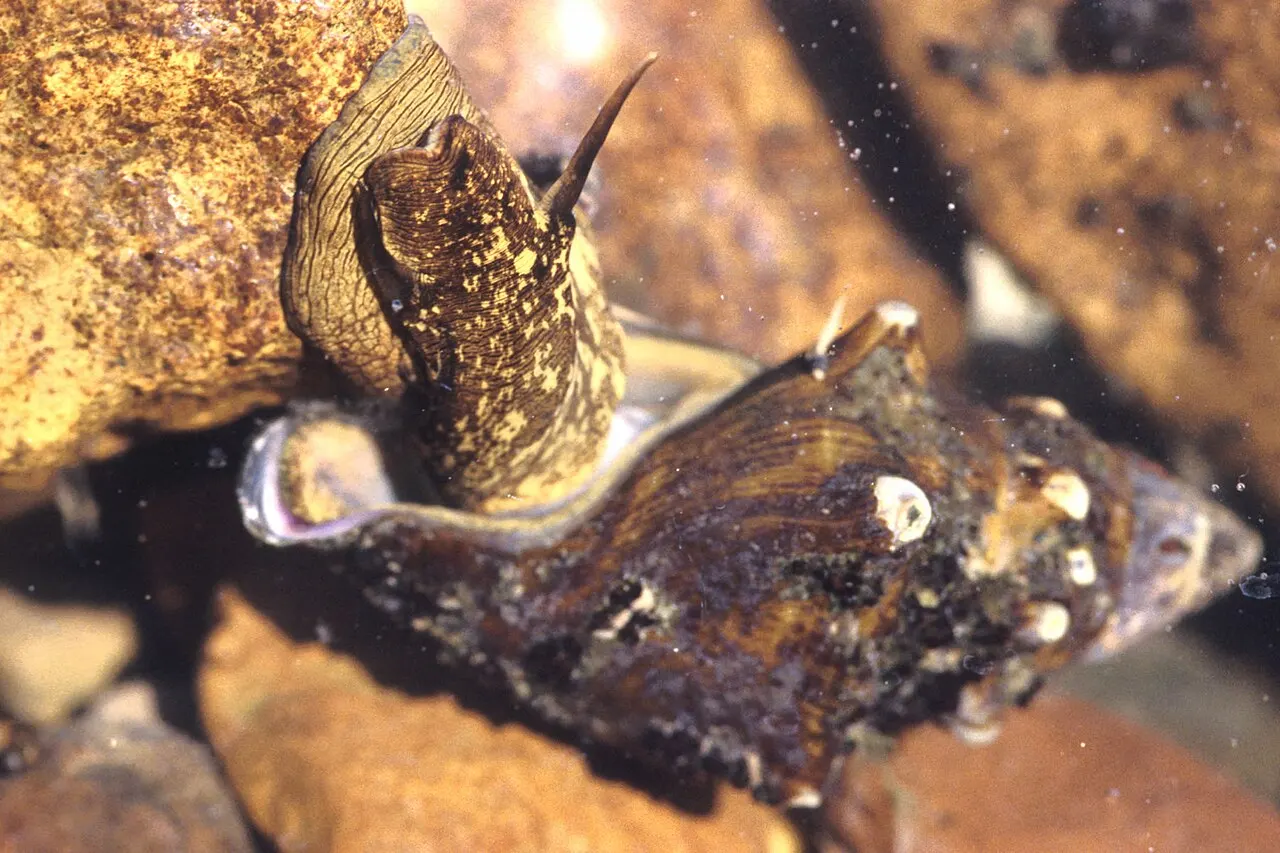
The spiny riversnail (Io fluvialis) is a freshwater snail from the Tennessee River system in the eastern United States, and the only member of its genus. It was once widespread in the big rivers there. The IUCN Red List's Endangered rating dates from 1996, and dams are blamed for its loss.
How to recognise it
This is a river snail of the family Pleuroceridae, a group of freshwater snails. Its shell is variable. Some individuals carry prominent spines and others have none, and the height of the spire differs too.
That variation caused confusion for a long time. Earlier workers gave many different Latin names to what turned out to be a single species, and a 1951 study by Lutz and Weese showed those names are synonyms. Thomas Say first described it in 1825 as Fusus fluvialis. Io is a single-species genus, and a shell of this snail has been the emblem of the American Malacological Society since 1960.
Where it lives
Historically it occupied the large rivers of East Tennessee, reaching west as far as Muscle Shoals in Alabama. It lives on rocky riffles and shoals where the water moves quickly and carries plenty of oxygen, rather than in the slack water below.
Twentieth-century dams on the Tennessee River and most of its major tributaries removed it from nearly all of that range. Surveys published in 1976 and 1978 found it holding on in the upper Powell River, the upper Clinch River and a small stretch of the lower Nolichucky River. It was also reintroduced to the North Fork Holston River in Virginia during the 1970s and 1980s.
Pins are Wikidata “endemic to” fields. Orange dots, when present, are GBIF occurrence tiles — survey bias included.
How it lives
Like other river snails, it grazes the film of algae that grows on stones. The sexes are separate, and eggs are laid on hard surfaces from spring into mid-summer. Its life history has never been studied closely, so details such as age at maturity (probably about two years) are inferred from related snails rather than measured.
Why it is in trouble
Impoundment is the main cause. A river snail that needs fast, well-oxygenated shoals cannot live in the deep, slow reservoirs that replaced them. Pollution is also reported to have played a part.
The Red List rates the species Endangered under criteria B1+2c, from an assessment made in 1996 under the older 2.3 version of the system. That record gives no population numbers, and it has not been updated since.
Sources
Written for this catalog in our own words from the sources below, checked against them on 12 November 2026. Population figures are estimates and carry the year they were made. Status and assessment year: IUCN. 2026. The IUCN Red List of Threatened Species. Version 2026-1. iucnredlist.org.




