Critically Endangered
Incomati rock catlet
Chiloglanis bifurcus
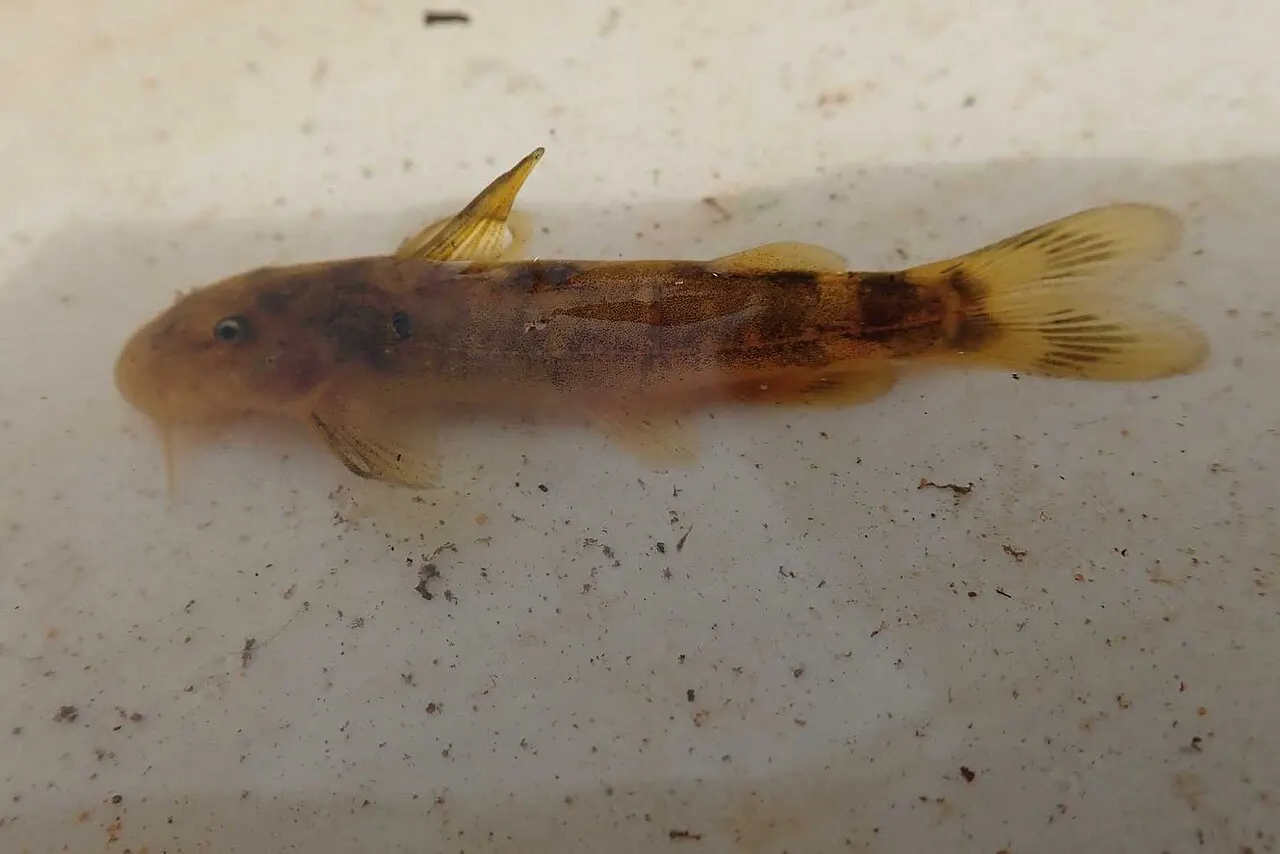
The Incomati rock catlet (Chiloglanis bifurcus) is a finger-length suckermouth catfish that clings to stones in fast, rocky streams of the Crocodile and Incomati river system in South Africa and Eswatini. The IUCN rated it Critically Endangered in 2017, and its range covers only three locations.
How to recognise it
This is a small, elongated catfish in the family Mochokidae, the upside-down catfishes. Adults reach about 6.8 cm in standard length, and fish begin to mature at around 3 cm. A large, sucker-like mouth lets it hold on against strong currents. The tail fin is clearly forked, with distinct upper and lower lobes, which helps separate it from Chiloglanis pretoriae, a species that shares part of its range and has nearly fused tail lobes.
Its common name varies. It is also called the Incomati suckermouth, and in Afrikaans the Inkomati-suierbekkie.
Where it lives
The species is found only in the Crocodile-Incomati system. The IUCN lists Eswatini and Mpumalanga province, South Africa, and other accounts also report Mozambique. The assessment counts three locations, with an occupied area of about 56 square kilometres inside a wider range of 1,324 square kilometres.
It lives at 900 to 1,200 m above sea level, in rocky rapids and cascades, usually over cobbles in water about 30 to 60 cm deep. It avoids pools, stagnant water and algae-choked stretches. Until a population turned up in Swaziland (now Eswatini) in 2003, it was known only from the upper Crocodile River and the Elands River with its main tributaries.
Pins are Wikidata “endemic to” fields. Orange dots, when present, are GBIF occurrence tiles — survey bias included.
How it lives
The catlet lives on the stream bed and feeds on small bottom-living invertebrates such as mayfly and caddisfly nymphs, blackfly and midge larvae and small snails. It breeds in summer, pairs up while breeding, and hides its eggs in gravel.
Why it is in trouble
The assessment, made in 2016 and published in 2017, estimated a population reduction of about 90 percent, based on direct observation, habitat decline and the effects of introduced species, and rated the trend as decreasing. Threats listed include farming and plantation forestry, dams, sediment washed into streams, surface water abstraction, utility lines and introduced largemouth bass, rainbow trout and brown trout, each scored as low impact.
Pollution has a documented history. A 2014 survey study in Koedoe reports that the Elands River population was abundant and well structured until chemical spills in 1985, 1986 and 1989, the last culminating in a large effluent spill on 23 September 1989. Catches fell afterward. Surveys from 2002 to 2006 found 69 fish in 18 surveys, and abundance had not returned to pre-1989 levels. The study named chronic effluent from a pulp and paper mill, altered flow, artificial barriers and sensitivity to water quality changes as continuing pressures.
A Rufford Foundation project (2024) says the species had not been recorded for about 20 years before it was found again in a small tributary of the Crocodile River.
What is being done
The IUCN records no recovery plan and lists site protection, site management and species recovery as actions still needed. Some measures do exist. In 1992 about 100 fish were moved into the Ngodwana River as a sanctuary, and the Koedoe study reports that population as stable and increasing. A sanctuary was also recommended for the Crocodile population in the Houtbosloop River, where numbers have fallen continuously since 1992. The Rufford-funded project aims to map the current range, investigate threats and involve local people.
Sources
Written for this catalog in our own words from the sources below, checked against them on 12 November 2026. Population figures are estimates and carry the year they were made. Status and assessment year: IUCN. 2026. The IUCN Red List of Threatened Species. Version 2026-1. iucnredlist.org.




