Endangered
Impressed tortoise
Manouria impressa
The impressed tortoise (Manouria impressa) is a flat-shelled forest tortoise of the hills of mainland Southeast Asia and southern China. The IUCN Red List rated it Endangered in 2021, with numbers still falling. It is secretive, spends most of its time hidden, and eats mostly mushrooms.
How to recognise it
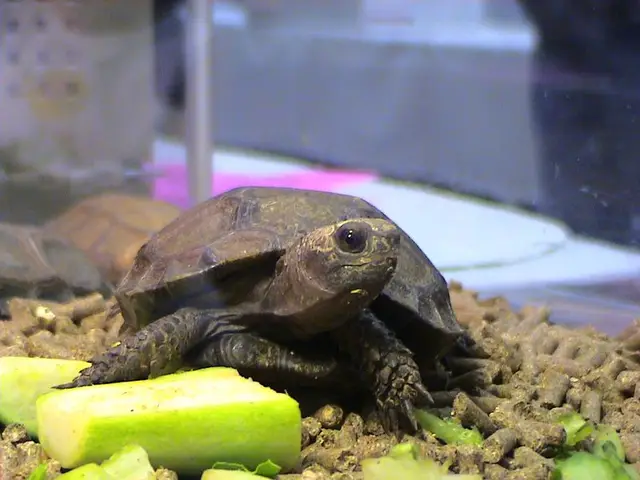
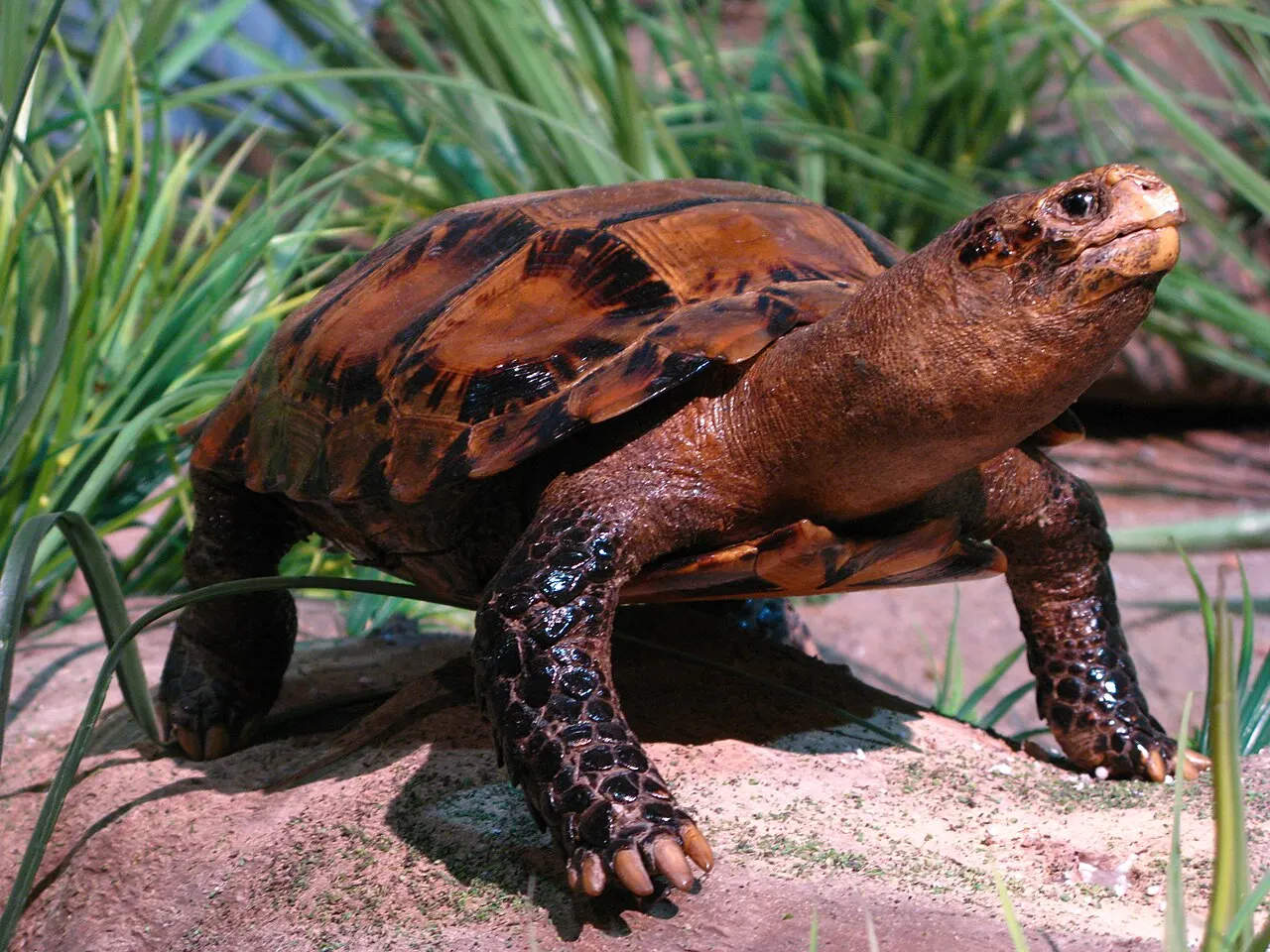
This is a medium-sized tortoise with a low, flattened shell. The shell scutes are slightly sunken, which gives the species its name, and the colour runs from orange-brown to dark brown, often with darker edges. The rear edge of the shell is serrated. Reported maximum shell length is 31 cm in one regional guide and 35 cm in another.
The head is yellow to cream, sometimes with pink markings, and the front legs carry stiff, elongated scales. In a Thai study the ten adults averaged about 26 cm, with females (27.1 cm) a little larger than males (25.8 cm). It is the smaller of the two Manouria tortoises; the Asian forest tortoise (Manouria emys) is much bigger.
Where it lives
The range covers upland forest in Myanmar, Thailand, Laos, Cambodia, Vietnam, peninsular Malaysia and southern China (the Red List assessment names Yunnan and Hainan). The 2021 assessment gives an elevation band of about 900 to 1,600 m, and it records subtropical and tropical moist montane forest as the main habitat, with some use of dry and lowland forest.
In Thailand's Phu Luang Wildlife Sanctuary, where the best field work has been done, the study area lay at 900 to 1,400 m and took in several forest types. The nests found there were in bamboo forest and montane forest mixed with bamboo.
Pins are Wikidata “endemic to” fields. Orange dots, when present, are GBIF occurrence tiles — survey bias included.
How it lives
A radio-tracking study at Phu Luang from January 2010 to October 2011 followed fourteen tortoises (ten adults and four juveniles). Hiding under leaf litter, rocks or fallen branches was the most common activity in both seasons, and no movement was seen in December or January. The animals were active at air temperatures of 12 to 30 degrees C and in 60 to 100 percent humidity, and they were more active in the wet season. Home ranges were small, no larger than 17.7 hectares and usually much less.
Mushrooms are the main food. The tortoises at Phu Luang fed on at least eight mushroom species and were not seen eating other plants or fruit. Feeding was recorded from March to September and peaked in May, when mushrooms were plentiful. A 2023 paper in Herpetology Notes reportedly recorded the first observation in northern Vietnam of one feeding on a stinkhorn-type mushroom.
Females build a large mound nest of leaves, sticks and bamboo litter and stay near it for days. Two nests found in 2011 at Phu Luang, both about a metre across, held an estimated 8 to 10 eggs each. Both were probably raided by predators, since broken eggs and shell were found. Other accounts give clutches of roughly a dozen to 20 eggs, and a crab-eating mongoose has been photographed digging at a nest.
Why it is in trouble
The IUCN assessed a population reduction of 50 to 79 percent over past generations (a generation is put at 19 years), based on loss of habitat and levels of exploitation. Threats listed include hunting and collection of the tortoise itself, fire, and unintended harm. It is taken for food, the pet trade and, reportedly, traditional medicine.
Collecting for the pet trade does not end well for the animals. The Thai study notes that almost all individuals die while adapting to captivity, and that the species has only recently been bred in human care.
What is being done
The tortoise is on CITES Appendix II, which controls international trade, and it occurs in at least one protected area. It is protected under wildlife law in Thailand. Conservation actions listed by the IUCN include harvest and trade management, site protection, and captive breeding.
The Turtle Conservancy says it is the only AZA-accredited facility in the United States breeding the species. Its report of 31 August 2025 describes eight hatchlings, raised in a greenhouse built to mimic the animals' forest home, and says they clearly prefer oyster mushrooms.
Sources
Written for this catalog in our own words from the sources below, checked against them on 12 November 2026. Population figures are estimates and carry the year they were made. Status and assessment year: IUCN. 2026. The IUCN Red List of Threatened Species. Version 2026-1. iucnredlist.org.