Critically Endangered
Imperial Woodpecker
Campephilus imperialis
The imperial woodpecker (Campephilus imperialis) was the largest woodpecker known, a black and white giant of Mexico's Sierra Madre Occidental pine forests. The IUCN rated it Critically Endangered in 2020, with the note that it is possibly extinct. The last confirmed record dates from 1956, and survivors would number fewer than 50.
How to recognise it
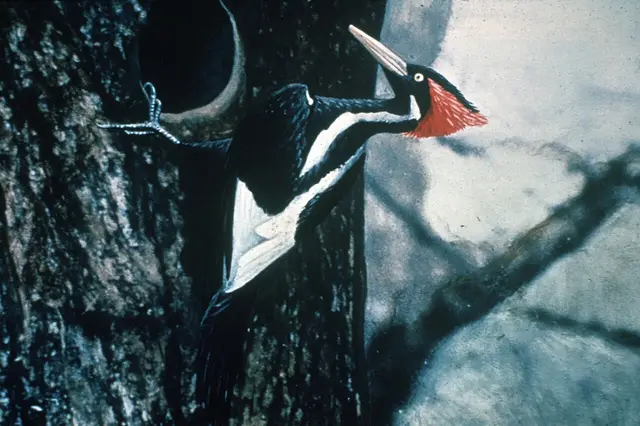
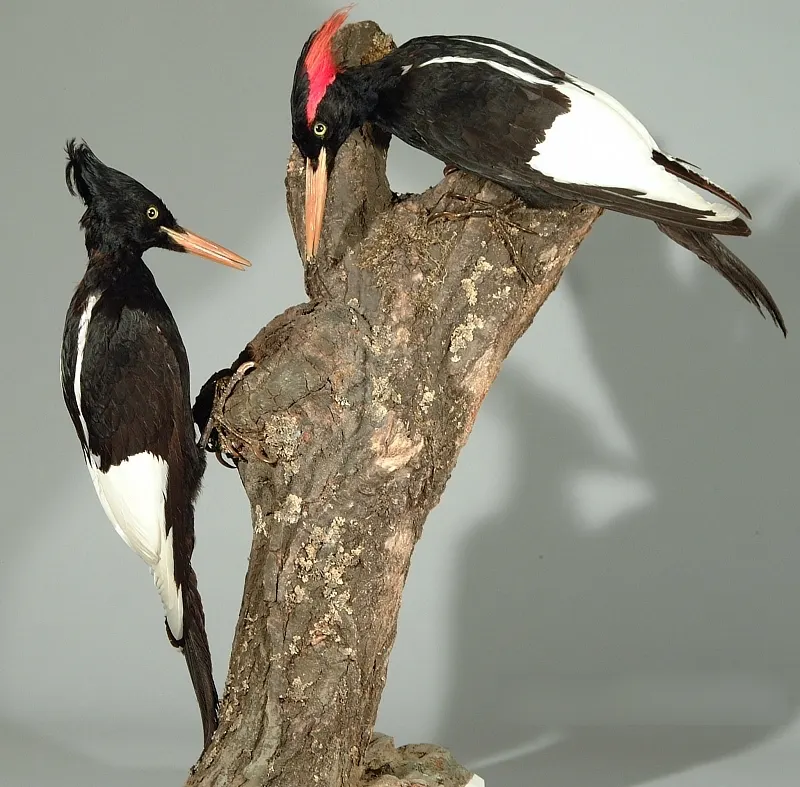
At 56 to 60 cm long, it was the largest woodpecker known and much bigger than any other woodpecker sharing its range. It was a close relative of the ivory-billed woodpecker of the southeastern United States, and John Gould described it in 1832. The body was mostly black with big white wing patches, thin white stripes down the back and a large ivory-coloured bill.
Males wore a crest with red sides and a black centre. Females had an all-black crest that curved up at the tip. It was the only woodpecker in its range with solid black underparts, and its call has been described as like a toy trumpet. Indigenous peoples had their own names for it, including cuauhtotomomi in Nahuatl, uagam among the Tepehuán and cumecócari among the Tarahumara.
Where it lived
The species was found only in Mexico, in the Sierra Madre Occidental from Sonora and Chihuahua south to Jalisco and Michoacán. It favoured open mountain pine and oak forest with big old pines and plenty of dead trees, usually at 2,100 to 2,700 m. The IUCN gives a recorded span of 1,920 to 3,050 m.
Pins are Wikidata “endemic to” fields. Orange dots, when present, are GBIF occurrence tiles — survey bias included.
How it lived
Insect larvae under the bark of dead pines, mainly beetle grubs, were the main food. Reports of more than four birds together were common, and outside the breeding season groups of up to 12 roamed after food. Nesting was recorded from February to June.
A pair needed roughly 25 km2 of mature forest. One estimate suggests the population never exceeded about 8,000 birds, even before the decline.
Why it is in trouble
Logging removed the large old trees the birds depended on, and logging roads opened remote forest to hunters. The birds were shot for food, sport and medicine, and bills and feathers were reportedly used in rituals in southern Durango.
Tim Gallagher, who interviewed local people, reported that foresters in the 1950s gave residents poison to smear on trees the birds fed on, wrongly believing they harmed timber. Groups fed on a single dead pine for up to two weeks, so poisoning could have wiped out a whole group.
The last confirmed record is from Durango in 1956, when a bird was filmed. One encyclopedia entry gives 1958 as the last confirmed sighting, so the year varies by source. Reports since then, including one after the 2005 ivory-billed woodpecker claim, have never been verified. The Mexican government is reported to have treated the species as extinct since 2001.
What is being done
Very little. The IUCN records no recovery plan, no monitoring scheme and no protected area for it, though conservation sites have been identified across its range. It puts the population at 1 to 49 mature individuals across two locations, with the trend unknown, and marks the bird as possibly extinct while keeping it listed as Critically Endangered.
The only known film is about 85 seconds of 16 mm footage shot in 1956 by dentist William Rhein, showing a single bird climbing, feeding and flying. Martjan Lammertink and colleagues at Cornell restored and analysed it, publishing in The Auk in 2011.
Sources
Written for this catalog in our own words from the sources below, checked against them on 12 November 2026. Population figures are estimates and carry the year they were made. Status and assessment year: IUCN. 2026. The IUCN Red List of Threatened Species. Version 2026-1. iucnredlist.org.