Critically Endangered
Saban black iguana
Iguana melanoderma
The Saban black iguana (Iguana melanoderma) is a dark, melanistic form of the green iguana from the Caribbean islands of Saba and Montserrat. The Saba population was assessed as Critically Endangered on the IUCN Red List in 2022. Adults darken with age and carry a black dewlap, and whether it deserves species status is still disputed.
How to recognise it
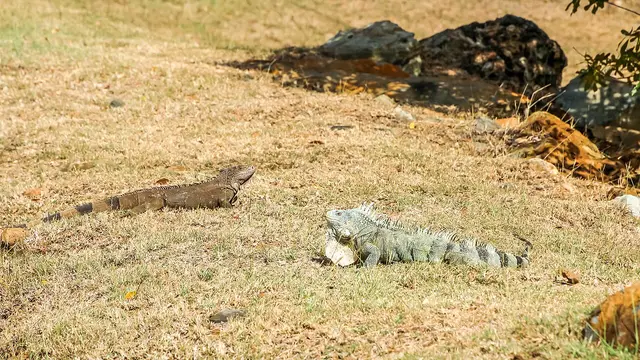
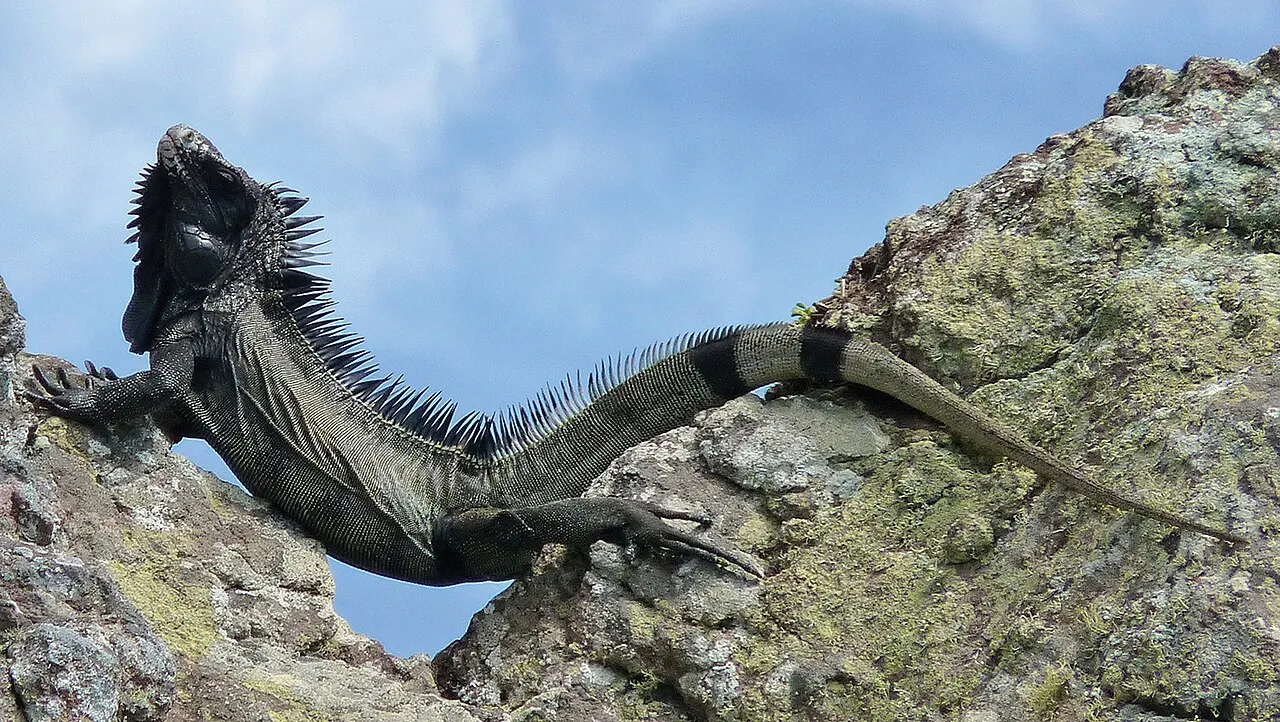
Most green iguanas are green. This one is not. Adults turn darker with age, and the dewlap (the throat flap) is black. Juveniles show a carpet-like pattern of darker bands and patches that fades as they grow. The jowls look pinkish when the animal is not too dark.
The 2020 description lists a black spot between the eye and the ear opening, present in every animal it describes. It also lists small triangular spikes under the chin, no horns on the snout and many large knobbly scales on the nape. The type specimen, an adult female collected on Saba in 1963, measured about 93 cm from nose to tail tip, of which roughly 66 cm was tail. Only a small share of Saba adults turn fully black.
Where it lives
Saba is a Dutch Caribbean island of about 13 square kilometres. The iguanas live there on cliffs, in trees and shrubs, and in dry woodland, mainly on the Windward side from sea level to about 500 m. Their total range on the island is only about 5 to 6 square kilometres. The Red List counts the Saba animals as a single location and gives an upper elevation of 530 m.
On Montserrat, an island of about 102 square kilometres, records come mostly from coastal residential areas and from stream gullies called ghauts, with the highest sighting at about 400 m. Saba and Montserrat iguanas share the same common mitochondrial DNA type. Dark iguanas on the Virgin Islands and in north-eastern Venezuela look the same, and early genetic data hint at a link, but that needs further study. The full range is not well mapped.
Pins are Wikidata “endemic to” fields. Orange dots, when present, are GBIF occurrence tiles — survey bias included.
A name under dispute
A team led by Breuil described it in 2020 as a new species, Iguana melanoderma, on the strength of its appearance and genetic markers. Not everyone agrees. The Reptile Database files it as a subspecies, Iguana iguana melanoderma, noting its close genetic similarity to other green iguana subspecies, and also records a 2026 study that folds it into Iguana iguana. The Red List assessed the Saba animals as a subpopulation of Iguana iguana.
Why it is in trouble
The 2020 paper named hunting, including for the pet trade, competition and hybridisation with invasive common iguanas, predation by cats and dogs, deaths on roads, and volcanic eruptions and hurricanes. The Red List assessment for Saba rates invasive green iguanas as the heaviest ongoing threat, alongside grazing and feral goats. It also lists mining and quarrying, roads, and possible future commercial development.
Non-native iguanas were reportedly seen on Saba for the first time in 2021, and removals were said to be continuing in 2025. Saba animals have also reportedly been exported under fraudulent CITES permits and sold as pets abroad.
How many are left
Counts differ. In 2020, Breuil and colleagues offered rough estimates of 100 to 300 adults and subadults on each island, about 400 adults in total. A 2022 distance-sampling survey of Saba, using 38 transects, estimated 8,233 iguanas (plus or minus 2,205), far more than earlier thought. The 2022 Red List assessment uses that figure, with a range of 6,028 to 10,438, and records the trend as decreasing.
That survey also found hatchlings and juveniles made up only 2.4 percent of the animals counted, which the researchers called worrying. They suspected feral cats, a large goat population and limited nesting sites.
What is being done
The Red List notes that the species occurs in a protected area, with national-level protection and some control of invasive animals, including feral goats and invasive green iguanas. Saba's land protected area is under half a square kilometre, and the assessment puts only 1 to 10 percent of the population inside protected areas. The 2020 paper urged biosecurity at ports, less hunting, habitat protection, regular monitoring and surveys of distribution and ecology. A reintroduction to Redonda, where it may once have lived, has reportedly been planned.
Sources
Written for this catalog in our own words from the sources below, checked against them on 12 November 2026. Population figures are estimates and carry the year they were made. Status and assessment year: IUCN. 2026. The IUCN Red List of Threatened Species. Version 2026-1. iucnredlist.org.