Endangered
Yaqui catfish
Yaqui catfish
The Yaqui catfish is a speckled, scaleless freshwater fish and the only known native catfish west of the Continental Divide. It survives in streams of the Rio Yaqui basin in northwestern Mexico, having vanished from the United States. The IUCN Red List rates it Endangered (assessed 2019), with a decreasing population.
How to recognise it
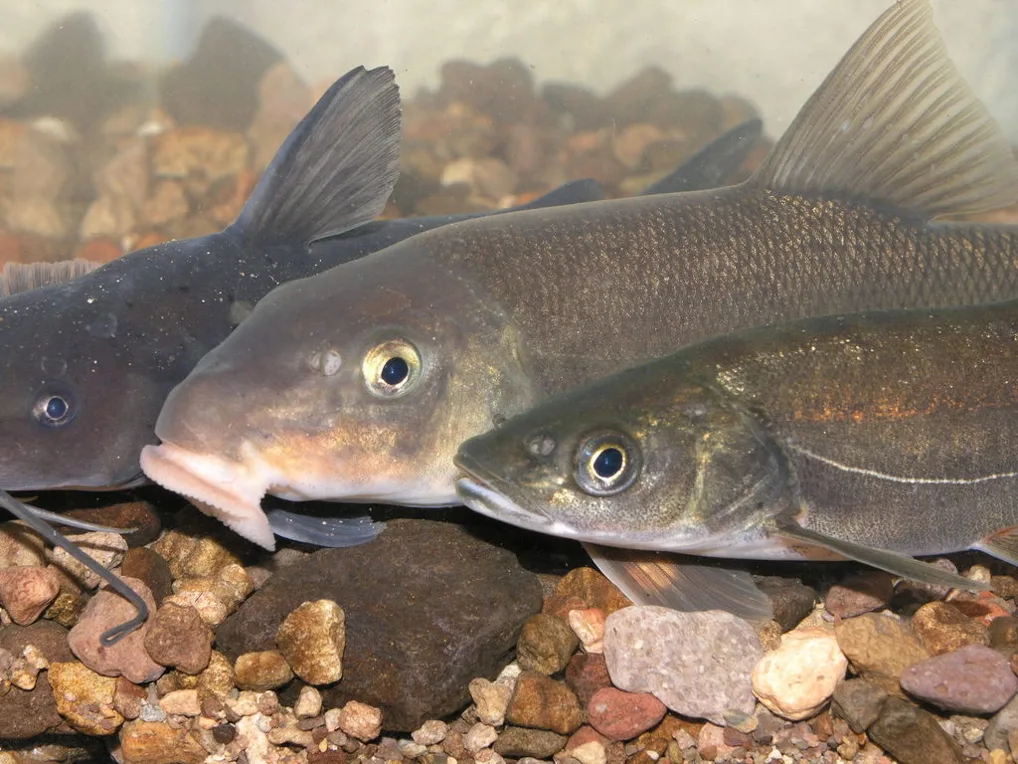
A scaleless catfish, brownish grey to nearly black on the back and paler beneath, usually heavily speckled. The barbels are black except for those on the chin, and there can be a reddish tint under the head and on the fins and tail. It looks much like the channel catfish, but its pectoral and dorsal fin spines are shorter, and the anal fin has 23 to 25 soft rays and a rounded edge.
Wild adults average about 40 cm and about 1 kg, though one description gives a maximum of 57 cm.
Where it lives
It is native to the Rio Yaqui drainage in Sonora, Mexico, and was historically found in Arizona as well, in San Bernardino Creek and Black Draw in Cochise County. The Red List also records Chihuahua and Sinaloa, and recent collections have come from the Tutuaca River in Chihuahua. Fish reportedly from Sonora were also introduced to a reservoir system near Patagonia, Arizona, in 1899, and that population lasted until the 1950s.
It prefers moderate to large streams with medium to slow current over sand or rock, mostly in quiet, clear pools at up to about 2,100 m elevation. When a stream dries seasonally, it retreats to permanent, often spring-fed pools. A 2021 study by Hafen and colleagues found signs that the fish move widely through a stream network and recolonise sections that dry out.
Pins are Wikidata “endemic to” fields. Orange dots, when present, are GBIF occurrence tiles — survey bias included.
How it lives
It feeds day or night near the bottom, taking insects, snails, crayfish, green algae, aquatic plants and small fish. It spawns in cavities such as banks, logs and rocks, where the male builds or uses a nest and guards it until the fry leave.
Why it is in trouble
Water is the main issue. Pumping groundwater dried San Bernardino Creek, and livestock trampling left what remained unsuitable, which ended the fish's population there. Red List threats include groundwater abstraction for homes, business and farming, dams, sewage, pesticides and farm run-off, and competition and hybridisation with introduced fish.
Hybridisation with channel catfish is a major concern. Channel catfish were farmed beside a stream in Sonora, and escapes interbred with the native fish. A 2024 genetic study of 23 fish from Arroyo Cajón Bonito in Sonora found 20 pure Yaqui catfish, one pure channel catfish and two hybrids, one of them a first-generation cross. The findings indicate that hybrids can breed, and the pure Yaqui fish showed low genetic diversity, which points to early inbreeding.
The species is regarded as extirpated from the United States. About 350 fish were reintroduced to San Bernardino National Wildlife Refuge in 1997, and fish were also released at West Turkey Creek, but those populations did not persist. A 2019 federal five-year review lists it as extirpated from the US.
What is being done
The Red List lists habitat protection, captive breeding and control of invasive species as conservation actions in place or needed. In 2018 and 2019, researchers caught 20 wild fish in Arroyo Cajón Bonito to start a breeding stock. Two hybrids were excluded, and the fish were held in a pond at Rancho San Bernardino and at a state aquaculture centre near Obregón City. Oklahoma State University began sampling environmental DNA across the basin to find unreported populations. The project reported a need for further funding.
Sources
Written for this catalog in our own words from the sources below, checked against them on 12 November 2026. Population figures are estimates and carry the year they were made. Status and assessment year: IUCN. 2026. The IUCN Red List of Threatened Species. Version 2026-1. iucnredlist.org.
- IUCN Red List assessment (2019)
- IUCN Red List taxon history (API)
- Yaqui catfish, Wikipedia
- US Fish and Wildlife Service, Yaqui catfish
- Desert Fishes Council 2024 abstract, genetic diversity and introgression
- Desert Fishes Council abstract, study and recovery of a reproductive stock
- Arizona Game and Fish Department, Yaqui catfish abstract



