Endangered
Ibiza Wall Lizard
Podarcis pityusensis
The Ibiza wall lizard (Podarcis pityusensis) is a stocky, long-tailed lizard native to Ibiza, Formentera and nearby islets in Spain's Balearic Islands. Rated Endangered by the IUCN in 2024, it is vanishing from places where an invasive snake has arrived.
How to recognise it
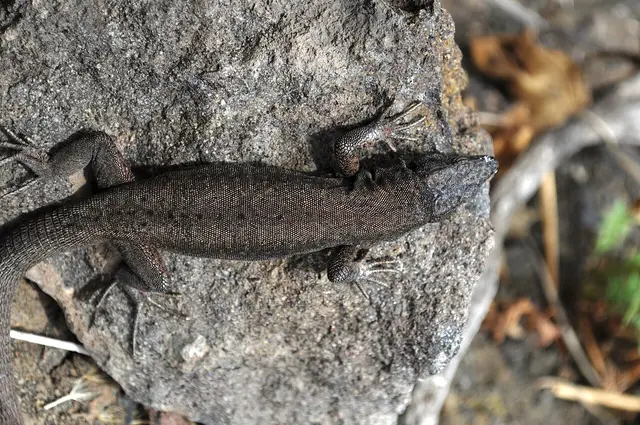
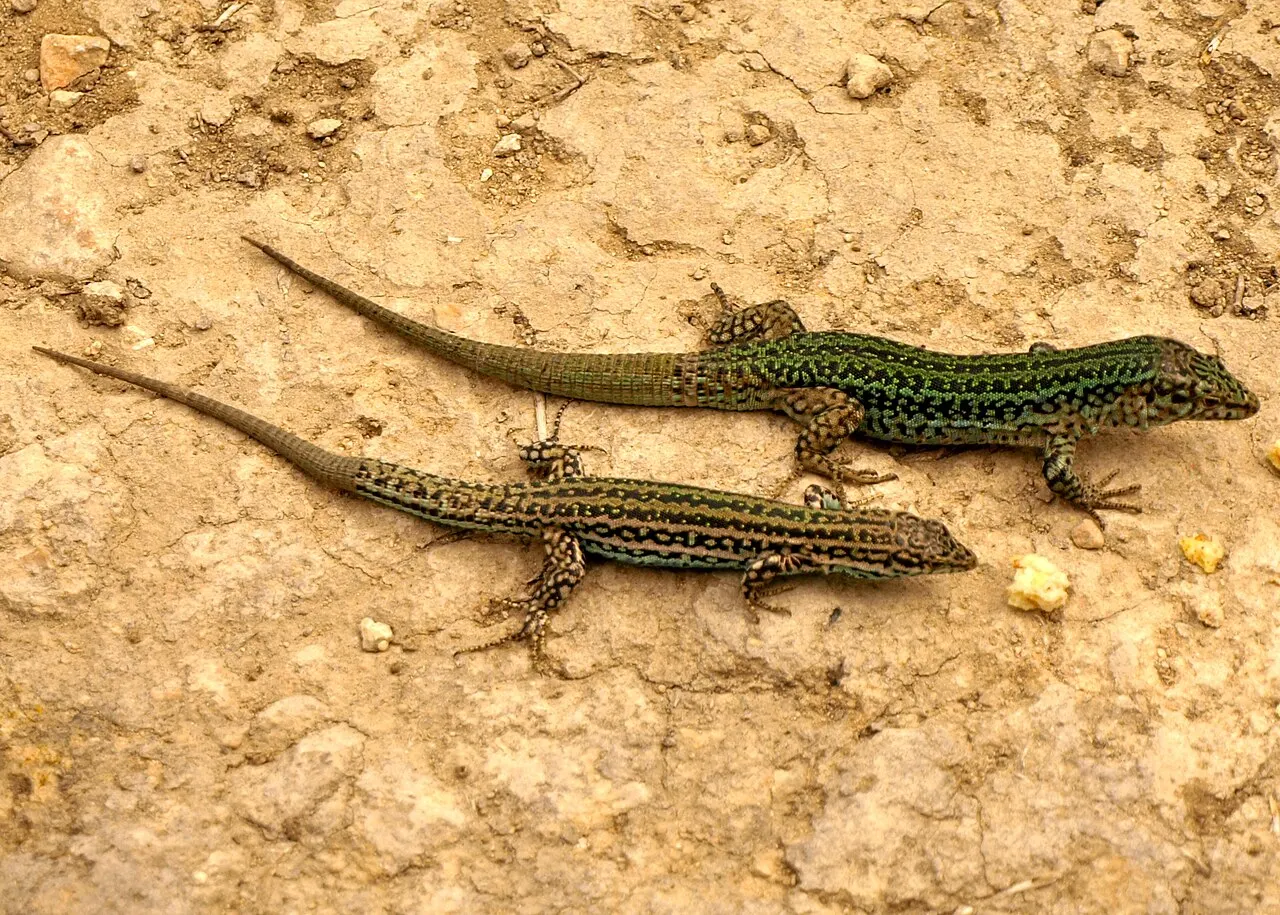
Adults reach about 7 cm from snout to vent, and the tail is roughly twice as long again. The body is solid, with a short head. Most are green on the back, though grey and brown animals turn up, often with a pale stripe down each side and dark spots or a dark line along the spine.
Bellies range from white and cream to orange or pink. The Formentera subspecies, found naturally on Formentera, Illa Conillera and Es Vedra, tends to be brighter than the Ibiza animals.
Where it lives
It is native to Ibiza, Formentera and a scatter of rocky islets, from sea level up to about 475 m. It likes shrubby Mediterranean vegetation, rocky ground and coastal rock, and it also does well around people, in gardens, pasture, plantations and arable land. On some small islets it lives almost entirely on bare rock. The IUCN also lists locations on mainland Spain, and naturalised populations are reported there.
Pins are Wikidata “endemic to” fields. Orange dots, when present, are GBIF occurrence tiles — survey bias included.
How it lives
Mostly it eats small invertebrates, with plenty of ants when they are available, and it adds plant matter in summer. Females generally lay one clutch of 1 to 4 eggs. Hatchlings measure about 3.2 cm from snout to vent, and lizards mature at 1.5 to 2 years.
Why it is in trouble
The threat is a snake. The horseshoe whip snake (Hemorrhois hippocrepis) reached Ibiza in 2003 as a stowaway in imported olive trees. A 2022 study in Current Zoology found that snakes had invaded 49% of the island's land area by 2018, and that nearly every lizard census inside snake territory found no lizards, while almost every census outside it did. At least one islet subspecies has already gone extinct, and snakes have been recorded swimming between Ibiza and the islets.
A newer study in Ecology, reported by the Catalan paper ARA Balears in May 2026, put the snake in about 90% of Ibiza, with lizards gone from around a dozen islets. On Santa Eularia islet, counts on the same transects fell from 72 lizards in 2016 to three in 2023 and none in 2025. The IUCN assessment lists a decreasing population and estimates a decline of about 50%, reportedly since 2010. The IUCN had rated the species Near Threatened in 2009.
What is being done
The IUCN lists site protection and management, control of the invasive snake, captive breeding and awareness work among the conservation actions. It records the lizard in at least one protected area, with invasive species control and awareness programmes in place. On Santa Eularia islet, researchers trapped up to 58 snakes between 2023 and 2025.
Sources
Written for this catalog in our own words from the sources below, checked against them on 12 November 2026. Population figures are estimates and carry the year they were made. Status and assessment year: IUCN. 2026. The IUCN Red List of Threatened Species. Version 2026-1. iucnredlist.org.
- IUCN Red List assessment, Podarcis pityusensis (2024)
- Montes et al., Collapse of the endemic lizard Podarcis pityusensis on Ibiza mediated by an invasive snake, Current Zoology 2022 (abstract via Europe PMC)
- ARA Balears, The invasive snakes already occupy 90% of Ibiza (15 May 2026)
- Wikipedia, Ibiza wall lizard