Endangered
Iberus gualtieranus
Iberus gualtieranus
Iberus gualtieranus is a flattened, keeled land snail from the limestone hills of south-eastern Spain, where Spanish speakers call it chapa or marquesa. The IUCN Red List rated it Endangered in 2026. It lives in only four known areas, shelters deep in rock cracks, and is still picked for food.
How to recognise it
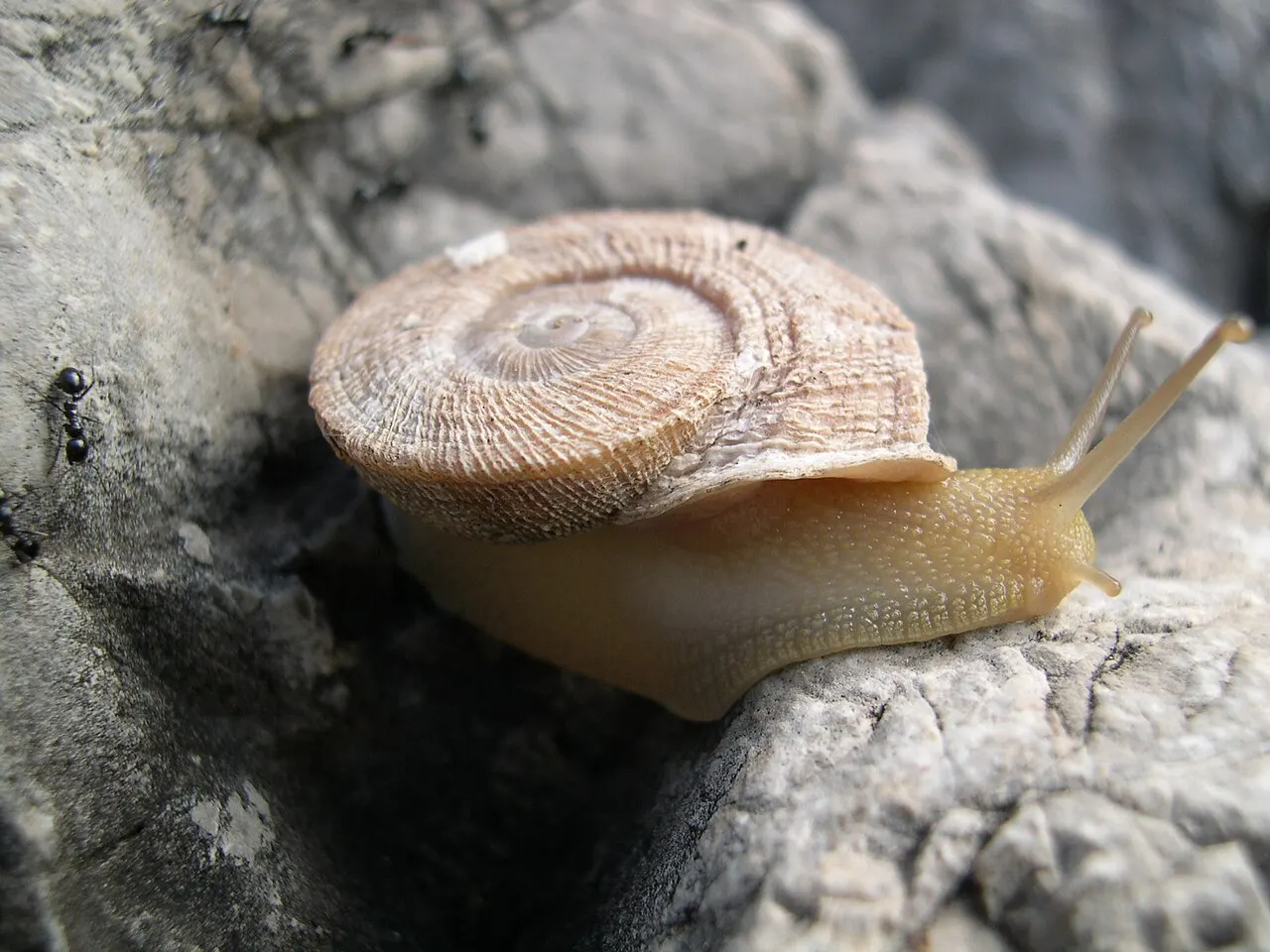
The shell is flattened and keeled, with strongly marked spiral and radial ribbing. That shape sets it apart from its relatives Iberus alonensis and Iberus campesinus, whose shells are rounder. The flat build is thought to help it slip into narrow limestone fissures to escape drying out. It's the type species of the genus Iberus, in the family Helicidae.
Where it lives
It's found only in south-eastern Spain. The IUCN counts four locations, with a tiny area of occupancy of roughly 140 to 160 square kilometres and an extent of occurrence of about 750 square kilometres. A 2011 Spanish review names isolated populations in the Sierra de Gádor, the Sierra de Jaén and the Sierra Elvira, and older records place it in Valencia and Murcia, so its range has shrunk. Much of the Spanish field research was done on the nominate form, Iberus gualtieranus gualtieranus. Genetic work suggests the Elvira and Jaén populations were recolonised from Gádor, probably with human help, since snails move so little.
The habitat is karst limestone hill country with a dry Mediterranean climate and Mediterranean-type shrubland. The IUCN gives its upper elevation as 500 m.
Pins are Wikidata “endemic to” fields. Orange dots, when present, are GBIF occurrence tiles — survey bias included.
How it lives
This is a nocturnal snail, active mostly in autumn and winter, when the weather is milder. The inactive period, spent wedged into crevices, covers roughly half the year and falls in the hottest, driest season. That hiding makes it hard to count.
A census published in 2007 for Sierra Elvira, the best-studied population, used plots sampled in autumn and winter, when detection is highest. It found the snail on about 323 hectares, mostly on the eastern slope, and estimated roughly 500,000 animals (range about 343,000 to 660,000). It is a generalist plant eater. Rats are a significant predator at Sierra Elvira, and ants and other rodents also eat it.
Why it is in trouble
The IUCN says the population is declining. The IUCN lists deliberate collection of the species as a threat. The snail has reportedly been eaten in the region since at least Roman times, and it's also taken for ornament and collections.
Habitat loss adds to this. Quarrying, greenhouse construction and wildfires damage habitat, and the IUCN also lists roads and housing. A Spanish review has also raised climate change, which could lengthen summer inactivity and shorten the active season, and notes that juvenile deaths might rise. With so few separate populations, a local loss is unlikely to be made good by natural recolonisation.
What is being done
The 2026 assessment records a recovery plan, a monitoring scheme and a regional management plan in place, with about half the population inside protected areas and some captive stock. It lists policy and regulation, awareness work and reintroduction among the actions still needed. A 2011 review of the nominate form argued it should be treated as endangered and called for regenerating lost habitat and creating micro-reserves.
Sources
Written for this catalog in our own words from the sources below, checked against them on 12 November 2026. Population figures are estimates and carry the year they were made. Status and assessment year: IUCN. 2026. The IUCN Red List of Threatened Species. Version 2026-1. iucnredlist.org.
- IUCN Red List assessment, Iberus gualtieranus (2026)
- Iberus gualtieranus (encyclopedia entry)
- Moreno-Rueda and Pizarro 2007, Census method for estimating population size of Iberus gualtieranus gualtieranus, Animal Biodiversity and Conservation 30.1
- Moreno-Rueda 2011, Review of the conservation status of Iberus gualtieranus gualtieranus, Zoologica baetica 22




