Endangered
Hystricella echinulata
Hystricella echinulata
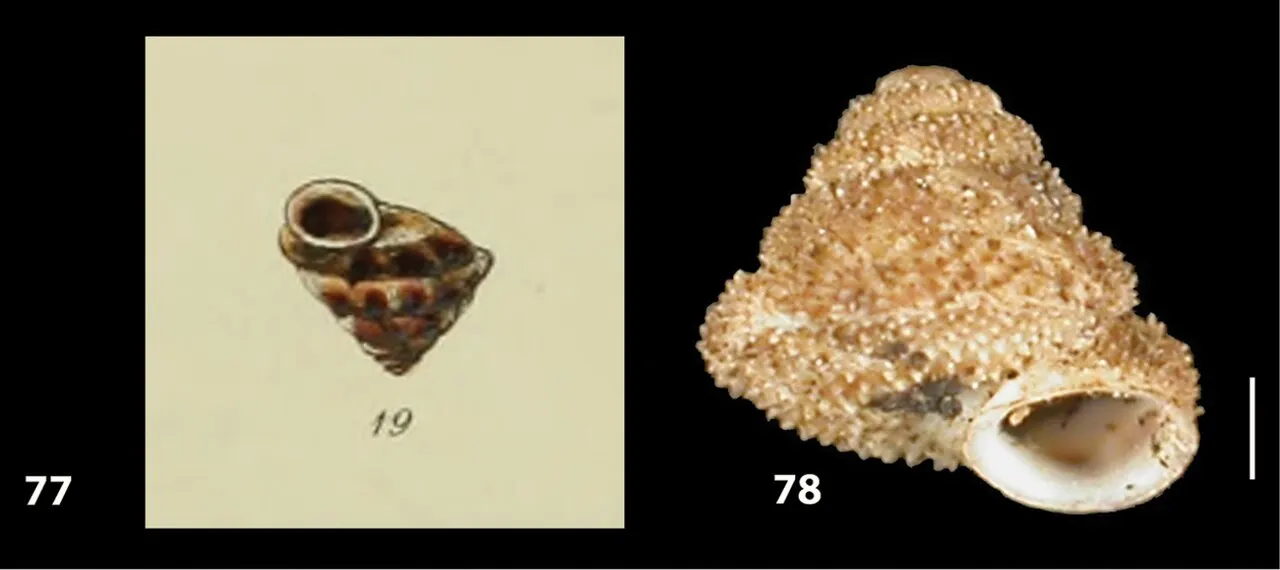
Hystricella echinulata is a tiny land snail with a conical, keeled shell, found only on Porto Santo, a small island in Portugal's Madeira archipelago. The IUCN Red List rated it Endangered in 2025. It survives in a handful of dry, stony highland spots in the island's northeast.
How to recognise it
This is a snail you'd need a hand lens for. A 2018 revision in ZooKeys measured 40 shells at about 5.2 mm wide and 4.8 mm tall. The shell is a low cone covered in rough granules, with rounded whorls, deep sutures and a small open navel. A single sharp keel runs along the last whorl, which is the main way to tell it from its close relative Hystricella bicarinata, a two-keeled species with a stepped, shouldered shell.
Where it lives
The species is endemic to Porto Santo and confined to the rugged northeast, in the Pico Branco and Terra Chã massif. It's commonly found along Faja Pequena and on the ridge and south-facing slope east of Terra Chã. No populations are known on the offshore islets. The first specimen was described in 1831 from Pico Branco itself.
The IUCN assessment gives five locations and lists temperate grassland as its habitat. Recorded heights differ between sources: the ZooKeys revision reports 20 to 450 metres above sea level, while the IUCN gives 110 to 343 metres.
Pins are Wikidata “endemic to” fields. Orange dots, when present, are GBIF occurrence tiles — survey bias included.
How it lives
It's usually found beneath volcanic rocks scattered over open, sloping grassland, and sometimes in cracks or among scree on steep slopes. Snails of this genus rest through dry spells on the underside of stones, often in clusters of 40 to 50 or more. Under one stone about 60 by 40 cm, on another Porto Santo slope, researchers counted roughly 200 snails of the genus.
Why it is in trouble
The 2018 revision put the species' area of occupancy and extent of occurrence at under 8 square kilometres (the IUCN gives 12). The snails live only in scattered, isolated patches with a damp enough microclimate, mostly at the highest elevations in the northeast. The revision recorded suitable habitat shrinking over about 30 years and linked it to longer droughts, more fires, grazing by goats and, to a lesser degree, hiking as tourism on the island grows. The IUCN assessment lists the same pressures (grazing, drought, fire, recreation and tourism areas) and records a decreasing population.
An earlier assessment, from 2011, rated the species Least Concern. The 2018 revision argued it should be Endangered, and the IUCN has rated it Endangered since 2018, most recently in 2025.
What is being done
Pico Branco lies within a Special Area of Conservation, and the regional government names Pico Branco and Terra Chã as priority sites for its endemic species. Measures from the 1990s reduced wild sheep and goat herds on land suited to forestry, and native vegetation has returned around Pico Branco. The IUCN records that 21 to 30 percent of the population lies inside protected areas and that a monitoring scheme is in place. The actions it lists are habitat restoration, land protection and control of problem species.
Sources
Written for this catalog in our own words from the sources below, checked against them on 12 November 2026. Population figures are estimates and carry the year they were made. Status and assessment year: IUCN. 2026. The IUCN Red List of Threatened Species. Version 2026-1. iucnredlist.org.




