Endangered
Hypolestes clara
Hypolestes clara
The Jamaican flatwing (Hypolestes clara) is a damselfly found only on the island of Jamaica, where it lives along permanent forest streams and rivers. The IUCN rated it Endangered in 2009, citing a small range and six known locations. Whether its population is rising or falling is unknown.
How to recognise it
Hypolestes clara is a damselfly in the family Hypolestidae, a small family found only in the Greater Antilles. Calvert described the Jamaican species in 1891 under the genus name Ortholestes, and it has since been placed in Hypolestes.
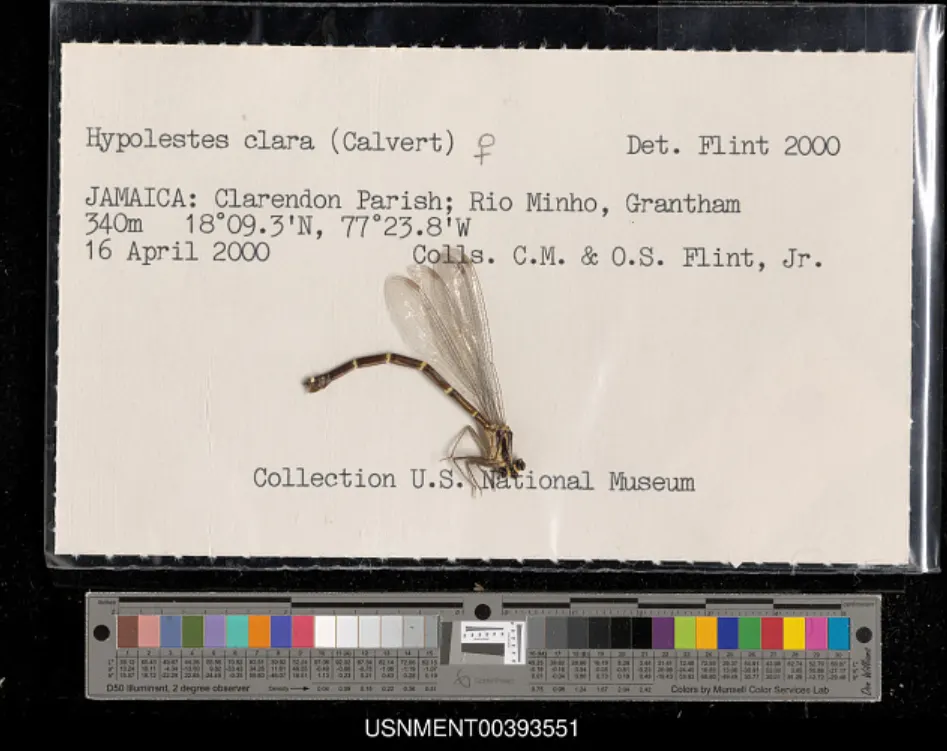
Descriptions of the genus say males are light blue and females black with yellow stripes down the thorax. Flatwings measure roughly 40 to 44 mm in total length, with forewings of about 24 to 26 mm. Those are genus-level figures, not measurements of the Jamaican species alone. When Torres-Cambas and colleagues described a Hispaniolan relative in 2015, they found its females differ from the Jamaican species in the shape of a thoracic stripe and in wing venation.
Where it lives
The flatwing is endemic to Jamaica. The IUCN assessment counts six locations, puts its extent of occurrence under 3,000 square kilometres and the area it actually occupies under 500 square kilometres. The assessment records these as size bands rather than precise measurements.
It depends on fresh water. The assessment lists permanent rivers and streams, including waterfalls, as suitable habitat and moist montane forest as marginal habitat.
The genus has two other members: the Cuban flatwing (Hypolestes trinitatis) and Hypolestes hatuey from Hispaniola, named in 2015. A 1991 review by Dunkle, based on male genital anatomy, recognised the Jamaican and Cuban forms and a possible Hispaniolan one, and said more specimens from Haiti were needed to settle the question.
Pins are Wikidata “endemic to” fields. Orange dots, when present, are GBIF occurrence tiles — survey bias included.
How it lives
Little has been recorded about the Jamaican species itself, so the following describes the genus. Males are territorial, holding perches near water from which they hunt and watch for females. A male grasps a passing female by the neck and mates with her in flight.
The female then looks for wet or submerged plant material at the water's edge and lays her eggs there, with the male guarding her, sometimes for up to a week. The larvae develop in stream or river water, and the stage can last several years. Flatwings are predators at every life stage, eating small aquatic animals as larvae and flies and mosquitoes as adults.
Why it is in trouble
The IUCN lists ongoing abstraction of groundwater as a threat and records the stress as degradation of the ecosystem it depends on. Habitat loss is also cited for the species. For the genus as a whole, threats include clearing of riparian forest, use of rivers and streams by nearby settlements, and pollution.
The population trend is recorded as unknown, so it is not clear whether numbers are falling or holding steady. The assessment gives no population size.
What is being done
The species occurs in at least one protected area, and the assessment lists site protection and site management as conservation actions. No recovery plan or population count is recorded. The assessment dates from 2009, so current conditions on Jamaican streams may differ.
Sources
Written for this catalog in our own words from the sources below, checked against them on 12 November 2026. Population figures are estimates and carry the year they were made. Status and assessment year: IUCN. 2026. The IUCN Red List of Threatened Species. Version 2026-1. iucnredlist.org.




