Endangered
Scissor-tailed hummingbird
Hylonympha macrocerca
The scissor-tailed hummingbird (Hylonympha macrocerca) is a long-tailed, violet-capped hummingbird found only on the Paria Peninsula of north-eastern Venezuela. The IUCN Red List assessed it as Endangered in 2023, with an estimated 3,000 to 4,000 mature birds and a population still declining.
How to recognise it
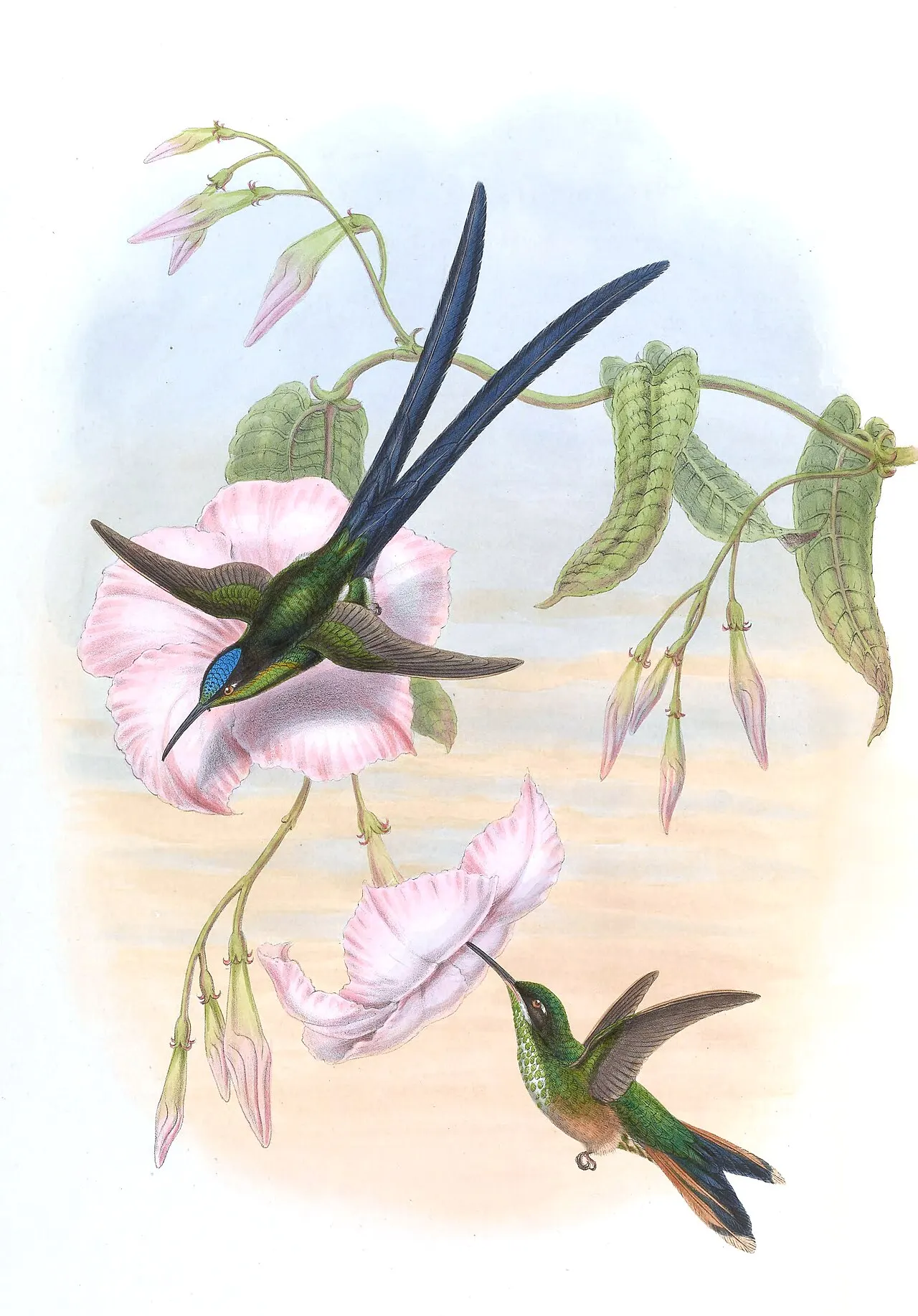
This is a big hummingbird with a very long tail. Males measure about 19 cm from bill tip to tail tip, with 9 to 10 cm of that being tail, and reportedly weigh 7 to 7.5 g. The outer tail feathers are much longer and broader than the inner ones, which gives the tail a deeply forked, scissor-like look. Both sexes have a long, slightly curved black bill.
Males are dark green with a glittering violet forehead and crown centre, a golden wash on the neck, and an emerald throat and breast. Females are smaller, reportedly 12 to 13 cm long, with green upperparts, a white throat and breast spotted with green, and a chestnut belly. Their tail is forked too, but far less dramatically.
Where it lives
The species is endemic to Venezuela, and within Venezuela it is confined to the Paria Peninsula. It lives in humid, tall forest and cloud forest between 500 and 1,200 m above sea level, and reportedly also uses forest edges and small clearings. It does not migrate.
The Red List counts four locations, grouped into three subpopulations, the largest holding an estimated 2,400 to 3,200 birds. Its extent of occurrence is only about 610 square kilometres, and the area it actually occupies about 556.
Pins are Wikidata “endemic to” fields. Orange dots, when present, are GBIF occurrence tiles — survey bias included.
How it lives
Nectar is the main food, taken especially from bromeliads, with Heliconia and Costus flowers also visited. It supplements that with small arthropods, picked off foliage or caught in the air by darting out from a perch. Females have reportedly been seen defending feeding territories.
Remarkably little else is known. Nothing has been published on its breeding season or nesting, so even basic questions about how quickly it reproduces are open.
Why it is in trouble
The main problem is the loss of its forest. Clearing for small-holder and larger-scale farming continues across its range, and the Red List also lists more frequent fires among the pressures. Banana and cacao growing presses against the boundaries of Paria Peninsula National Park, where ranger numbers are limited and interior facilities are minimal.
The Red List puts the past decline at 1 to 19 percent, but the area the bird occupies is still shrinking. With only four locations, a bad run of habitat loss could matter a great deal.
What is being done
The species occurs in at least one protected area, and conservation sites have been identified across its whole range. Awareness programmes have been run, and the Red List lists work on alternative livelihoods and site management as needed actions. It is reportedly covered by CITES Appendix II. There is no recovery plan, no systematic monitoring scheme and no captive population.
Sources
Written for this catalog in our own words from the sources below, checked against them on 12 November 2026. Population figures are estimates and carry the year they were made. Status and assessment year: IUCN. 2026. The IUCN Red List of Threatened Species. Version 2026-1. iucnredlist.org.




