Critically Endangered
Hyalobagrus ornatus
Hyalobagrus ornatus
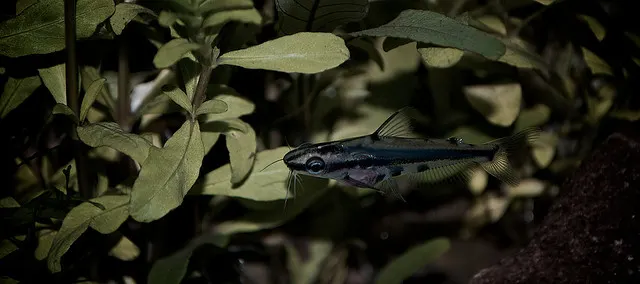
Hyalobagrus ornatus is a tiny bagrid catfish known from the Muar River drainage of the southern Malay Peninsula in Malaysia. The IUCN assessed it as Critically Endangered in 2019, with at most one location and a population trend that is unknown. It may already be extinct.
How to recognise it
It's a tiny catfish, with a maximum length given as about 3 cm. Its body is elongated, with one dorsal spine and six dorsal soft rays, and 21 to 22 soft rays in the anal fin. The genus name Hyalobagrus means transparent bagrid.
Identification has been a problem. The species was originally named Pelteobagrus ornatus, and when Ng Heok Hee and Maurice Kottelat erected the genus in 1998, they found that the old name covered more than one species. A hobbyist factsheet says the fish pictured in aquarium books for years was Hyalobagrus flavus, not this one.
Where it lives
The species was described by Duncker in 1904. The IUCN lists only Peninsular Malaysia, and a hobbyist factsheet treats it as known only from the Muar drainage in the southern Malay Peninsula. Some databases also give the Kapuas basin in western Borneo, and one adds Thailand. The same factsheet assigns the Kapuas fish to a related species, Hyalobagrus leiacanthus, so the records outside Malaysia are in doubt.
It lives in freshwater, in streams and peat swamps. FishBase gives a temperature of 21 to 25 degrees C and a pH of 6.6 to 7.2. The IUCN lists permanent rivers and streams as its habitat.
Pins are Wikidata “endemic to” fields. Orange dots, when present, are GBIF occurrence tiles — survey bias included.
Why it is in trouble
The IUCN names agro-industrial farming, housing and urban areas, herbicides and pesticides, and nutrient runoff as threats across its whole range, and records a continuing decline in the area it occupies. Small-scale fishing is also listed as an unintended effect on the species.
The species is rated under criterion B2ab(iii), based on a very small range, with the number of locations given as zero to one. Its population trend is unknown. The IUCN flags it as possibly extinct, meaning it is uncertain whether any survive.
What is being done
Nothing specific is recorded. The IUCN assessment lists no recovery plan, no systematic monitoring scheme and no protected-area occurrence. FishBase says the fish is occasionally seen in the aquarium trade, but because of the mix-up with other species, fish sold under this name may well be a different Hyalobagrus.
Sources
Written for this catalog in our own words from the sources below, checked against them on 12 November 2026. Population figures are estimates and carry the year they were made. Status and assessment year: IUCN. 2026. The IUCN Red List of Threatened Species. Version 2026-1. iucnredlist.org.




