Endangered
Hyalinobatrachium yaku
Hyalinobatrachium yaku
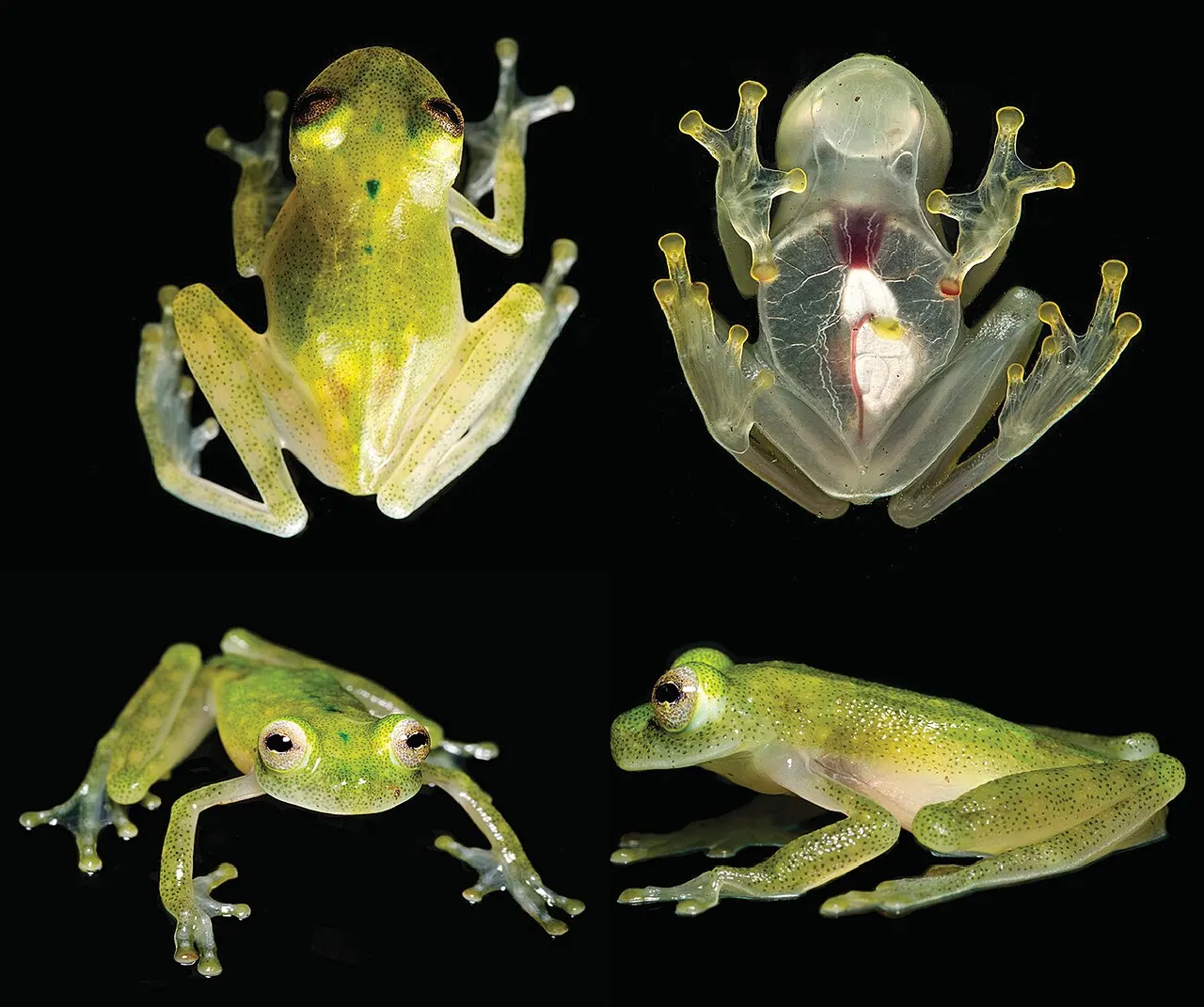
Hyalinobatrachium yaku is a tiny glass frog of the lowland rainforest of Ecuador's Amazon, known from just three sites between 300 and 360 m. Its belly is transparent, leaving the red heart in plain view. The IUCN Red List rated it Endangered in 2022, only five years after it was named.
How to recognise it
This is a very small frog. Adult males measured 20.8 to 22.3 mm from snout to vent, and the one female in the original description was 21.1 mm. The back is apple green to yellowish green, dusted with small yellow spots. A few small, sharp-edged dark green spots sit along the middle of the back, on the rear of the head and the front half of the body, and the first one is usually the biggest.
Underneath, the skin around the heart and some organs is transparent, so the red heart is fully visible. The eyes are silver to yellow, and the bones are white. The dark green spots fade completely in preserved museum specimens, which makes old collections a poor guide to where the species has been.
Where it lives
The frog is known from three places in Ecuador: Kallana in Pastaza province, Ahuano in Napo, and San José de Payamino in Orellana. The farthest two are about 110 km apart, with Ahuano roughly midway. The IUCN estimates the extent of its range at about 3,989 square km, across one to five locations, in lowland moist forest and along permanent streams. The 2022 assessment records it as absent from protected areas.
Its closest relative, Hyalinobatrachium pellucidum, lives higher up, in foothill and cloud forest above 1,000 to 1,300 m. Guayasamin and colleagues, who named the frog in 2017, think it probably lives more widely than the three records show, possibly into nearby Peru.
Pins are Wikidata “endemic to” fields. Orange dots, when present, are GBIF occurrence tiles — survey bias included.
How it lives
Glass frogs breed over streams, and the species name reflects that: yaku is the Kichwa word for water. Males call from the underside of leaves hanging over the water. The call is a single, high-pitched note lasting about 0.3 seconds, repeated roughly nine times a minute, at a dominant pitch near 5,300 Hz.
At Kallana, the male used for the original description sat on a leaf about 3 m above a narrow stream, beside two clutches of eggs. Males attend the clutches, though clutch size hasn't been recorded. At Ahuano, a frog sat on the underside of a leaf 1 m above a stream about a meter wide. At Payamino the frogs perched on shrubs, ferns and grasses 30 to 150 cm up in disturbed secondary forest, always more than 30 m from any stream.
Why it is in trouble
The IUCN lists roads, small and industrial farming and grazing among the ongoing threats, and records a continuing decline in the area it occupies. The 2017 description singled out water pollution from oil and mining, and pointed out that the Ecuadorian government was planning to expand oil extraction in the region. New roads follow extraction, and at Payamino a dirt road has been shown to reduce amphibian numbers and diversity. All records of the frog there were more than 1 km from it.
The status has shifted quickly. The 2017 description suggested Data Deficient, because the information was too thin to apply Red List criteria. By 2022 the IUCN had assessed it as Endangered under criterion B1ab(iii), which rests on a small, fragmented range and declining habitat quality.
What is being done
Very little is documented. The assessment names site protection, habitat protection and site management as the actions that apply, and records research on distribution and ecology. The 2017 description paper said options combining conservation with some resource use deserve serious consideration in Ecuador's Amazon, but no species-specific program is on record.
Sources
Written for this catalog in our own words from the sources below, checked against them on 12 November 2026. Population figures are estimates and carry the year they were made. Status and assessment year: IUCN. 2026. The IUCN Red List of Threatened Species. Version 2026-1. iucnredlist.org.




