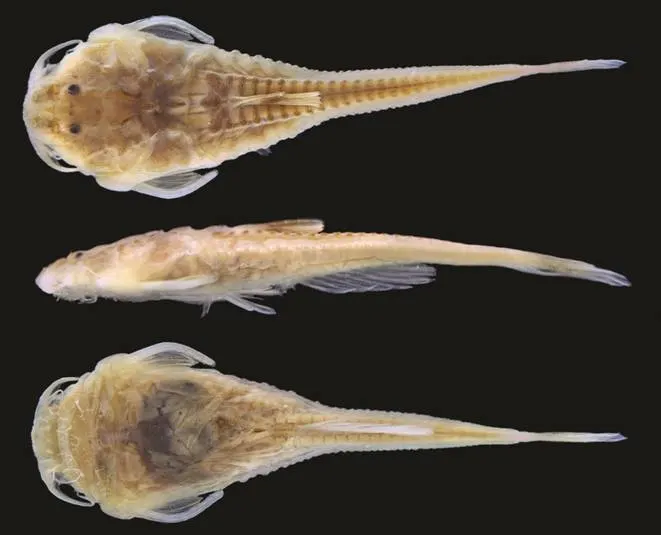
Endangered
Hoplomyzon cardosoi
Hoplomyzon cardosoi
Hoplomyzon cardosoi is a tiny banjo catfish, under 2 centimetres long, known from streams that drain into the Lake Maracaibo basin in Venezuela. Scientists described it only in 2017. The IUCN Red List rated it Endangered in 2021 because its range is minute and its streams are degrading.
How to recognise it
This is a miniature fish. The largest recorded length is about 1.9 cm, and the single specimen chosen as the holotype measures 18.5 mm. It belongs to the banjo catfishes (Aspredinidae), a family of small South American catfishes.
Carvalho, Reis and Friel separated it from its relatives in 2017 in the journal Neotropical Ichthyology. Several features set it apart. It has eight anal-fin rays, where other Hoplomyzon species have six or seven. It has no teeth on the lower jaw, and adults carry several thread-like, barbel-like structures on the underside of the head. The team described its skeleton in detail using high-resolution X-ray microtomography of the holotype.
The species name honours Alexandre Rodrigues Cardoso, a colleague and fish taxonomist who died early.
Where it lives
It is known from three tributaries on the south-western side of the Lake Maracaibo basin in Zulia State, Venezuela. The holotype came from Caño La Raya, a stream about 12 m wide with mostly slow, whitish water over sand, broken by fast riffles over pebbles and with little plant growth along the banks.
The Red List assessment lists Venezuela and Colombia, counts one or two locations, and gives an elevation of roughly 17 to 34 m above sea level. The habitats it names are permanent rivers and streams, marshes and swamps, and freshwater springs.
Pins are Wikidata “endemic to” fields. Orange dots, when present, are GBIF occurrence tiles — survey bias included.
Why it is in trouble
Its whole known world is a few lowland streams, and the assessment records continuing decline in the area it occupies. The threats listed are mostly about land and water use: small-holder and industrial farming and grazing, shifting agriculture, nutrient loads, soil erosion and sedimentation, herbicides and pesticides, sewage, withdrawal of surface water for agriculture, industrial aquaculture, and oil spills and drilling.
Nobody has published a population estimate, and the trend is listed as unknown. It's rated under criterion B1ab(iii)+2ab(iii), which covers a small range with few locations and habitat decline.
What is being done
Action so far is limited. The assessment notes awareness work, national-level action and policies and regulations, and says conservation sites have been identified over part of the range. It records no recovery plan and no systematic monitoring.
Sources
Written for this catalog in our own words from the sources below, checked against them on 12 November 2026. Population figures are estimates and carry the year they were made. Status and assessment year: IUCN. 2026. The IUCN Red List of Threatened Species. Version 2026-1. iucnredlist.org.




