Endangered
Hopliancistrus tricornis
Hopliancistrus tricornis
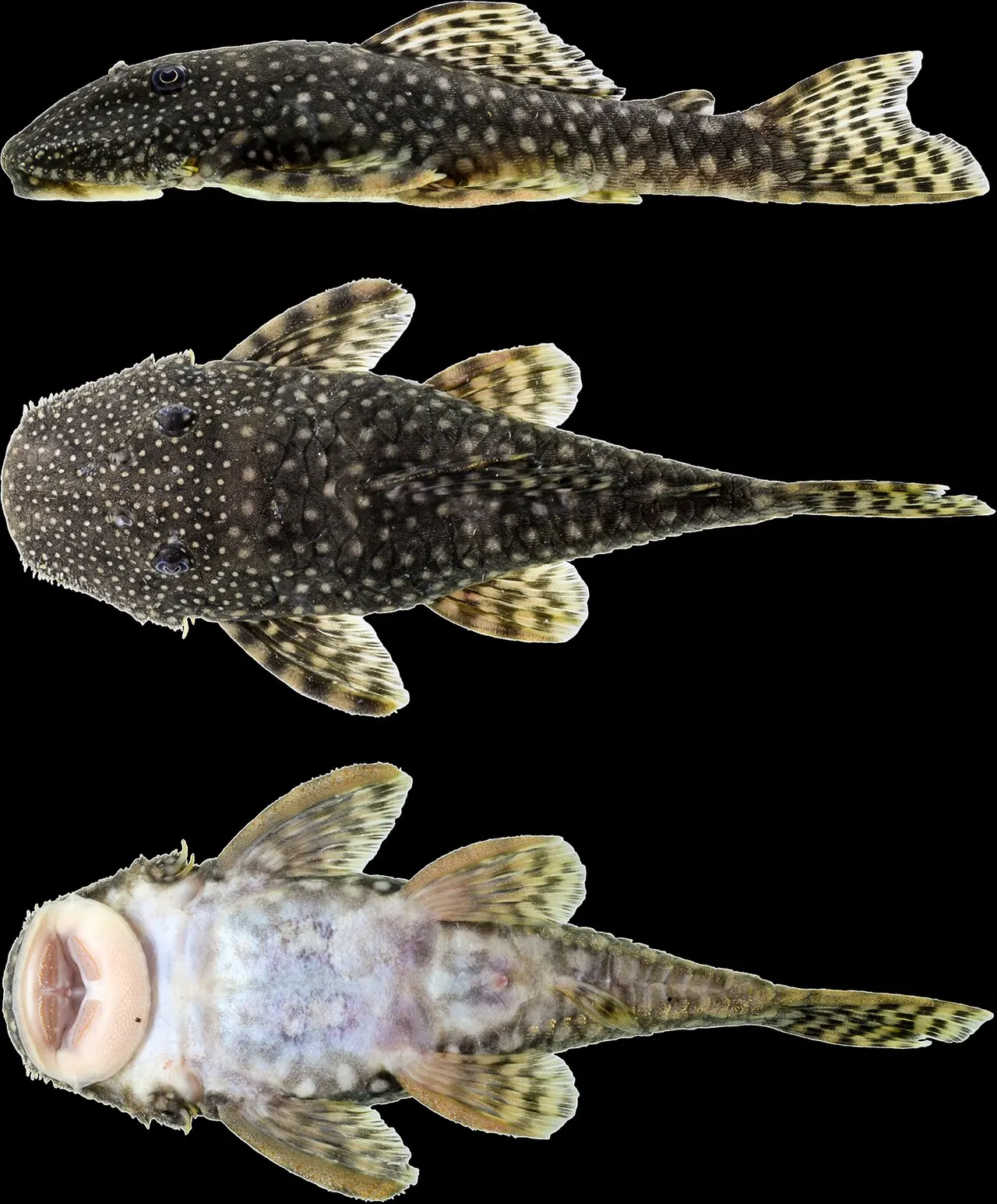
Hopliancistrus tricornis is a spotted, armoured suckermouth catfish from the rocky rivers of Para, Brazil. It is known to aquarists as L212. The IUCN Red List rated it Endangered in 2022, mainly because of the threat from large dams within its range.
How to recognise it
This is a medium-sized armoured catfish. The largest specimen measured in a 2021 PLoS ONE revision was 132.1 mm standard length. In life the body is dark brown with yellow spots, while the fins are yellowish-white with dark brown to black spots on the rays. The spots are less conspicuous in fish from the Tapajos and its large tributaries than in those from small streams.
Three large, curved, hook-like odontodes, tooth-like spines, sit on each cheek, and in this genus they are everted when the fish is disturbed. Four branched anal-fin rays separate it from its relatives, which have five. Isbrucker and Nijssen described it in 1989.
Where it lives
The type locality is a rock pool on the Rio Tapajos at Sao Luiz, Para. The original type series also included fish from the von Martius waterfall on the Xingu, but the 2021 revision showed those belong to a different species, Hopliancistrus xavante. The range of H. tricornis is therefore the Tapajos basin. It occurs around the Sao Luiz rapids and in tributaries such as the Jamanxim and Itapacura, plus small streams such as Igarape Leitoso, a tributary of the Rio Cupari.
The genus now has five described species, all confined to the Tapajos and Xingu basins.
Pins are Wikidata “endemic to” fields. Orange dots, when present, are GBIF occurrence tiles — survey bias included.
How it lives
The genus lives in fast, clear, well-oxygenated water over rock, and the Red List gives permanent rivers and streams as habitat. Its generation length is estimated at about 5.5 years. Little about feeding or breeding is documented in the sources available.
Why it is in trouble
The 2022 assessment lists large dams as the main threat, along with small-scale harvesting for subsistence. A fish that depends on fast, rocky water is poorly placed when rivers are dammed. The Red List records a decreasing population and applies criterion A3c, which rests on projected or suspected future decline. Conservation needs listed are site management and protection of the river habitat.
Sources
Written for this catalog in our own words from the sources below, checked against them on 12 November 2026. Population figures are estimates and carry the year they were made. Status and assessment year: IUCN. 2026. The IUCN Red List of Threatened Species. Version 2026-1. iucnredlist.org.



